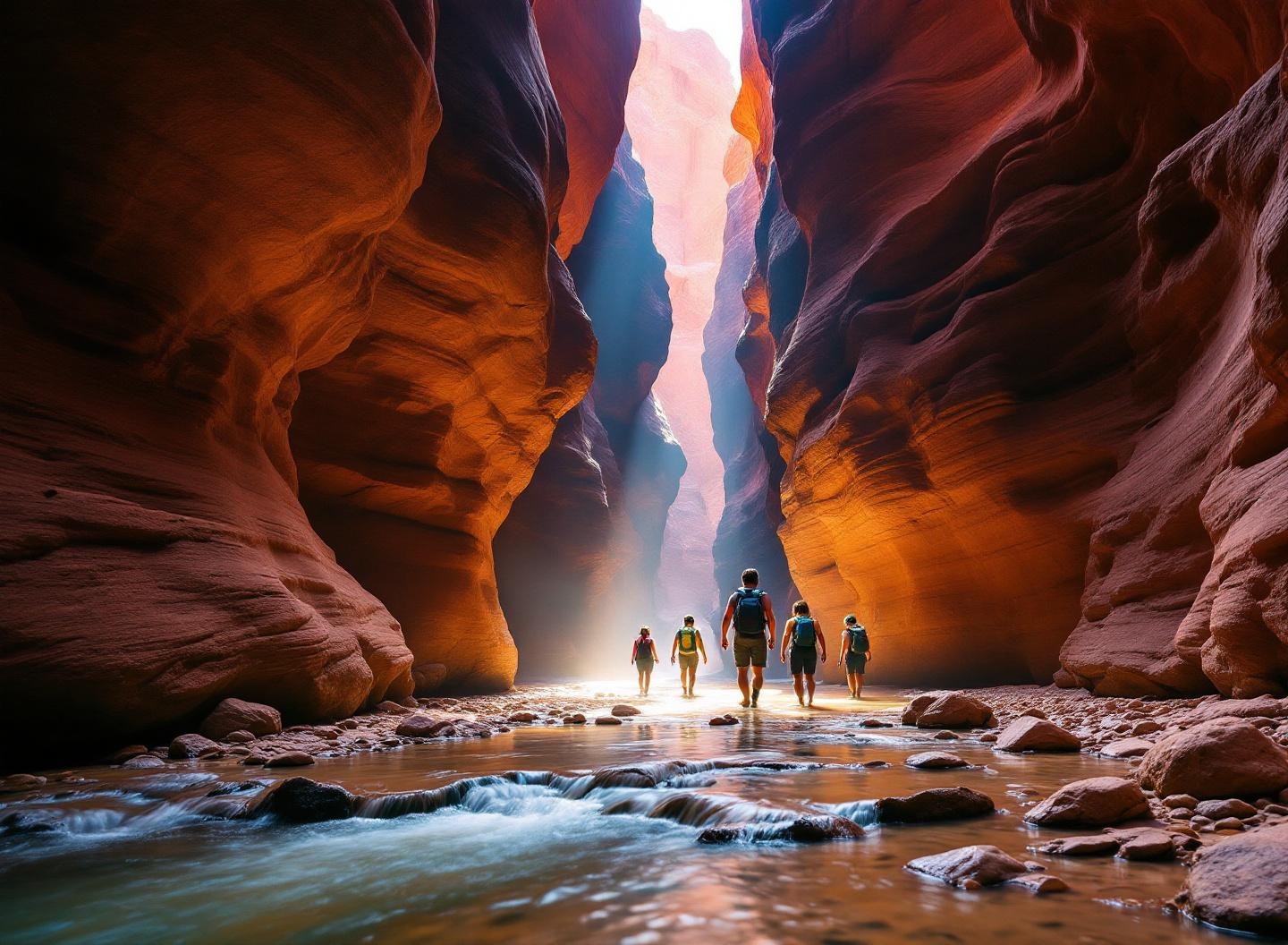
| Where | Dead Sea Highway (Route 65), ~90 km south of Amman |
| Cost | Around 21 JOD/person, incl. life jacket and guide |
| Time needed | 1.5–2.5 hours on the trail |
| Getting there | 1.5–2 hrs from Amman by car, or a guided tour |
| Best time | Morning, April–October (closed in winter) |
What is the Wadi Mujib Siq Trail
The Wadi Mujib Siq Trail is a guided water hike through the lower gorge of Wadi Mujib — the deepest canyon in Jordan, carved through the central plateau to the Dead Sea. RSCN (Royal Society for the Conservation of Nature) manages the trail as part of the Mujib Biosphere Reserve, which protects one of the most spectacular canyon systems in the Middle East.
This is not a conventional hike. From start to finish, you will wade through chest-deep water, swim short sections, pull yourself up rope-assisted waterfalls and scramble over wet boulders. The canyon walls close to 4–5 m apart in the narrowest sections, rising 70–100 m above the water on either side. Sunlight reaches the gorge floor only at midday. It is one of the most dramatic natural environments in Jordan.
The trail takes 1.5–2.5 hours for most visitors. The entry is at the Dead Sea coast (lowest point on earth at -430 m), and the hike goes upstream into the gorge. You return the same way — this means the current is with you on the exit, which is considerably easier than going in.
Seasonal opening and closure
Open: April to October (approximate) Closed: November to March
The closure is for two reasons: safety and practicality. In winter, the canyon is fed by heavy rains in the Jordanian highlands, creating flash flood risk that can fill the gorge within minutes. Water temperature in January and February drops to 8–12°C — dangerously cold for extended wading. The RSCN closes the trail by formal announcement, usually in November and reopens it in late March or April depending on water conditions.
Important: The opening and closing dates shift slightly year to year. Always check the RSCN website (rscn.org.jo) or call the Mujib Reserve visitor centre directly before planning your visit. Arriving at a closed gate has cost many visitors a trip.
Flash flood risk does not disappear entirely in summer. Even on a clear sunny day, rain falling on the plateau 50 km upstream can reach the canyon floor within 30 minutes. The RSCN monitors weather conditions and will close the trail on days with upstream storm risk — this happens several times per season. If you are told the trail is closed on the day you arrive, it is for your safety.
What the experience involves — no surprises
Swimming is mandatory. The gorge has sections where there is simply no foothold — you must swim. If you cannot swim or are not comfortable in moving water, this trail is not for you. Life jackets are provided and all visitors must wear them.
You will get completely wet. From the knees up within the first 10 minutes. Cameras, phones, valuables and dry clothes must be in a waterproof bag or left at the start point. The RSCN provides waterproof bags at the gate.
There are rope sections. Fixed ropes assist hikers up waterfalls of 1–2 m height. Moderate upper body strength helps. Guides assist at each rope point.
It is a guided trail. You cannot complete the Siq Trail independently. RSCN-licensed guides lead groups from the entrance. Group sizes are capped for safety.
The current runs against you going in. The water flows downstream (toward the Dead Sea), so you are pushing upstream through current on the way in — tiring in the narrowest sections. On the way out, the current assists and the hike feels much easier.
Fees and booking
| Item | Cost |
|---|---|
| Mujib Reserve entrance fee | ~21 JOD per person |
| Life jacket | Included |
| Waterproof bag | Included |
| Guide | Included in group sessions |
The 21 JOD fee covers entry to the reserve, the guided trail, life jacket and waterproof storage. Jordan Pass does not cover Mujib Reserve entry. Book at the entrance on arrival (if space is available) or pre-book through the RSCN website or an Amman-based tour operator.
Peak season (July–August) can see the trail fully booked by mid-morning. Arrive early — the first group typically enters at 8:00 am — or pre-book at least 48 hours in advance.
Pre-booked guided tours that include return transport from Amman are available through several operators. The Wadi Mujib Siq Trail hiking experience from Amman is a widely used option that includes pickup, guide and all entry fees. The Wadi Mujib river canyon hike and private day trip from Amman is available for private groups preferring a customised schedule.
Getting there
The Mujib Reserve visitor centre sits on the Dead Sea Highway (Route 65), approximately 90 km south of Amman. Journey time from Amman: 1.5–2 hours depending on traffic.
Self-drive: The most flexible option. Follow Route 65 south from the Dead Sea resort area. The reserve entrance is well signposted on the east side of the road.
From Amman by bus: No direct public bus. Take a JETT or local bus toward the Dead Sea and ask the driver to drop you at the Wadi Mujib turn-off. This leaves you 1–2 km from the gate. Taxis cover the last stretch.
With a tour operator: Most convenient. Tours depart Amman by 7–8 am to reach the reserve for the first group. Return to Amman by late afternoon.
What to wear and bring
Do wear:
- Lightweight clothes you don’t mind getting permanently wet
- Water shoes or sandals with heel straps (mandatory — bare feet are dangerous on rocks)
- Rash guard or lightweight long-sleeved top for sun protection
Do not wear:
- Jeans (become impossibly heavy when wet)
- Cotton trainers that weigh 2 kg when soaked
- Anything valuable or non-waterproof
Bring in a waterproof bag (provided):
- Phone (sealed in a separate zip-lock bag as backup)
- Snack
- Sunscreen (apply before the trail — no reapplication possible mid-hike)
Leave at the car or reserve locker:
- Non-waterproof cameras
- Non-essential valuables
- Dry change of clothes for after (essential — you will be soaked at exit)
The alternative: Mujib Ibex Trail
If you visit in winter (November–March) when the Siq Trail is closed, or if anyone in your group cannot swim, the Mujib Ibex Trail is the alternative. This is a drier upland trail that gives views into the canyon and traverses the cliffs above where the Nubian ibex live. It is open year-round and does not require water immersion. See the separate guide for full details.
Is it worth it?
The Wadi Mujib Siq Trail is consistently rated one of the top ten experiences in Jordan. The scale of the canyon — towering walls, the sky reduced to a thin strip of blue above you, the cold rushing water of a desert river — creates a genuinely memorable experience. It is unusual enough to feel unlike anything else you will do in Jordan.
Whether it is “worth it” depends on your relationship with cold water and mild physical challenge. If you are comfortable with those, yes — strongly worth the trip.
Combining Wadi Mujib with the Dead Sea
The Mujib Reserve sits directly on the Dead Sea Highway. The most logical day combines:
- Morning: Wadi Mujib Siq Trail (arrive 7:30 am, trail by 8 am, exit by 11 am)
- Late morning: Drive 20 minutes north on Route 65 to a Dead Sea beach club
- Afternoon: Float in the Dead Sea, swim and lunch
This is a full and memorable day. The contrast — cold rushing canyon water in the morning, the hyper-saline buoyancy of the Dead Sea in the afternoon — is genuinely pleasurable.
For Dead Sea planning, see our Dead Sea visitor guide. For the broader Jordan Valley region, see our jordan-valley itinerary.
Pre-booked tours that combine both experiences: the Dead Sea and Wadi Mujib full-day tour from Amman handles all transport and entry logistics, letting you focus on the hiking and floating rather than the driving. Visitors based in Aqaba can join the Wadi Mujib and Dead Sea tour from Aqaba , which covers both sites in a long single day heading north.
The geology and geography of Wadi Mujib
Wadi Mujib is known in biblical scholarship as the Arnon — a river mentioned multiple times in the Old Testament as a boundary between Moab to the north and Edom to the south. The modern Arabic name preserves a different reference — mujib means “the answerer” in one interpretation, possibly referring to the echo that canyon walls create when sound reflects between the 900 m cliffs.
The gorge was cut by the Mujib River (Wadi Mujib) over millions of years as the land surrounding it uplifted through tectonic movement while the river maintained its course. The result is a water-cut slot canyon of extraordinary depth — 900 m from plateau to river level in places — through limestone and sandstone geology that displays the layering of Jordan’s geological history in cross-section.
The river itself originates on the east Jordanian plateau near the Iraqi border, flowing west through progressively deepening terrain to the Dead Sea. The section managed as the RSCN reserve is the lower 4 km of the gorge — the deepest, narrowest and most dramatic section where the walls close in to create the canyon environment of the Siq Trail.
Above this section, the Jordan Trail traverses the plateau and canyon rim — an entirely different experience from the Siq Trail below.
Water conditions throughout the season
The Siq Trail’s character changes dramatically across its open season (April–October).
April–May (spring): The canyon runs with significant water flow from snowmelt and spring rains on the highland plateau. Water depth in the deepest sections reaches chest height on an average adult. The current is the strongest of the season — pushing upstream against the current on the way in is genuinely tiring. Water temperature: cool, 16–20°C. The canyon walls are lush with water plants and the sound of rushing water is constant.
June–July: Water levels begin to drop as the spring snowmelt ends. The deepest sections remain waist-to-chest depth but sections that were knee-deep in spring are now ankle-deep. Current is lighter. Water temperature: 22–26°C — the most comfortable for wading.
August–September: The lowest water levels of the season. Some sections that are swimmable in spring are now wading sections. The canyon is the warmest. Flash flood risk is present — afternoon thunderstorms on the plateau can send a flash flood down the canyon with 20–30 minutes warning. The RSCN monitors weather and closes the trail on days with storm risk.
October: Water levels rise again with early autumn rain. Current increases. This is the last viable month before winter closure.
The Mujib Biosphere Reserve: beyond the Siq Trail
The Siq Trail is the most famous activity in the Mujib Biosphere Reserve, but the reserve encompasses a much larger area. The total reserve covers 212 km2 of the most rugged terrain in Jordan.
Within the reserve, RSCN manages:
- Siq Trail (April–October): The water canyon hike described in this guide
- Ibex Trail (year-round): The dry upland loop for Nubian ibex viewing
- Malaqi Trail: A longer canyon hike combining two wadi systems; less frequently run due to difficulty
- Rakan Trail: An upland trail through the reserve’s northern section; rarely offered commercially
The reserve also includes significant wildlife beyond the ibex: grey wolf, striped hyena, sand cat (rarely seen), Egyptian vulture, and during spring migration an enormous variety of raptors moving through the Jordan Valley.
What happens if a flash flood occurs while you are in the canyon
Flash floods in narrow canyon systems can be fatal. The RSCN monitors upstream weather conditions in real time and will cancel trail access on days when there is significant storm activity on the eastern plateau. This happens several times per season without incident because the system works.
If you are in the canyon and the guide signals a flash flood warning (usually a whistle blast and the command to move immediately to the highest available point), the correct response is to climb. Canyon walls in the Siq Trail section have alcoves and ledges that can be reached quickly. The guide knows the locations.
The flow from a flash flood in Wadi Mujib can rise 3–4 m in minutes. The highest point you can reach immediately is the correct destination. Do not try to run out of the canyon — the water moves faster than you can run.
This sounds alarming but context is important: no guided Siq Trail participant has been killed by a flash flood since RSCN began managing the trail. The monitoring system is effective and guides are trained in emergency response. The risk is real but managed.
Frequently asked questions about Wadi Mujib Siq Trail
What is the minimum age for the Wadi Mujib Siq Trail?
RSCN sets the minimum age at 18 years for the Siq Trail. Children are not permitted on this specific trail due to the swimming requirements and current strength. Families with children should consider the Mujib Ibex Trail instead.
Can I do the trail without a life jacket?
No — life jackets are mandatory for all participants. The RSCN enforces this without exception. The jacket is provided and included in the entry fee.
How difficult is the Siq Trail for non-swimmers?
The trail is not suitable for non-swimmers. There are sections where swimming is unavoidable. If you can float on your back in a pool but are not a strong swimmer, the life jacket provides sufficient support but you should inform your guide at the start.
Is there a locker or secure storage at the reserve?
Yes — the visitor centre has lockers (small fee) and a secure bag drop. Leave valuables here, not in your car (break-ins have been reported in the parking area).
What time should I arrive at the reserve?
Aim to arrive by 7:30–8:00 am. The first group enters at 8:00 am, the trail is cooler in the morning, and you avoid afternoon crowding. July and August see the trail at maximum capacity by 10 am.
Can I enter the gorge from the upstream end?
No. The trail is managed as a one-direction route starting from the Dead Sea (downstream) end. Entry from the upstream plateau is not permitted through the RSCN. The Jordan Trail traverses the plateau above the gorge but does not descend into the water canyon.
Siq Trail vs Ibex Trail: which one for your group
Mixed groups — swimmers and non-swimmers, or visitors travelling outside April–October — often need to choose between the two Mujib trails rather than defaulting to the famous one.
| Siq Trail | Ibex Trail | |
|---|---|---|
| Season | April–October only | Year-round |
| Water | Mandatory swimming and wading | Dry, upland walking |
| Minimum age | 18 | No swimming restriction |
| Wildlife | None specific | Nubian ibex viewing |
| Difficulty | Moderate, current and rope sections | Moderate, uphill walking |
If your group includes children, non-swimmers, or you are travelling November–March, the Mujib Ibex Trail is the honest substitute rather than a consolation prize — it gives a genuinely different, dry view into the same canyon system.