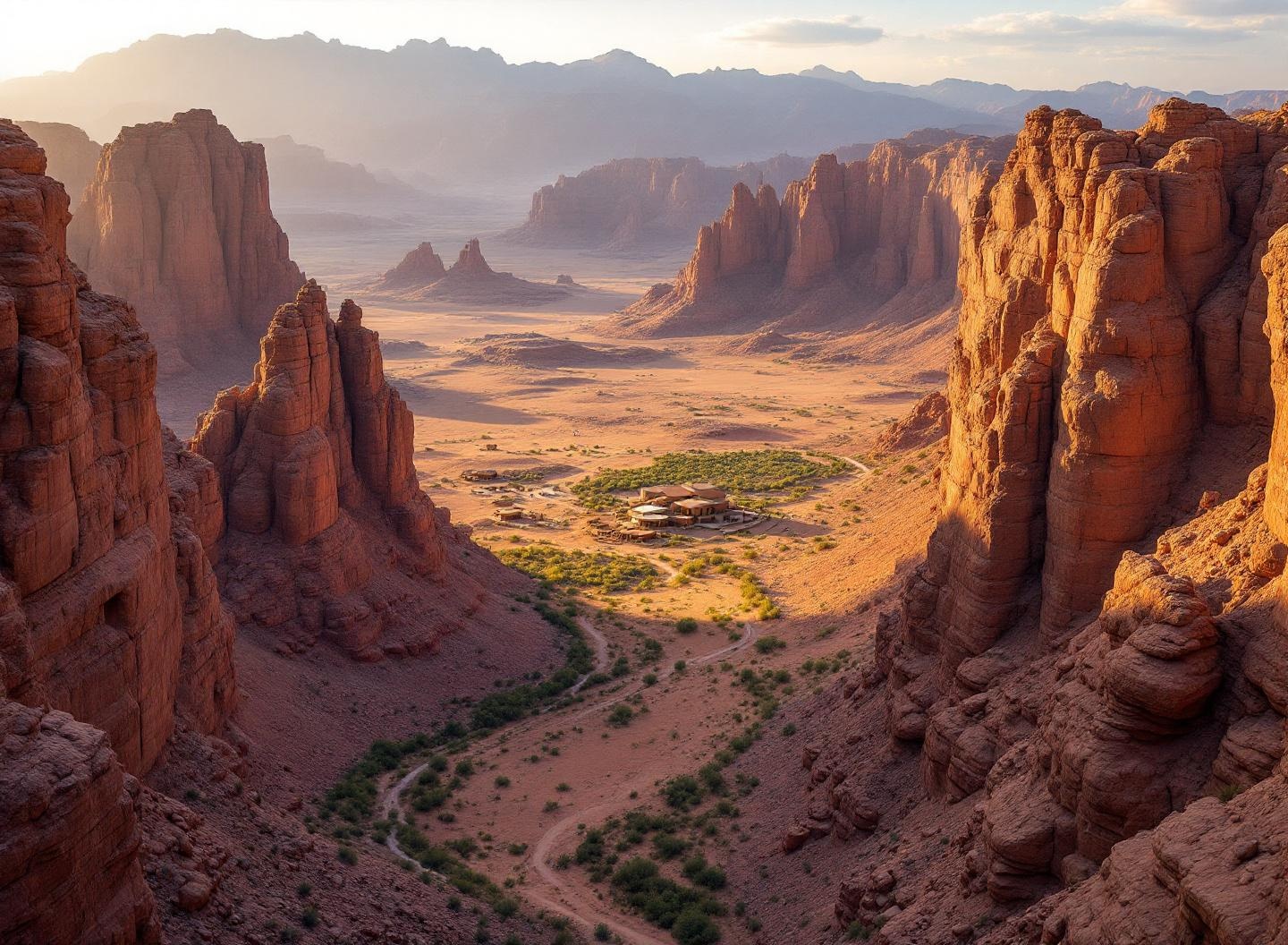
| Where | Wadi Feynan, foot of the Dana escarpment, south Jordan |
| Cost | Around 120–160 JOD/person/night full board at Feynan Ecolodge |
| Time needed | 1–2 nights minimum |
| Getting there | 3–3.5 hrs from Amman (4WD), or on foot from Dana village |
| Best time | March–May and October–November |
Wadi Feynan: the valley copper built
Wadi Feynan occupies a strange position in Jordan’s travel geography — it is simultaneously one of the country’s most significant archaeological landscapes and one of its least-visited destinations. This is partly by design and partly geography: the valley sits at the junction of Wadi Dana and Wadi Feynan at the foot of the Dana escarpment, 40 km from the nearest town, accessible only by a poorly paved track.
Copper ore has coloured the soil here for thousands of years. The green and blue streaks in the rock faces, the dark pits of ancient mines in the valley walls, and the slag heaps of Bronze Age smelting operations create a landscape that announces its industrial past openly. Copper extraction began here approximately 8 000 years ago — in the Chalcolithic period — and continued through the Bronze Age, the Nabataean era, the Roman occupation and the Byzantine period. The Romans knew this place as Phaeno and used prisoner labour from across the empire to extract copper ore. Early Christians were among those sent to die in the mines of Phaeno — a martyrdom site referenced in early church texts.
Walking through Wadi Feynan is walking through the entire sweep of human copper history in a single valley.
Feynan Ecolodge: the base for all hikes
Feynan Ecolodge is the reason most visitors come to Wadi Feynan. Built in partnership with RSCN and the local Amamreh Bedouin community, the ecolodge is designed and operated without mains electricity — it runs on solar power during the day and candlelight after dark. This is not a marketing concept; there genuinely is no generator backup. Dinner is by candlelight in a communal dining room, with traditional Bedouin food prepared by local women.
National Geographic Traveler named Feynan Ecolodge one of “the world’s 25 best ecolodges” — it remains one of the most-cited examples of successful community-based tourism in the Middle East.
Booking: Via the Wild Jordan website (wildjordan.com) — operated by RSCN. Advance booking of at least 2–4 weeks is strongly recommended in spring and autumn. The lodge has 26 rooms and fills quickly for weekend stays.
Cost: Approximately 120–160 JOD per person per night, full board (dinner, breakfast included). Lunch is additional. The price includes access to all guided walks from the lodge.
Access: The lodge provides a 4WD vehicle pickup from the main road junction near Qadsiyyeh. Self-driving requires a high-clearance vehicle for the last 15 km of rough track. Confirm pickup arrangements when booking.
The hiking trails from Feynan Ecolodge
Copper mines trail (2–4 km, easy–moderate, 1.5–3 hours)
The signature walk of Wadi Feynan. A local Bedouin guide leads the route through the main copper mining area, descending into ancient pit mines, examining slag heaps and tracing the water channels that processed ore. The scale of the mining operation — tens of thousands of pits covering several square kilometres of hillside — is astonishing.
The guide’s storytelling is the centrepiece of this walk: a good Amamreh guide connects the physical evidence with the Roman and Biblical narratives of the mines, the identification of slave quarters, the ventilation shafts cut into cliff faces, and the Byzantine basilica remains at the valley’s edge.
Best time: Morning, when the mine faces are lit by low sun from the east. The copper minerals in the soil glow blue-green in direct morning light.
Wadi Ghuweir canyon hike (6 km, moderate, 3–4 hours)
A water-carved canyon northwest of the ecolodge with a seasonal stream in winter and spring. The canyon walls of red and black sandstone squeeze to 3–4 m apart in the narrowest sections — a miniature version of the Siq in Petra without the crowds. In spring (March–April) the stream runs clear and ankle-deep for most of the route.
Technical difficulty: low to moderate. Some boulder-hopping required in the canyon. River shoes or waterproof trail shoes recommended in spring.
Wildlife: The canyon is known for migrant bird species in spring — European roller, bee-eater, Levant sparrowhawk — that use the Wadi Araba flyway. Rock hyrax on the canyon walls throughout the year.
Wadi Dana downhill trail (14 km, moderate, 5–6 hours, one way)
The route from Dana village to Feynan Ecolodge — this is effectively the Day 1 approach of the Dana to Petra trek. If you are staying at the ecolodge without doing the full trek, this trail can be walked one-way downhill from Dana (arranged with transport pickup at the lodge end). The descent covers 1 200 m of elevation and passes through the Dana Nature Reserve — juniper forest, fig trees, ibex habitat — before emerging into the desert floor of Wadi Feynan.
A vehicle needs to drop you at Dana village (or the RSCN trailhead above Dana) in the morning, and the ecolodge collects you from the trail at Feynan in the afternoon.
Distance/time: 14 km, 5–6 hours descent. Not suitable as a round-trip on foot.
Prehistoric settlement walk (3 km, easy, 2 hours)
A shorter walk focusing on the Chalcolithic and Bronze Age settlement sites adjacent to the ecolodge. A guide leads visitors to the remains of a 6 000-year-old copper-smelting camp — foundations of stone walls, slag accumulations, a collapsed furnace. The eerie thing about this walk is the density of the remains: the valley floor around the lodge is pockmarked with archaeological features that have never been formally excavated.
Star-gazing and night walks
Wadi Feynan has no light pollution for 40 km in any direction. On moonless nights the Milky Way is visible as a solid band across the sky. The ecolodge offers guided night walks with a telescope and Bedouin astronomical knowledge. The absence of generator noise makes the valley floor extraordinary quiet after dark — the only sounds being desert fauna and distant wind.
Getting to Wadi Feynan
Wadi Feynan is logistically awkward. This is part of its appeal — it remains undiscovered partly because it resists easy access.
From Amman: 3–3.5 hours by car via the Desert Highway and the Queen Alia–Qadsiyyeh junction. GPS coordinates: 30.612°N 35.444°E (ecolodge entrance track junction). A 4WD or high-clearance vehicle is recommended for the last 15 km.
From Dana village: 14 km downhill on foot (the Wadi Dana trail described above), or 45 minutes by 4WD on rough track. Dana is accessible from Qadsiyyeh on the King’s Highway.
Ecolodge transfer: The lodge provides 4WD collection from the road junction. This is the simplest option for visitors without a suitable vehicle — arrange when booking.
As part of a guided trek: The Dana to Petra trek passes through Feynan with an overnight at the ecolodge. The Dana to Petra 4-day trekking adventure includes Feynan Ecolodge as the Day 1 stop.
If a multi-day commitment is not practical, the Dana full-day hiking tour from Amman covers the Dana escarpment and can be combined with a separate night at Feynan. For the complete Jordan Trail experience of which Feynan is the midpoint, the Jordan Trail Dana to Petra 4-day guided trek is the most rewarding context for understanding Wadi Feynan’s place within the broader south Jordan landscape.
Feynan and the Jordan Trail
Wadi Feynan is the overnight stop at the midpoint of Jordan Trail Section 6 — the Dana to Petra section. Through-hikers on the Jordan Trail spend a night at the ecolodge as part of their guided itinerary. The ecolodge’s position on the trail has introduced Feynan to a wider hiking community, and bookings from trail hikers now form a significant portion of the lodge’s guests.
Combining Wadi Feynan with Petra and Dana
A south Jordan itinerary that includes Wadi Feynan naturally connects to Dana village (above the valley, accessible by trail or road) and Petra (60 km south by road, or 2.5 days by the Dana–Petra trek).
A logical 3-night structure: Night 1 in Dana village (RSCN guesthouses), Night 2 at Feynan Ecolodge (after the Wadi Dana descent), Night 3 back at Dana or transit by vehicle toward Petra. This gives access to the ecolodge trail programme without committing to the full 4-day trek.
For the full south Jordan route, see our south Jordan itinerary.
What to pack for Feynan
The ecolodge provides bedding, towels and basic toiletries. What to add:
- Headtorch (candlelight is atmospheric but limited for reading)
- Warm layer (nights are cold in autumn and winter; even spring nights drop to 10–15°C on the valley floor)
- Water shoes or waterproof trail shoes for canyon hikes (spring)
- Sun hat and sunscreen (valley is exposed and elevation is low — heat is intense)
- Binoculars (copper mines trail and canyon hike both benefit)
- Cash (ecolodge accepts card but Bedouin guide tips should be in JOD)
Wadi Feynan in archaeological context: Phaeno and the copper mines
The Romans knew Wadi Feynan as Phaeno. By the 3rd and 4th centuries AD, the copper mines here were among the most productive in the Eastern Roman Empire. The emperor Diocletian’s edict of 301 AD lists Phaeno copper among the standard-regulated imperial commodities.
The labour force at Phaeno was entirely involuntary. Roman sources record that convicts — including early Christian martyrs during the Diocletianic Persecution of 303–313 AD — were condemned to the mines of Phaeno as the harshest available punishment short of execution. The martyrs Peleus, Nilus and others, described in early Christian texts as dying “in the mines of Phaeno,” likely died here.
The conditions were lethal: poor ventilation in the mining tunnels, continuous dust inhalation (silicosis), exhaustion, and the absence of any medical care. The slag heaps visible today across the valley floor — blue-grey mounds of processed ore waste — represent the output of this labour.
After the Arab conquest of the 7th century AD, mining at Phaeno declined and eventually ceased. The valley was occupied by Bedouin pastoralists who had no use for the copper deposits but valued the year-round spring water and the flat valley floor for goat grazing.
Modern archaeological surveys (particularly those by the British team from the University of Glasgow in the 2000s) have mapped over 11 000 separate mining features in the Wadi Feynan landscape — pits, tunnels, ventilation shafts, smelting installations and settlement remains. It is one of the most archaeologically rich valley systems in the Middle East and remains almost entirely unexcavated.
The astronomy of Wadi Feynan
Feynan Ecolodge markets its night sky as one of its headline features, and the claim is not exaggerated. The valley sits at approximately 250 m elevation, below the plateau rim, which means the horizon is partly blocked by the escarpment. This natural amphitheatre reduces light pollution from distant Jordan Valley settlements to almost zero in the most sensitive directions.
The Bortle scale (a measure of night sky darkness, from 1 — perfect dark — to 9 — inner city) rates Wadi Feynan at approximately 2–3 in optimal conditions. For comparison, Amman rates approximately 8–9. The Milky Way is visible as a textured band, not just a vague patch. On moonless nights, your shadow is cast by starlight.
The ecolodge’s astronomy guides are Bedouin men from the Amamreh tribe who have grown up under these skies. Their astronomical knowledge is non-academic but practically detailed — they know which stars rise over which valley ridge at which time of year, which stars mark the beginning of each agricultural season, and which constellations the Bedouin use for navigation. The guided night walk combines Western sky knowledge (constellation names, satellite passes, planet identification) with Bedouin celestial tradition.
Water in the desert: the Feynan spring system
The permanent spring at Wadi Feynan (now reduced to a seep by comparison with its historical flow, but still significant in a desert context) is the reason for the valley’s 8 000-year occupation. Every ancient culture that mined copper here needed water for smelting — the process requires cooling and quenching — and the spring provided it.
The ecolodge has restored some of the Nabataean-era spring channels to direct seep water to the garden and the building’s utility systems. Walking near the ecolodge you can see the characteristic green strip of vegetation — rushes, water-loving plants, a small stand of date palms — that marks the spring’s zone of influence.
The spring also attracts wildlife that cannot survive in the surrounding dry desert. The green zone around the ecolodge is consistently the most productive area for birdwatching — Palestine sunbird, Tristram’s grackle and sand partridge all use the vegetation cover.
Supporting the Amamreh community through your visit
The Amamreh Bedouin tribe has lived in and around Wadi Feynan for generations. When RSCN established the ecolodge, one of the core conditions was that the local community must benefit economically — not through marginal employment but through meaningful income sharing.
In practice this means: the ecolodge kitchen staff, cleaning staff and maintenance workers are all Amamreh. The guides for all hikes are Amamreh men who have received RSCN training. The food served at the lodge is largely sourced from Bedouin households in the area — goat cheese, seasonal vegetables, dried herbs, olive oil from the Dana plateau above.
Visitors who buy handicrafts from the women’s cooperative stall at the lodge are purchasing items made by Amamreh women in their homes — the income goes directly to those households. This is not a performance of development: it is the actual mechanism by which a marginal Bedouin community has become economically more stable through tourism.
Frequently asked questions about Wadi Feynan hikes
Is Wadi Feynan accessible for non-hikers?
Yes — the ecolodge itself is accessible by vehicle and the prehistoric settlement walk and star-gazing sessions require minimal walking. Guests who are not strong hikers can participate in most of the ecolodge’s programme. The Wadi Dana trail and Wadi Ghuweir canyon require moderate fitness.
How far in advance should I book Feynan Ecolodge?
For March–May (spring wildflower season) and October–November, book 4–8 weeks in advance. For summer and winter, 2 weeks is usually sufficient. Weekend dates fill faster than weekdays.
Is the ecolodge off-grid truly?
Yes — solar power runs basic lighting and phone charging during the day. After sunset, the lodge operates entirely on candles (provided in each room). There is no air conditioning and no television. Wi-Fi coverage is limited to the reception area.
Can I visit Wadi Feynan as a day trip without staying overnight?
Technically possible — the copper mines trail and a look at the valley can be done in 4–5 hours. However, the ecolodge’s dinner experience and the night sky are among the valley’s main draws. A day trip undervalues what Feynan offers. If time is limited, one night is the minimum worthwhile stay.
Is there mobile phone signal at Feynan?
Signal is very limited in the valley floor. Zain and Orange networks have partial 3G coverage in some parts of the valley, but connectivity is unreliable. Inform people of your itinerary before arriving. The lodge has a satellite phone for emergencies.
Wadi Feynan vs other Jordan hiking bases
Visitors weighing Feynan against other south Jordan hiking bases should know what each offers. Dana village sits at the top of the escarpment with cooler air, a wider choice of guesthouses and easier access; Feynan sits at the valley floor with the ecolodge, the copper mines and the off-grid night sky. Neither replaces the other — most serious hikers combine both, using the Wadi Dana descent to link them. If time only allows one, choose Dana for flexibility and easier logistics, and Feynan specifically for the ecolodge experience and the copper-mine archaeology, which has no equivalent elsewhere in Jordan.