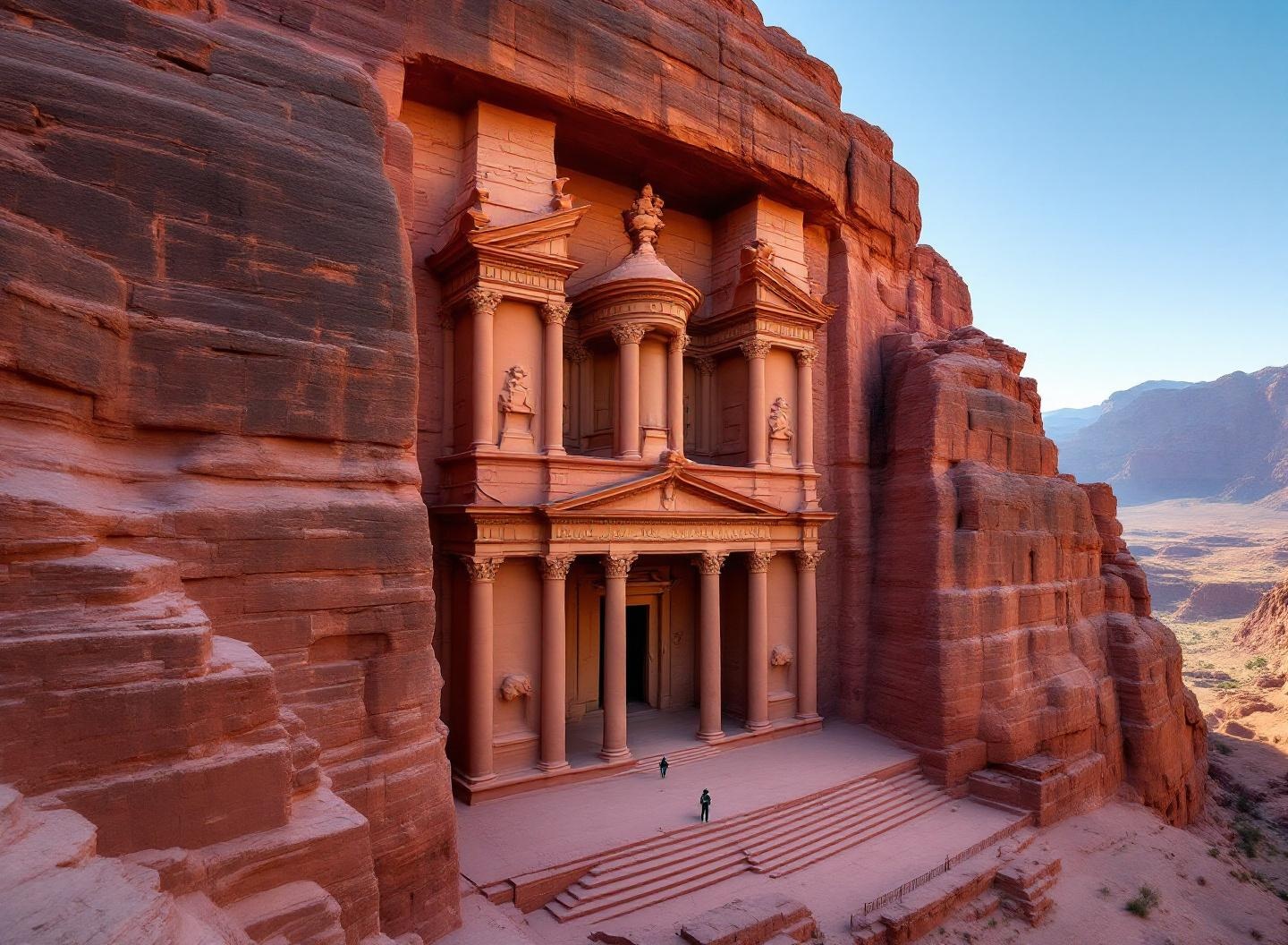
| Where | Little Petra to the Monastery, southern Jordan |
| Cost | Standard Petra ticket + guide (20–40 JOD for the route) |
| Time needed | 2–3 hours for the back-door section alone |
| Getting there | Taxi from Wadi Musa to Little Petra (7–10 JOD) |
| Best time | Morning start, 7–8am; March–May or September–November |
Why take the back door into Petra
The standard entry to Petra — through the main Siq from the Visitor Centre near Wadi Musa — is a magnificent experience. It is also shared, in peak season, with several thousand other visitors per day. The narrow 1.2 km canyon fills with horse-drawn carriages, guided tour groups and individual travellers, all funnelling toward the Treasury reveal. This is Petra as a spectacle, and there is nothing wrong with it. But there is another way in.
The Petra back door is a 6 km trail that begins at Little Petra (Siq al-Barid) — the smaller Nabataean complex 8 km north of the main site — and descends through an increasingly narrow ravine to arrive at the Monastery (Ad Deir) from above. Instead of looking up at a carved facade from a crowded sand floor, you arrive at eye level with the Monastery’s upper pediment, looking down into Petra’s ancient heart. The approach is genuinely dramatic, and you will share it with a fraction of the people in the main Siq.
Little Petra: the starting point
Little Petra (Siq al-Barid, meaning “the cool siq”) is an underappreciated Nabataean site in its own right. A compact canyon with carved facades, cisterns, a triclinium with the remnants of a painted ceiling (the “Painted House”) and merchants’ rock-cut rooms, it gives a sense of Nabataean architecture without the scale of the main city. Little Petra was likely a caravanserai — a staging post for the merchant camel trains arriving at Petra.
Entry to Little Petra with a valid Petra ticket is free. The Petra ticket must be purchased at the main Visitor Centre in Wadi Musa or online; there is no ticket sales point at Little Petra.
Getting to Little Petra from Wadi Musa: By taxi (7–10 JOD, 20 minutes) or by private car (8 km north on the road toward Showback). A few budget hotels near Wadi Musa offer morning minibus transfers to Little Petra for independent hikers doing the back door route.
The back door route: stage by stage
Little Petra to the ravine entry (1 km, 20 minutes)
Beyond the Little Petra canyon exit, a clear path leads onto the sandstone plateau. For the first kilometre the terrain is open and the views extend south toward the Shara mountains and west toward Wadi Araba. This section is easy walking with no navigation difficulty.
A small Bedouin stall at the end of the Little Petra canyon is the last opportunity for water and snacks before the descent. The Bedouin family here have been welcoming back-door hikers for decades — stopping for a tea (even under the typical Bedouin chai pressure) is culturally appropriate and the engagement is genuine.
The ravine descent (3 km, 1–1.5 hours)
The trail enters a progressively narrowing sandstone ravine. The walls rise on either side as the path descends — gradually at first, then steeply through a series of rock steps and gully sections that require hands-on scrambling in places. The sandstone here is spectacularly coloured: banded red, orange, purple and white in the compressed geological layers.
This is the most technically demanding section. Good footwear is essential — trail shoes or light hiking boots with grip. Sandals are a poor choice. The descent is loose in places and trekking poles reduce the risk of slipping on dusty sandstone.
Navigation: the main ravine path is clear, but side-canyon entries can cause confusion. A local guide eliminates any doubt about the correct route — particularly important because taking a wrong canyon can lead to dead ends requiring backtracking.
The Monastery reveal (2 km, 30–45 minutes)
The ravine opens and you emerge at a viewpoint above the Monastery. The scale of Ad Deir from this angle — the 47 m height of the carved facade, its rose-coloured sandstone glowing in morning light — lands differently when you have arrived here under your own power after a canyon descent. Most visitors photograph the Treasury. Far fewer have ever seen the Monastery from above.
The path then descends through a series of carved stairs to the Monastery’s terrace level, where a small café (operated by a Bedouin family) sells coffee and snacks with improbable views across Petra Valley and toward Wadi Araba. From here, Petra’s entire trail network lies below.
Total distance and time
| Section | Distance | Time |
|---|---|---|
| Little Petra to ravine entry | 1 km | 20 min |
| Ravine descent | 3 km | 1–1.5 h |
| Ravine to Monastery viewpoint | 1 km | 30 min |
| Monastery terrace to main Petra site | variable | 1–3 h |
| Total (back door section) | ~6 km | 2–3 h |
Add 2–4 hours to explore Petra from the Monastery down through the site via the High Place of Sacrifice descent route or the direct path to Qasr al-Bint and the Treasury.
Petra ticket: what you need
A Petra entry ticket is mandatory. Without a valid ticket, you will be turned back by the ticket control at the trail junction near the Monastery.
| Ticket | Cost |
|---|---|
| 1-day Petra | 50 JOD |
| 2-day Petra | 55 JOD |
| 3-day Petra | 60 JOD |
| Jordan Pass (includes Petra entry) | 70–80 JOD total |
The Jordan Pass makes the most financial sense for most visitors who will spend at least 3 nights in Jordan. Buy online at jordanpass.jo before arrival. See our Jordan Pass guide for full value calculations.
Tickets can be purchased at the Visitor Centre in Wadi Musa — 8 km south of Little Petra. If you are doing the back door route, buy your ticket the day before, or on the same morning before traveling to Little Petra.
Using a guide
A local guide is not legally required for the back door route but is strongly recommended for three reasons:
- Navigation. Several side canyons branch off the main ravine. Wrong turns cost time and energy.
- Safety. The descent has loose sections. A guide can spot hazards and assist at difficult passages.
- Experience. Bedouin guides from the Wadi Musa area know the geology, the Nabataean history and the wildlife of the trail in ways that no guidebook can replicate.
Guide cost: 20–40 JOD for a half-day route from Little Petra to the Monastery. Arrange through your hotel in Wadi Musa the evening before, or through the Jordan Trail Association. Do not accept unsolicited guide offers at the Little Petra car park without agreeing on a price first.
Pre-booked guided options that include Little Petra and the back door: the Little Petra private tour from Amman covers both sites in a structured format. For a two-day itinerary that incorporates the back door approach, the Petra and Little Petra 2-day private tour provides accommodation in Wadi Musa plus the full back-door descent.
If you want a shorter, structured introduction before attempting the back door independently, the private 3-hour guided Petra tour orientates you to the site’s layout and key monuments — useful context for anyone planning the back-door approach the following day. For a complete two-day Petra package departing Amman that includes overnight accommodation in Wadi Musa, the Petra 2-day overnight tour from Amman can be combined with a back-door morning on Day 2.
Best time to do the back door route
Morning start (7–8 am): Ideal. The ravine is cool, the Monastery is in morning light (south-facing, catches the sun from the east early), and you arrive at the Monastery before the main site crowds climb up from below.
Avoid midday in summer: The ravine offers shade but the plateau section at the start is exposed. June–August temperatures reach 35–42°C in Petra. Complete the back door descent by 11 am or wait for an autumn visit.
Best season: March to May and September to November. The ravine can hold water after winter rains (March particularly) — wading through ankle-deep water in the ravine is possible after a recent downpour and adds to the adventure rather than detracting from it.
What to bring
- Solid trail shoes or light hiking boots (sandals are inadequate)
- 2 litres of water minimum (more in summer)
- Petra ticket (purchase in advance)
- Cash for guide and Bedouin café
- Trekking poles (helpful for the rocky descent)
- Head torch if you plan to reach the site late in the day
Exiting Petra after the back door approach
From the Monastery, you have several options for reaching the main Petra Visitor Centre exit:
- Direct descent from Monastery to Qasr al-Bint: 1 km path, mostly downhill, 30 minutes. Then through the main colonnade street to the Visitor Centre.
- High Place of Sacrifice detour: From the Monastery, head south along the ridge via the High Place of Sacrifice, then descend to the Roman Theatre. Allow 3 additional hours.
- Carriage or horseback from Qasr al-Bint: If legs are tired after the back door descent and full site exploration, a horse-drawn carriage from the lower colonnaded street to the Visitor Centre is available (5–10 JOD; agree price before boarding).
Little Petra in depth: the Nabataean gateway city
Little Petra (Siq al-Barid, the “cold siq”) deserves more time than most hikers give it. Arriving at the back-door trailhead, it is tempting to walk straight through and start the canyon descent. Resist this: the site contains some of the most interesting Nabataean architecture in the Petra region, and taking 45 minutes to explore it properly changes how you understand what you are hiking toward.
The Painted House triclinium: The most significant monument in Little Petra is a triclinium (dining hall) whose ceiling retains traces of painted fresco decoration. The paintings show Erotes (winged love gods), grapevines and birds — a remarkable survival of Nabataean interior decoration, most of which has been destroyed by weathering or human damage. The figures are rendered in a Hellenistic style, demonstrating how thoroughly Greek cultural influence had penetrated Nabataean art by the 1st century AD.
The cisterns and water system: Little Petra’s Nabataeans engineered an elaborate water collection system throughout the site. Rain falling on the plateau above was directed by carved channels into cisterns cut into the rock. Several large cisterns are visible in the Siq wall — dark rectangles cut at various heights. The volume of water stored here would have supported a significant permanent and transient population of merchants and their animals.
The Biclinium: Adjacent to the Painted House, a two-couch chamber carved with symmetrical facades — likely a funerary or memorial hall associated with a wealthy merchant family. Less visited than the triclinium but better preserved in its carved detail.
The Carved Staircases: Throughout Little Petra, Nabataean staircases are carved into the rock faces — some leading to obvious platforms, others to destinations that are now unclear because the structures above them have eroded. These stairs are a reminder that Nabataean Petra was a three-dimensional city built on multiple levels simultaneously.
The history of the back-door route
The trail from Little Petra to the Monastery was not constructed for tourism — it was a Nabataean trade and access route. The Nabataeans built and maintained routes throughout their territory, and this particular path served as the northern approach to Petra’s upper city for merchants arriving from the Negev and Hejaz.
Archaeological surveys have identified Nabataean cairns and route markers along sections of the ravine that confirm the path’s antiquity. The water cisterns cut into the ravine walls at two points on the descent are Nabataean-era installations — not natural features. The Nabataeans could not have built the Monastery without a reliable supply of stone-cutting workers moving up and down this path.
The route’s use by tourists is a recent development. Until the late 1990s, the back-door trail was known primarily to local Bedouin who used it for goat herding. Adventurous travellers began discovering it through word of mouth; guides from Wadi Musa started offering it as an alternative approach as its reputation spread.
Sandstone: the material of Petra
The back-door ravine provides perhaps the best opportunity to examine the sandstone of Petra’s geology at close range. The colours and textures that make Petra visually extraordinary — the banded layers of red, orange, purple, cream and grey — result from the mineralogical composition of the ancient sands that were deposited here and subsequently lithified.
The colouring agents are simple iron compounds: haematite (Fe2O3) produces red; goethite produces yellow-orange; magnetite produces grey-black. The variation in colour between adjacent layers reflects varying mineral content in the original sand deposits — wind-blown sand from different source areas, deposited in alternating layers over millions of years.
The sandstone is relatively soft compared with the limestone above it — this is what allowed the Nabataeans to carve it with iron chisels. A skilled Nabataean stone-cutter could carve a column capital in a few hours. The surface of a freshly cut face would have been much lighter in colour than the patinated weathered surface visible today — Petra was originally a city of pale cream rock, not rose red.
Accommodation near Little Petra
If you are doing the back-door route as a standalone day (not as part of the Jordan Trail Dana–Petra trek), you will need to base yourself in Wadi Musa (8 km south of Little Petra) or in one of the camps near Little Petra itself.
In Wadi Musa: Wide range of accommodation from budget hostels (~15–20 JOD/person) to mid-range hotels (~60–100 JOD) to the Mövenpick Resort Petra (160–300 JOD) directly at the Petra Visitor Centre gate. Most hotels can arrange morning transport to Little Petra.
Camp near Little Petra: Several Bedouin camps operate within 2 km of Little Petra, offering tented accommodation with dinner and breakfast. Cost: 25–45 JOD per person. More rustic than Wadi Musa hotels but positioned for an early morning back-door start.
Combining the back door with the rest of Petra
Most hikers who do the back door treat it as the opening act of a full Petra day rather than a standalone excursion — arriving at the Monastery from above, then descending through the site to exit via the main gate several hours later. If you’re planning your full trip around this approach, the 1-day vs 2-day Petra guide shows how the back door slots into a second-day itinerary alongside the High Place of Sacrifice, and the Monastery hike guide covers the conventional bottom-up approach for comparison if you want to understand what you’d be doing differently.
Little Petra and Petra combined day tour from AmmanFrequently asked questions about Petra back door
Can I do the back door route in reverse (from the Monastery to Little Petra)?
Yes — the route works in both directions. The Monastery-to-Little-Petra direction is an ascent (harder on the legs) but rewards you with views expanding as you climb out of the ravine. Starting from the main Petra site means you begin in the crowds and end in quiet. Many guides prefer the direction described in this guide (Little Petra to Monastery) for the dramatic reveal effect.
Is the back door route suitable for older hikers or those with knee problems?
The ravine descent puts significant stress on knees. Trekking poles are essential for anyone with knee issues. The route is not suitable for people who cannot safely descend loose rocky slopes. The Soap House Trail in Ajloun forest reserve is a better option for those wanting accessible Jordan hiking.
Are there toilets on the back door route?
No public toilets on the trail itself. The small Bedouin café at the Monastery terrace has basic facilities. Plan accordingly before starting at Little Petra.
How does the back door compare with the main Siq?
The Siq entry reveals the Treasury; the back door reveals the Monastery. The Treasury is more ornate and more photographed; the Monastery is larger and more isolated. Doing both on separate days — Siq on Day 1, back door on Day 2 — is the best approach for a 2-day Petra visit.
Can I hire donkeys or horses for the back door route?
Horses and donkeys are offered at the Little Petra car park for the trail. However, the ravine section is too narrow and too rocky for animals in its lower half. If using a horse, you will ride the open plateau and dismount for the ravine descent. Most guides recommend walking the entire route — it is the physicality of the back door approach that makes the Monastery arrival rewarding.
Can I do the back door route as a day trip from Amman?
It’s possible but tight. You would need to leave Amman very early (before 5am) to reach Little Petra by 7–8am, complete the 2–3 hour back-door hike, explore the main Petra site, and drive back — a very long day. Staying overnight in Wadi Musa the night before is strongly preferable and lets you start the ravine descent at first light without a 3-hour drive already behind you.
Is the back door route included on group tours?
Rarely. Most standard GYG group tours use the main Siq entrance. The back door is better suited to a private guide arranged specifically for this route, or a self-organised hike with a hired Bedouin guide from Wadi Musa.