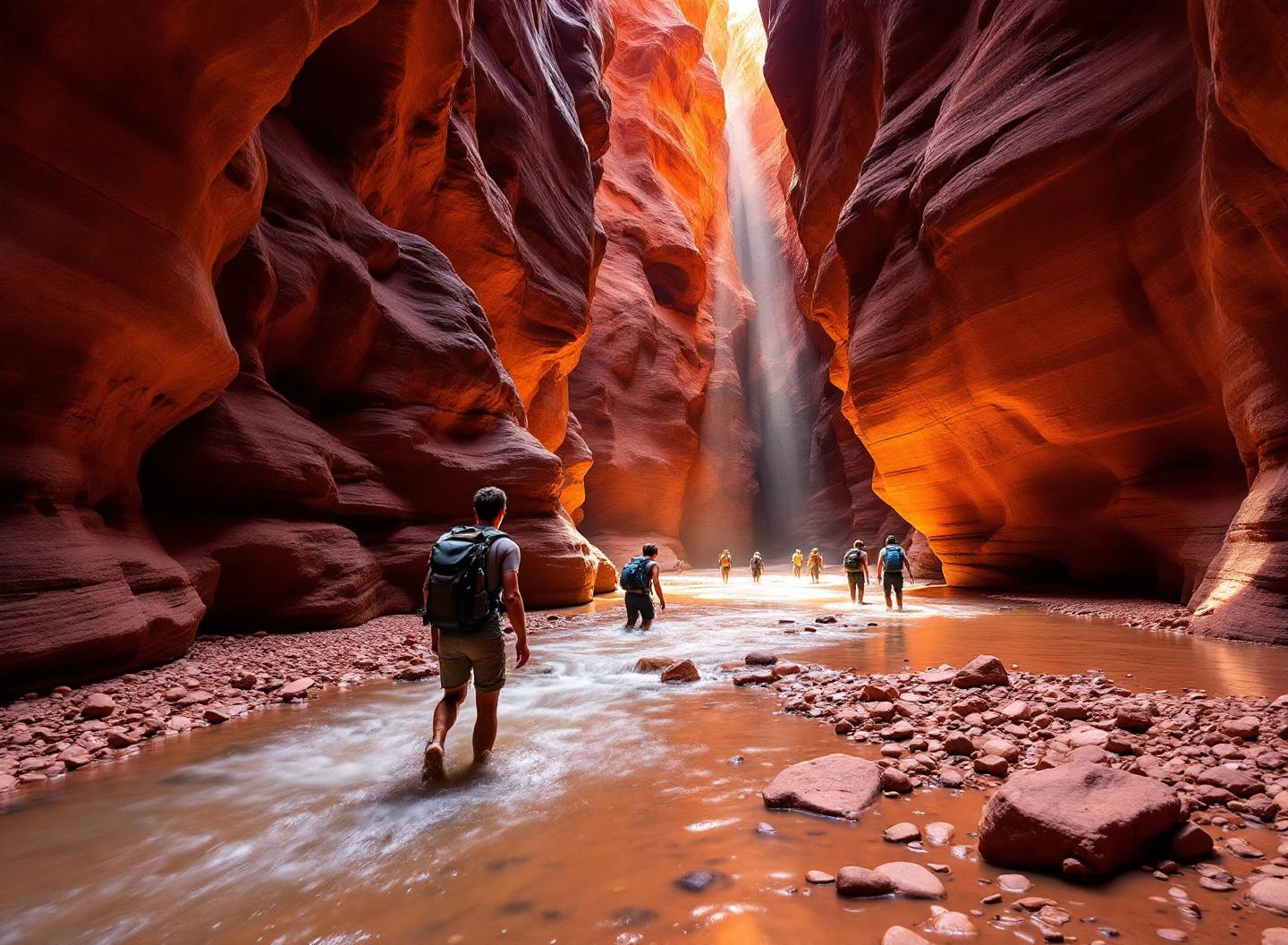
| Where | Wadi Mujib Reserve, Dead Sea Highway, ~90 km south of Amman |
| Cost | Around 35 JOD solo (entry + guide), ~24 JOD/person in a group of 4 |
| Time needed | 4–6 hours for the full 8 km loop |
| Getting there | Self-drive on Route 65, or taxi from Dead Sea resorts (10–15 JOD) |
| Best time | Year-round; early morning or late afternoon for ibex |
The Ibex Trail vs the Siq Trail: which to choose
Wadi Mujib reserve offers two main trail experiences that could not be more different. The Siq Trail sends you into the gorge itself — a wet, physically demanding wade upstream through waist-deep water. The Ibex Trail sends you up and out — onto the dry plateau above the canyon, where the views are vast, the terrain is rocky scrubland, and the wildlife is the point.
| Feature | Siq Trail | Ibex Trail |
|---|---|---|
| Season | April–October only | Year-round |
| Water involved | Yes — swimming required | No |
| Distance | ~2 km one-way | 8 km loop |
| Duration | 1.5–2.5 h | 4–6 h |
| Guide required | Yes (included) | Yes (additional cost ~35 JOD) |
| Primary draw | Canyon immersion | Wildlife and panoramic views |
| Minimum age | 18 | None (children OK with supervision) |
If you visit between November and March when the Siq Trail is closed, or if anyone in your group cannot swim, the Ibex Trail is the natural choice. It is also the better option for older hikers, families with children who can walk 8 km on rough terrain, and anyone primarily interested in wildlife and landscape photography over physical challenge.
The Nubian ibex
The Nubian ibex (Capra nubiana) is the species for which the trail is named. Once common across the Middle East, the Nubian ibex has been eliminated from most of its range by hunting and habitat loss. The Mujib Biosphere Reserve is one of the few remaining strongholds of the species in Jordan, along with the Wadi Rum area.
Identification: Adult males are unmistakable — large curved horns reaching 1 m length in old individuals, tawny-brown body, white underparts. Females are smaller with shorter, slightly curved horns. Juveniles are a lighter grey-buff.
Behaviour: Ibex are well-adapted to cliff environments and can navigate terrain that appears impossible for any large mammal. They congregate in groups of 2–15 animals on the south-facing cliff faces that warm rapidly in morning sun. In summer they push to higher elevations in the cooler hours; in winter they descend to sheltered gorge positions.
Best viewing times: Early morning (7–9 am) and late afternoon (4–6 pm). Midday in summer the ibex retreat to shade and are rarely visible. In winter they are more active throughout the day.
Photography: A 400 mm lens or equivalent telephoto is strongly recommended. The ibex on cliff faces may be 200–400 m distant. Mirrorless cameras with good tracking autofocus perform well in the bright canyon light. See our Jordan wildlife photography guide for equipment and location tips.
Other wildlife on the Ibex Trail
The Nubian ibex is the headliner but not the only wildlife on the trail. The Mujib plateau and gorge rim supports:
- Rock hyrax (Procavia capensis) — small, guinea pig-like mammals on rocky outcrops; alarm call sounds like a cat
- Fan-tailed raven — the most common large bird, always present soaring the thermals above the canyon
- Bonelli’s eagle — occasional, hunting along the gorge edge
- Tristram’s starling — iridescent black starling with orange wing patch, perches on exposed rocks
- Little owl — in rock crevices along the trail; active even in daylight
- Hyrax hare — fast-running, rarely stopped long enough to photograph
- Desert monitor lizard — in summer on warm rocks, 50–70 cm body length
Spring (March–May) brings additional migratory bird species passing through on the Jordan Valley flyway — one of the most important raptor migration corridors in the world. Several hundred thousand raptors (steppe buzzards, honey buzzards, marsh harriers) pass through between late February and early May.
Trail description
The Ibex Trail is a loop starting and finishing at the Mujib Reserve visitor centre on the Dead Sea Highway. The full 8 km loop takes 4–6 hours depending on pace and how long you spend observing wildlife.
Section 1 (Ascent): Visitor centre to plateau rim — 3 km, 400 m ascent
The first section climbs steeply from the Dead Sea level (-430 m) to the plateau rim. The path is rocky and requires solid footwear. Views over the Dead Sea appear quickly and expand as you climb. At the rim, the full scale of the Wadi Mujib canyon becomes visible — a 900 m deep gash in the plateau stretching east to the horizon.
Section 2 (Rim traverse): Plateau rim loop — 3 km
The middle section follows the canyon rim, alternating between exposed ridge walking and sections of sheltered scrubland. Ibex are typically found on the opposite canyon wall in the morning, switching to the trail-side wall in late afternoon. Your RSCN guide will know the current congregation zones.
Section 3 (Descent): Rim to visitor centre — 2 km, 400 m descent
The descent uses a different route than the ascent, completing the loop. Less steep than the ascent but harder on knees — trekking poles recommended on the downhill.
Difficulty: Moderate. No technical climbing. Requires reasonable fitness for 400 m of ascent on rough terrain.
Fees and booking
| Item | Cost |
|---|---|
| Mujib Reserve entry | ~21 JOD |
| RSCN guide (Ibex Trail) | ~14 JOD per group (1–4 people) |
| Total per person (solo) | ~35 JOD |
| Total per person (group of 4) | ~24 JOD |
Unlike the Siq Trail where the guide is included in the base fee, the Ibex Trail charges separately for the guide. Booking is possible at the visitor centre gate on arrival, but calling the reserve in advance is advisable for early morning starts.
Jordan Pass does not cover Mujib Reserve entry. There is no online pre-booking system for the Ibex Trail as of 2025 — contact the reserve directly.
Pre-booked day trips from Amman that include Wadi Mujib: the Wadi Mujib Siq Trail hiking experience from Amman is primarily a Siq Trail tour but operators sometimes offer a combined Siq plus Ibex package. For a Dead Sea and Wadi Mujib combined day, the Dead Sea and Wadi Mujib trail full-day tour from Amman provides transport and guide for both.
If you are based in Aqaba and heading north, the Wadi Mujib and Dead Sea day tour from Aqaba covers both the reserve and a Dead Sea float in a single itinerary.
Getting there
The visitor centre is on Route 65 (Dead Sea Highway), approximately 90 km south of Amman. Journey time: 1.5–2 hours from Amman.
Self-drive: Most convenient. Follow Route 65 south from the Dead Sea resort zone. Signposted entrance on the east side of the road.
From the Dead Sea resorts: The Mujib Reserve is 20–30 km south of the main resort strip. Taxi from a Dead Sea hotel: 10–15 JOD one-way.
From Amman by public transport: Take a bus toward Dead Sea and ask to be dropped at Wadi Mujib. Taxis cover the last 1–2 km to the gate.
What to bring
- Sturdy hiking boots or trail shoes (rocky terrain; water shoes are not suitable for this trail)
- Trekking poles (helpful for the steep ascent/descent)
- 2–3 litres of water per person (no water on the trail)
- Sun hat and high-SPF sunscreen (exposed terrain, minimal shade)
- Binoculars (essential for ibex watching)
- Telephoto lens if bringing a camera
- Long-sleeved light layer (plateau can be cooler than valley in winter; windy in spring)
- Snacks for a 4–6 hour outing
Combining Ibex Trail with the Dead Sea
The Ibex Trail and the Dead Sea make a natural combination. The reserve sits directly on the Dead Sea Highway, and a morning on the trail followed by an afternoon float in the Dead Sea is a genuinely satisfying day.
Order of operations: Start the trail at 7:30 am to catch ibex in morning light (4–6h on trail), arrive Dead Sea resort for lunch and floating by early afternoon. For Dead Sea planning see our Dead Sea guide.
Photography guide for the Ibex Trail
Wildlife photography on the Ibex Trail requires different technique from most Jordan photography. You are dealing with wild animals on cliff faces at variable distances — the setup priorities are different from architectural or landscape photography.
Focal length: A 400 mm or longer is strongly recommended for ibex on cliff faces. The animals may be 200–400 m away, and even at 400 mm you will need to crop significantly for a close portrait. If you only have a 70–300 mm kit zoom, you can still get identification shots but not intimate portraits.
Teleconverter: A 1.4× TC on a 400 mm prime gives 560 mm with 1-stop light loss — a useful combination for the bright desert environment.
Shutter speed: Ibex on cliff faces are usually stationary, making them easier to photograph than running mammals. 1/500 s is sufficient for a stationary ibex in good light. For ibex moving across a face — climbing or jumping — 1/1000 s or faster is needed.
Golden hour: The south-facing cliff faces that ibex favour are in golden light during the first 30–45 minutes after sunrise. This window produces the most photogenic images — warm light, dimensional shadows, and maximum ibex activity. It means a very early start (arrive at the reserve gate for opening at 7 am or earlier if possible).
Rock hyrax: The hyrax are much closer and less mobile than ibex — ideal subjects for medium telephoto (200–300 mm) or even long macro. They allow remarkably close approach if you move slowly and avoid direct eye contact.
Bird photography: Spring migration raptors on thermals require continuous tracking focus and a fast shutter (1/2000 s for sharp wing detail). The wide open sky above the canyon rim is perfect — no background clutter.
When the Siq Trail is closed: winter visits
Between November and March, the Siq Trail is closed but the Ibex Trail is open. Winter is actually the best season for ibex viewing — the animals are more active throughout the day in cooler temperatures, more visible on sunny cliff faces, and the crystal-clear winter air gives exceptional long-distance views across the canyon and toward the Dead Sea.
Temperatures at the plateau rim in December–February can drop to 5–10°C in the morning. Bring layers.
Nubian ibex ecology: understanding what you are seeing
To appreciate the Ibex Trail fully, some background on Nubian ibex ecology helps.
Social structure: Nubian ibex live in single-sex herds for most of the year. Females and juveniles form nursery groups; adult males live in bachelor herds. The groups merge during the October–November rut, when males display and compete. The trail’s peak viewing season (November–January) coincides with post-rut dispersal, when males and females are more likely to be seen on the same cliff face.
Cliff adaptation: Ibex are not merely capable of climbing cliffs — they prefer them. Their split hooves, with hard outer keratin and soft inner pad, grip rock faces that appear vertical. The cliffs of the Mujib canyon provide safety from predators (wolves, hyenas and occasional leopards historically) that cannot follow them onto the rock faces. An ibex on a 70-degree cliff face is the animal in its optimal habitat.
Seasonal movement: In summer, ibex push to higher elevations and more shaded canyon sections to escape the heat. In winter, they descend to sun-warmed south-facing slopes. The Ibex Trail follows the canyon rim, which exposes south-facing cliff sections in morning sun — this is exactly where the ibex concentrate in winter mornings.
Conservation status: The Nubian ibex is classified as “Vulnerable” on the IUCN Red List. The global population is estimated at 4 000–5 000 animals, with the largest remaining populations in Israel and Jordan. The Mujib and Wadi Rum populations in Jordan are genetically significant to the species’ long-term survival.
Threats: Hunting, habitat degradation and competition with livestock are the primary threats. Within the Mujib Biosphere Reserve, hunting has been eliminated and livestock grazing is managed. The reserve’s ibex population has been increasing since the early 2000s.
The Jordan Valley bird migration flyway
The Mujib Biosphere Reserve sits directly on one of the world’s most significant raptor and waterbird migration routes. The Great Rift Valley — of which the Dead Sea trough is the southernmost section — creates a topographic funnel that concentrates migrating birds along a narrow corridor as they move between Africa and Eurasia.
Spring migration (March–May): Hundreds of thousands of birds move northbound through the Jordan Valley. The most spectacular are the large raptors — steppe buzzard, honey buzzard, short-toed snake eagle, booted eagle, marsh harrier — that form “kettles” (circular soaring groups) over the thermals rising from the valley floor. From the Ibex Trail plateau, you can sometimes be at eye level with soaring raptors rather than looking up at them.
White stork: A regular spring migrant, sometimes in flocks of thousands. The storks use the same thermal corridors as the raptors.
Waterbirds: The Dead Sea shore, visible from the plateau, attracts flamingos, herons and waders during migration periods.
Autumn migration (August–October): The return migration is less concentrated (migrants spread out over a wider area going south) but still produces significant sightings. September is particularly good for short-toed snake eagle over the Mujib plateau.
For bird watchers, combining the Ibex Trail with a morning at the Dead Sea shore creates an exceptional half-day birding excursion during migration season.
Comparing Mujib Ibex Trail with other Jordan wildlife experiences
| Experience | Ibex sighting chance | Other wildlife | Difficulty | Season |
|---|---|---|---|---|
| Mujib Ibex Trail | High (>80%) | Rock hyrax, raptors | Moderate | Year-round |
| Ajloun Forest Reserve | Roe deer: 50–60% | Woodland birds, stone marten | Easy–moderate | Year-round |
| Dana Nature Reserve | Ibex: moderate | Tristram’s grackle, eagle | Moderate | Year-round |
| Shaumari Wildlife Reserve | Arabian oryx: certain | Ostriches, onagers | Easy (vehicle) | Year-round |
| Wadi Rum | Ibex: occasional | Desert fox, rock hyrax | Varies | Year-round |
For dedicated wildlife photography, the Mujib Ibex Trail has the highest return on effort of any Jordan wildlife experience.
Booking through Amman or Aqaba if you don’t have a car
If self-drive isn’t an option, day trips built around Wadi Mujib generally originate from Amman or the Dead Sea resorts rather than including the Ibex Trail as their headline activity — most pre-packaged tours are built around the Siq Trail’s April–October season.
Outside that window, the practical approach is arranging a private driver for the day: the private driver from Amman (1–8 days) can be routed to the Mujib visitor centre with waiting time built in, letting you book the RSCN guide on arrival. For a broader south Jordan itinerary that swings past Wadi Mujib, see the King’s Highway pilgrimage guide and the 7-day Jordan tour, both of which pass within a short detour of the reserve.
Frequently asked questions about Mujib Ibex Trail
Do I have to use an RSCN guide for the Ibex Trail?
Yes — RSCN guides are mandatory on the Ibex Trail. This is both for visitor safety (the plateau trail is less defined than the Siq and navigation without local knowledge is difficult) and for wildlife welfare (guides know where to stand and how to approach ibex without disturbing them).
What is the chance of seeing ibex?
High — RSCN estimates ibex sightings occur on over 80% of Ibex Trail visits. The reserve population is well-established and the animals have become habituated to the presence of people on the trail. Near-certain at dawn and dusk in any season.
Is the Ibex Trail suitable for children?
The trail is suitable for children who can walk 8 km on rough terrain. There is no minimum age restriction (unlike the Siq Trail). Young children (under 6) would find the 4–6 hours and steep ascent tiring. The reserve gate staff can advise on whether conditions on the day are appropriate.
Can I visit both trails in one day?
Only possible in the Siq Trail’s open season (April–October) and only for very fit visitors. The Siq Trail is typically 2–2.5 hours; the Ibex Trail 4–6 hours. A 7 am Siq Trail start followed by an afternoon Ibex Trail is physically demanding but feasible. Most visitors choose one or the other.
Can I combine the Ibex Trail with Wadi Mujib’s Siq Trail visitor centre facilities?
Yes — both trails share the same reserve entrance and visitor centre on the Dead Sea Highway, so you can check conditions, hire a guide and use the café regardless of which trail you choose. Just note that only one trail’s guide fee applies per visit unless you book both.