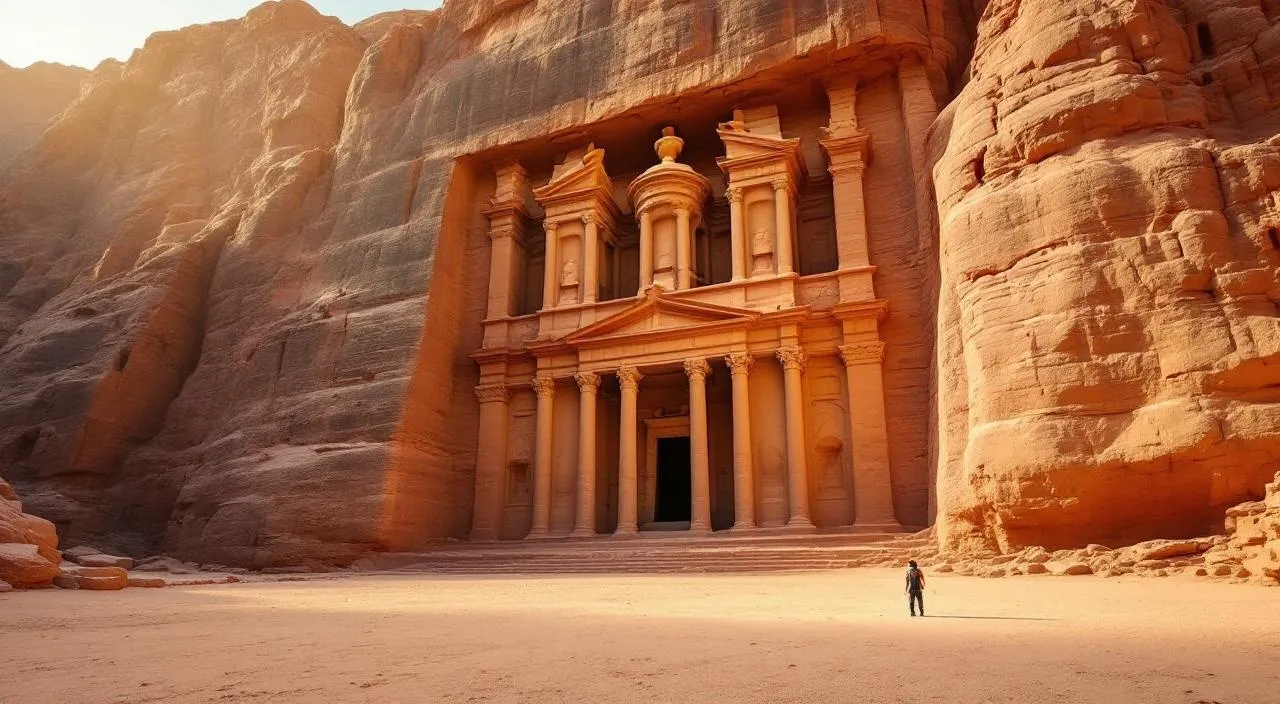
| Distance from Visitor Centre | ~3 km, plus the 850-step climb |
| Climb time | 45–60 min up, 30–40 min down |
| Entry | Covered by the standard Petra ticket (around 50 JOD, 1-day) |
| Best light | Afternoon, 2–5pm — the facade faces west |
| Difficulty | Moderate — sustained stairs, no technical climbing |
The Monastery: Petra’s overlooked centrepiece
When most people picture Petra they picture the Treasury (Al-Khazneh) — the narrow-columned facade at the end of the Siq that has appeared in Indiana Jones, countless travel advertisements and a thousand Instagram grids. But the Treasury is not the largest carved monument in Petra. That distinction belongs to the Monastery, Ad Deir, hidden at the far northwest corner of the site at the top of 850 steps.
At 47 m high and 48.3 m wide, the Monastery facade is larger than the Treasury in every dimension. Where the Treasury rewards a quick reveal at the end of the Siq, the Monastery rewards patience and physical effort. The fewer visitors who make the climb — typically 30–40% of those who enter Petra — means the terrace in front of Ad Deir offers something increasingly rare in Petra: space to stand and look without elbow contact.
Understanding the Monastery
Name and history
The name “Monastery” is a misnomer applied by early Western travellers who found Byzantine crosses carved into the interior walls and assumed the structure had religious use — but later analysis suggests these were added centuries after the Nabataean construction, possibly by early Christian hermits who sheltered here.
In Nabataean use, Ad Deir was almost certainly a royal tomb or memorial complex for one of the Nabataean kings, possibly Obodas I. The architectural style — Nabataean Baroque, featuring a broken pediment and a central urn — dates the construction to the 1st century BC. The scale suggests royal patronage.
Architecture
The facade is carved from a single massive sandstone cliff face. It shares compositional DNA with the Treasury — columned facade, upper urn — but is unornamented by comparison. Where the Treasury has fine carved reliefs and Hellenistic decorative detail, the Monastery is austere. The rose-coloured sandstone glows in afternoon light; at sunrise the facade is in deep shade.
The single interior chamber is large and bare — approximately 12 m wide by 10 m deep — with no carved decorations surviving beyond the Byzantine crosses. The door opening is 8 m tall.
The climb: route from Qasr al-Bint
The standard route to the Monastery begins at Qasr al-Bint — Petra’s large free-standing temple on the main colonnaded street. A signposted path leads northwest from Qasr al-Bint, climbing steadily into a widening wadi before the staircase begins.
Stage 1: Qasr al-Bint to the wadi (0.5 km, flat)
A flat walk through the valley floor, passing the monument of Triclinium and Basin Restaurant on the left. The path is wide and clear. The Monastery is not yet visible — it hides behind the ridge until you are almost upon it.
Stage 2: The staircase (850 steps, 45–60 minutes)
The staircase begins where the wadi narrows and steepens. Steps are cut into the sandstone cliff, roughly 30–40 cm high in places, worn smooth by decades of foot traffic. The staircase is continuous — no particularly dramatic rest points until the upper third, where a Bedouin tea stall has established itself on a ledge (excellent timing for a rest).
Character of the climb: Sustained rather than sudden. The gradient is not extreme but the step height and the uneven surface require focus. The stairs are open to sun from the east until mid-morning; afternoon climbers bake on this section in summer.
What to see on the way up: The sandstone walls narrows and colours intensify as you climb — banded purple, cream and rose in the rock faces. Small niches and carved channels appear in the cliff sides — water-collection systems and votive niches from the Nabataean period.
Stage 3: The top and the Monastery terrace
The stairs emerge onto a wide sandy terrace directly in front of the Monastery facade. The scale of the monument becomes apparent only at this moment — photographs taken from here do not convey the feeling of standing in front of something 47 m tall that has been carved from a single cliff face.
The terrace has a Bedouin-run café on the right, with simple plastic chairs, coffee, Bedouin tea and snacks. The view from the café terrace extends southwest — past the Monastery’s shoulder and over a vast eroded landscape dropping toward Wadi Araba. On clear days, the Negev hills of Israel are visible in the distance.
Views from the Monastery level
The views from the Monastery terrace are among the best in all of Petra. Unlike the High Place of Sacrifice, which looks down into the main Petra basin, the Monastery terrace looks out of the basin entirely — west over the desert plateau, south toward the Wadi Rum direction, and back east across the convoluted canyon system that hides Petra from the outside world.
A short scramble on the path north of the Monastery terrace — 10 minutes of rocky walking — leads to a cliff-edge viewpoint directly above Wadi Araba. On a clear morning the Dead Sea is visible 60 km to the north.
Timing and the light
Best light for photography: The Monastery’s facade faces west. It is in deep shade in the morning and receives direct sunlight from approximately 2 pm onward. Afternoon light (2–5 pm) illuminates the rose sandstone most dramatically. If you can arrange to be at the Monastery in the two hours before sunset, the orange-to-red shift in the facade colour is extraordinary.
Best light for the terrace view: Morning (8–10 am) gives a clear, cool atmosphere for the westward panorama.
Crowd management: Weekday mornings before 10 am are the quietest time at the Monastery. The crowds build after late morning as day-trippers arrive from Amman. School holidays and October–November peak season bring the highest traffic.
Donkeys and horses on the Monastery trail
Donkeys and horses are offered for the Monastery climb from various points in the lower Petra site. They can take you approximately to the foot of the staircase (the point where the wadi narrows) but no further — the stepped staircase is impassable for animals.
If you use an animal for the lower section, allow 30–40 minutes for the ride plus the full staircase walk. Always agree the price before mounting — 10–20 JOD for the lower section is typical.
Travellers with knee problems or limited walking ability who cannot manage 850 steps should note that the Monastery is genuinely inaccessible without climbing. The High Place of Sacrifice has a similar step count but a shorter overall distance. Neither is easily avoided if significant altitude gain is a concern.
Guided tours
A guided tour that covers the Monastery route provides context for the Nabataean engineering, the religious history of the monument and the flora on the cliff faces. The Petra 3-hour private guided tour with hotel pickup can be tailored to prioritise the Monastery; ask specifically when booking. For visitors coming from Amman, the Petra private day trip from Amman offers a full-day format with flexible routing.
Alternative approach: the Petra back door
Rather than climbing from Qasr al-Bint, experienced hikers can approach the Monastery from above via the Petra back door route — a 6 km trail from Little Petra through a desert ravine that arrives at the Monastery terrace from the top. This approach is more physically demanding but produces the most dramatic reveal: the Monastery’s upper pediment appears as you emerge from the ravine, before you see the full facade.
Petra entry ticket
A valid Petra ticket is required. The Jordan Pass covers Petra entry for visitors who spend at least 3 nights in Jordan (the condition is important — check jordanpass.jo for current terms). The ticket must be purchased at the Visitor Centre in Wadi Musa; there is no ticket sales point at the Monastery trail.
| Ticket | Cost |
|---|---|
| 1-day Petra | 50 JOD |
| 2-day Petra | 55 JOD |
| Jordan Pass (Wanderer, 2-day Petra) | 75 JOD total |
See our Jordan Pass guide for the full value calculation.
Combining with a 2-day Petra visit
The Monastery is a full half-day commitment (allow 3–4 hours for the climb, terrace time and descent). For a 2-day Petra visit, the Petra 2-day overnight tour from Amman provides structured coverage of both days — including the Monastery on day two — with accommodation in Wadi Musa arranged. The classic DIY split is:
- Day 1: Enter via main Siq, Treasury, High Place of Sacrifice, Royal Tombs, Colonnaded Street
- Day 2: Monastery in the morning (arrive before crowds); Petra back door route in the afternoon for those with energy
This split avoids attempting both major climbs in a single day, which is feasible but exhausting.
What to bring
- 2 litres of water minimum (1.5 litres for the climb + 0.5 litres for the terrace visit)
- Sturdy closed-toe shoes with grip (no flip-flops)
- Hat and sun protection
- Small snack for the Bedouin café stop mid-climb (Jordanian tea is 1–2 JOD per glass)
- Petra ticket (already stamped at the main gate)
- Camera (don’t miss the afternoon facade light)
Understanding the Monastery’s architecture
The Monastery (Ad Deir) is a Nabataean monument of the Classical period — roughly 1st century BC to 1st century AD. It belongs to the “Nabataean Baroque” architectural style that represents the mature development of Nabataean carved architecture, distinguished from earlier simpler facades by the introduction of the broken pediment (a triangular pediment interrupted in the centre by a round element, usually an urn) and by the increasing use of Hellenistic decorative vocabulary.
The facade composition: At the ground level, four half-columns and two pilasters (flat columns embedded in the wall) frame a large central doorway. The columns rest on low plinths and carry Nabataean capitals — a local adaptation of the Corinthian capital with stylised acanthus leaves.
Above the cornice, the intermediate zone has a rectangular attic register containing smaller columns and niches. The broken pediment above this frames the central urn (tholos) at the apex — the signature element of Nabataean Baroque.
The urn atop the Monastery (and the Treasury) has local interpretive significance. Popular tradition — enhanced by the Indiana Jones film in which the Grail is hidden inside the Treasury urn — holds that treasure is concealed within. The Monastery’s urn shows the scars of this belief: bullet holes, chipping and other damage from treasure-seekers. The urn is, in reality, solid stone carved in situ.
Scale and proportion: The Monastery is designed to be viewed from approximately 60 m — the distance from the carved facade to the terrace edge. At this distance, the classical proportional system (column height related to column diameter related to overall facade height) creates a visual harmony. Standing directly beneath the facade, the proportions feel different — overwhelming rather than harmonious.
Interior: The single large chamber (approximately 12 m wide, 10 m deep) has no interior decoration beyond the Byzantine crosses. The walls show evidence of multiple phases of use: Nabataean carved plaster on the lower walls (largely gone), Roman-period graffiti, Byzantine additions, and centuries of weathering. In the centre of the rear wall, a carved niche may have held a divine image in the Nabataean period.
The Monastery in the context of Petra’s complete site
The Monastery is the furthest significant monument from the main Visitor Centre — roughly 3 km from the Siq entrance, plus the 850-step climb. This distance filters the casual visitor and means the Monastery is always quieter than the Treasury, even in peak season.
Petra’s major monuments, in order of distance from the Visitor Centre:
- Treasury (Al-Khazneh): 1.2 km (end of the Siq)
- Roman Theatre: 1.7 km
- Royal Tombs: 2 km
- High Place of Sacrifice: 2 km (plus 800-step climb)
- Colonnaded Street / Qasr al-Bint: 2.5 km
- Monastery (Ad Deir): 3 km + 850 steps
Understanding this layout helps with planning. The deeper you go into Petra, the fewer people you share the experience with.
The Monastery compared with the Treasury
The inevitable comparison:
| Feature | Treasury | Monastery |
|---|---|---|
| Height | 39 m | 47 m |
| Width | 30 m | 48 m |
| Age | 1st century BC | 1st century BC–AD |
| Interior decoration | None surviving | Byzantine crosses only |
| Orientation | Faces east, morning light | Faces west, afternoon light |
| Crowds | Very high | Moderate |
| Approach | Dramatic Siq reveal | Earned 850-step climb |
| View from monument | Narrow canyon | Open desert panorama |
Neither is “better” — they serve different emotional registers. The Treasury delivers a theatrical reveal after a walk through a dramatic canyon. The Monastery rewards physical effort and stands in a more open, expansive landscape.
Practical notes on the Bedouin café at the Monastery
The café at the top of the Monastery steps is operated by a Bedouin family from the Ammarin tribe. It has been there for many years and serves the standard Bedouin tourist tea (sweet black tea with mint or sage), coffee (bitter cardamom-spiced), water and simple snacks.
There is no menu and prices are not posted. A glass of tea: 2–3 JOD. Water: 2 JOD. It is one of the most atmospherically located cafés in Jordan — plastic chairs and concrete tables notwithstanding.
The family also sells small handicrafts (bracelets, camel figurines, painted stones). The quality of the handicrafts varies; the quality of the conversation is usually higher than the goods. The family has been engaging with international visitors long enough to have accumulated an interesting archive of stories about the Monastery and Petra.
Best months to climb the Monastery
The Monastery’s exposed staircase is one of the most weather-sensitive hikes in Petra. Winter (December–February) brings the coolest climbing conditions — mornings can start near freezing at this elevation, so the ascent itself is comfortable, though very occasionally the site sees the odd dusting of rare Petra winter snow. Spring (March–May) and autumn (September–November) are the most reliable windows: warm enough for a sunrise Treasury visit beforehand, cool enough that 850 steps do not become a struggle.
Summer (June–August) turns the staircase into a genuine endurance test — the east-facing steps bake from mid-morning onward, and climbing after 10am in July or August is not recommended. Our best time to visit Jordan guide covers the wider seasonal picture; for the Monastery specifically, aim to be on the trail by 6:30–7am so you finish climbing before 9am regardless of season.
Frequently asked questions about Monastery hike, Petra
Is the Monastery hike safe for people with vertigo?
Mostly yes. The staircase itself has a rock wall or slope on one side for most of its length and is not narrow or exposed in the way some cliff-edge trails are. The optional 10-minute scramble to the cliff-edge viewpoint north of the terrace is more exposed and can be skipped entirely without missing the main facade view.
Is there any shade on the climb?
Very little. The staircase is largely open to the sky, with brief pockets of shade from overhanging rock in a few sections. The Bedouin tea stall roughly two-thirds of the way up is the most reliable shaded rest point.
Is the Monastery taller than the Treasury?
Yes. The Monastery (47 m high, 48.3 m wide) is larger in both height and width than the Treasury (39 m high, 30 m wide). It is the largest carved monument in Petra. It is less ornately decorated but more monumental in scale.
How long does the Monastery hike take in total from the Visitor Centre?
Allow 4–5 hours: 30 minutes from the Visitor Centre to Qasr al-Bint (via the Siq, which is already done on entry), 1 hour to climb to the Monastery, 30 minutes at the top, 45 minutes to descend, 30 minutes back through the site.
Is there a café at the Monastery?
Yes — a Bedouin-operated café on the terrace directly beside the Monastery serves coffee, tea, water and simple snacks. One of the most atmospheric tea stops in Jordan. Cash only; no fixed menu price — typically 2–3 JOD for tea or coffee.
What is the best camera lens for the Monastery facade?
A 24 mm or wider is needed to capture the full facade in a single frame from the terrace. At the standard viewing distance (approximately 60 m from the facade) a standard 35 mm lens cuts off both columns at the top. For detail shots of the urn and carved elements, 100–200 mm works well.
Can I visit the Monastery without having previously seen the Treasury?
Yes — Petra entry allows access to all monuments within the site boundary. You can skip the Treasury and go directly to the Monastery route, though most visitors find the Treasury approach (through the Siq) one of the most memorable single moments in travel and prefer to do it first.
From Amman: private day trip to Petra with pickup
Visiting Petra from Amman on a day trip? This private full-day tour includes transport, a licensed guide and the flexibility to prioritise the Monastery route.