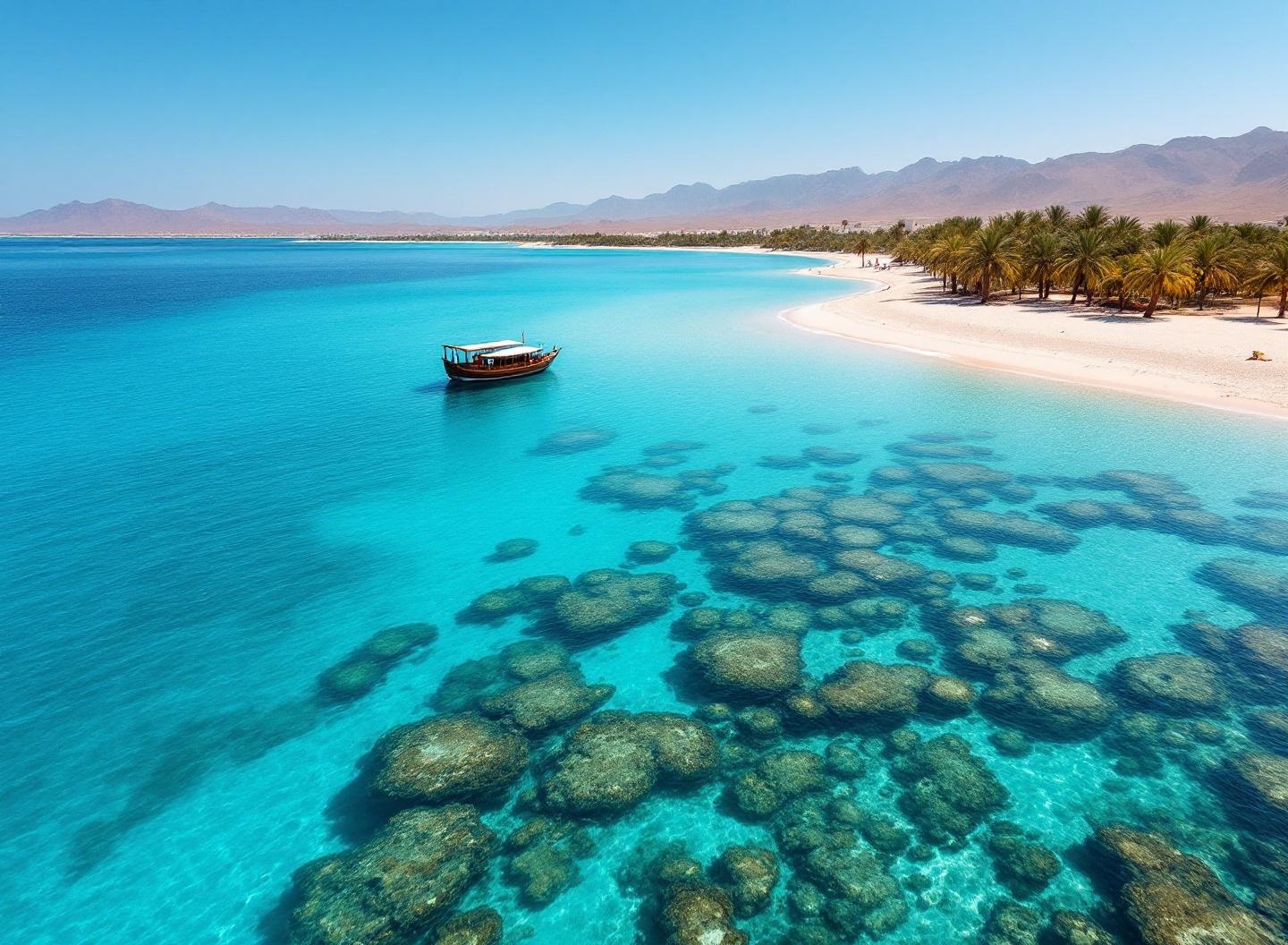
| Where | South coast road, 7 km south of Aqaba city centre |
| Cost | Free shore access; boat trips/dives from around 20–40 JOD |
| Time needed | 45 minutes minimum, half a day for a full dive/snorkel session |
| Getting there | Taxi 5–7 JOD, or self-drive with free parking |
| Best time | Before 10 am, weekday mornings, winter for best visibility |
What makes the Japanese Garden special
The name came from early divers who thought the neat coral formations — low sprawling tables of Acropora, rounded brain corals and upright pillars of Porites — resembled the ordered beauty of a Japanese garden. Whether the analogy holds up is debatable, but the reef itself is undeniably beautiful.
Situated at the southern end of the Aqaba Marine Park boundary, Japanese Garden is both the most accessible dive site in Jordan and, arguably, the most rewarding for first-time visitors. It serves as the primary Discover Scuba Diving site for most of Aqaba’s dive centres, and it doubles as an exceptional snorkeling spot that requires no certification at all.
The site forms part of the broader underwater landscape described in our Aqaba diving guide. Combined with the Cedar Pride wreck — visible from the same stretch of road — it makes a perfect two-site morning for newly certified divers.
Location and how to get there
GPS coordinates: approximately 29.40°N 34.98°E — on the south coast road (King Hussein Street), 7 km south of Aqaba city centre.
There is a signposted turning and a small car park adjacent to the entry point. The entry itself is concrete steps descending directly into the water — there is no sandy beach. Water shoes or dive booties are essential; the coral rubble and concrete ledge are hard on bare feet.
Getting there:
- Taxi: 5–7 JOD from central Aqaba. Agree on the price in advance or use the Careem app.
- Tour operator: Most snorkeling boat trips include a stop at Japanese Garden. Many operators also offer guided shore-dive packages with equipment pickup.
- Self-drive: Ample free parking. Follow the south coast road south past the Marine Park gate.
Depth and site topography
The reef starts almost immediately below the entry steps in as little as 1.5 m of water. The bottom profile is a gentle slope:
| Zone | Depth | Character |
|---|---|---|
| Inner fringing reef | 1–6 m | Dense coral garden, snorkeler zone |
| Main reef plateau | 6–12 m | Open water corals, most marine life |
| Outer slope | 12–20 m | Wall start, sea fans, deeper fish |
| Deep wall | 20 m+ | Typically a second dive / advanced |
For most recreational divers and all snorkellers, the 6–12 m plateau is where the Japanese Garden earns its reputation. The sea floor here is covered in a mosaic of hard coral species — table corals (Acropora hyacinthus), brain corals (Platygyra), massive Porites boulders — interspersed with fire coral, gorgonian fans and patches of soft coral.
Marine life: what to expect
Japanese Garden is not a pelagic dive — you won’t encounter sharks or rays reliably here. What it offers instead is extraordinary reef biodiversity at accessible depth.
Fish life (reliably seen):
- Pufferfish (Arothron spp.) — often stationary on the coral, easy to photograph
- Lionfish (Pterois miles) — resting on coral rubble; do not touch
- Scorpionfish — camouflaged, watch your hands
- Blue-spotted stingray — common in the sandy patches
- Moray eels (giant and undulate) — in coral crevices
- Schools of glassfish (Atherinidae) — clouds of silver around coral heads
- Parrotfish — crunching coral throughout the dive
- Surgeonfish, wrasse, triggerfish in abundance
Invertebrates:
- Carpet anemones with resident anemonefish (clownfish)
- Sea urchins under ledges (avoid contact)
- Octopus under coral heads (twilight and night)
- Nudibranchs (seasonal, spring best)
Turtles: Rare but reported, especially on early morning dives. More likely on the outer slope below 15 m.
Best time to dive or snorkel
Time of day: Before 10 am consistently delivers the best conditions. Later in the day, boat traffic increases (both pleasure boats and dive boats) and visibility can drop marginally from the disturbed water column.
Season: The Japanese Garden can be visited year-round. Winter (November–March) brings the best visibility — sometimes exceeding 40 m — and the water temperature of 22–23°C requires a 3 mm wetsuit. Spring (April–May) combines comfortable air temperature with still-excellent water clarity. Summer (June–October) is workable but the midday heat on the surface is intense (38–42°C); early morning dives are strongly preferable.
Day of week: Friday afternoon and Saturday are the busiest days for local visitors. Weekday mornings see the least traffic.
Facilities and what to bring
The Japanese Garden car park has no permanent facilities — no toilets, no shade canopy, no equipment rental, no food or drink vendors. This is a practical, no-frills entry point.
What to bring:
- All equipment (mask, fins, wetsuit or rash guard, BCD if diving)
- Water shoes or dive booties (mandatory)
- At least 2 litres of water per person
- Reef-safe sunscreen (mineral/zinc oxide — chemical sunscreens damage coral)
- Dive flag if doing an independent dive
- Cash for the Marine Park mooring fee (paid by the operator if you are on a guided tour)
Equipment rental from nearby dive shops: call ahead to arrange, or hire equipment from your hotel dive centre and drive south.
Snorkeling at Japanese Garden
Unlike many dive sites that are anti-climactic from the surface, Japanese Garden delivers a genuine experience for snorkellers. The inner reef at 2–5 m is colourful and busy with fish life. You can float over the coral plateau and observe almost everything the reef has to offer.
The Red Sea snorkeling boat trip with buffet lunch typically includes Japanese Garden as its first stop, which allows non-divers to experience the site with a guide in the water. For independent snorkellers, the shore entry is completely free.
Key snorkeling tips:
- Stay in the 2–5 m zone where coral cover is densest
- Swim north along the reef edge for best variety
- Do not stand on the coral — hover and fin slowly
- Visibility is best in the first two hours after sunrise
Diving Japanese Garden with an operator
For first-time divers, Japanese Garden is the standard choice for guided dives and Discover Scuba Diving sessions. The shallow, calm conditions and rich marine life make it ideal for people trying scuba for the first time.
For experienced divers, Japanese Garden is usually combined with a deeper second site — Power Station, Black Rock or the Cedar Pride wreck — in a two-tank boat-dive package. The private Red Sea diving tour from Aqaba can be customised to include Japanese Garden as the first tank.
Certified divers preferring a boat departure to avoid the step entry may prefer the 2 boat dives package for certified divers , which includes all equipment and typically covers Japanese Garden plus one deeper site.
Conservation rules at Japanese Garden
Japanese Garden falls within the Aqaba Special Economic Zone and is covered by the Aqaba Marine Park regulations:
- No anchor dropping. Operators must use designated mooring buoys.
- No touching or collecting. All coral, fish and invertebrates are protected.
- No fishing. The entire 17 km stretch of the Marine Park is a no-take zone.
- No feeding fish. Disrupts natural behaviour and ecosystem balance.
- Reef-safe sunscreen. Encouraged by the Marine Park; increasingly enforced.
Fines for violations range from 50 to 500 JOD depending on severity.
Japanese Garden vs other Aqaba sites
| Site | Depth | Access | Best for |
|---|---|---|---|
| Japanese Garden | 6–15 m | Shore/boat | Beginners, snorkellers |
| Cedar Pride | 25–30 m | Shore/boat | Advanced, wreck divers |
| Power Station | 5–40 m | Shore | Intermediate+ |
| Black Rock | 10–30 m | Shore | Macro photography |
| First Bay | 0–18 m | Shore | Night diving |
| The Tank | 6 m | Boat | Snorkellers, DSD |
For a complete comparison of all Aqaba dive sites, see our Aqaba diving guide.
Combining Japanese Garden with the rest of Aqaba
A typical day at Japanese Garden finishes by midday, leaving the afternoon free. Options include:
- Afternoon snorkeling boat trip from the marine park area
- Petra day trip — Aqaba to Petra is 2 hours by road; possible as a day trip though demanding
- Wadi Rum — 1 hour north of Aqaba. The Wadi Rum overnight camp guide covers the best camps for an evening arrival
- Berenice Beach Club — 5 minutes south for a beach afternoon after a morning dive
Japanese Garden in the context of Aqaba’s reef system
Japanese Garden is the shallowest and most accessible of the Aqaba Marine Park’s major sites, but understanding where it fits in the reef geography helps with planning.
The site sits at the northern end of the Aqaba Marine Park protected zone. The reef in this location is a fringing reef — a reef that grows directly from the shoreline out to the deeper water, with no lagoon barrier. This means the transition from land to productive reef is almost immediate: two steps down the concrete entry, and you are in coral.
The fringing reef at Japanese Garden extends south along the coast, connecting without interruption to the Power Station site, then further to the Black Rock and Gorgonian sites. Japanese Garden therefore functions as the northern gateway to a continuous reef ecosystem that runs 17 km to the Saudi border.
The garden’s history and naming
Early sport divers in Aqaba in the 1970s gave this site its name. The precise origin story has several versions depending on who you ask, but the consensus is that a group of Jordanian and European divers thought the arranged coral formations — not the dense tangle of Australian or Maldivian reefs, but orderly, spaced clusters of massive corals on an otherwise sandy plateau — resembled the deliberate arrangement of a Japanese garden’s elements.
The name stuck, and the site has been the starting point for generations of first-time Red Sea divers.
Night diving at Japanese Garden
First Bay gets most of the night-dive traffic in Aqaba, but Japanese Garden is also excellent after dark. The transformation between day and night on the reef is one of the most dramatic in diving:
- Parrotfish find a rock crevice and secrete a mucus cocoon around themselves — you can see them sleeping in their transparent sleeping bags
- Octopus emerge from under coral heads and hunt actively, changing colour and texture in seconds
- Moray eels leave their daytime crevices and hunt the reef openly
- Brittle stars unfold their five arms and cover the reef surface
- Crown-of-thorns starfish (occasionally) move slowly across the coral in search of coral polyps
Night diving at Japanese Garden requires prior arrangement with an operator (not accessible independently at night — too close to boat traffic). Cost: approximately 10–15 JOD supplement on a regular dive fee. A good dive torch is essential; a backup torch recommended.
Underwater photography at Japanese Garden
Japanese Garden is one of the best underwater photography sites in Aqaba for one specific reason: the subjects don’t move. Lionfish, scorpionfish and pufferfish are famously unafraid of divers and photographers. They sit. They pose. They remain exactly where you found them while you compose your shot and adjust your strobe angle.
Recommended equipment:
- Macro lens (60 mm or 100 mm): For nudibranchs, ghost pipefish and small reef inhabitants
- Wide angle (10–17 mm zoom): For reef panorama and large coral formations
- Single or twin strobes: Necessary below 8 m to restore colour
- Red filter: For video in the 3–8 m zone where ambient blue light dominates
Best shots at Japanese Garden:
- Pufferfish full face: position yourself at eye level, get within 40–50 cm. Pufferfish are tolerant enough to allow this with slow approach.
- Lionfish in coral: backlight with strobe on the coral, allow the fish’s fins to extend fully
- Brain coral macro: the surface texture of Platygyra brain coral is extraordinary at 1:1 magnification
- Anemonefish in anemone: classic shot, requires patience to catch the fish mid-swimming rather than retreating into the tentacles
Environmental pressures and conservation at the site
Japanese Garden is among Aqaba’s most resilient reef sections — but resilience is not immunity. The site experienced partial bleaching in 2015 and 2019 during periods of abnormally warm water (above 30°C surface temperature). Surveys after each event showed less than 20% coral mortality at Japanese Garden compared to some unprotected sites where mortality exceeded 50%.
The Marine Park management credits the lower bleaching impact to several factors:
- Less boat anchor damage before bleaching (bleached corals have no secondary stress from physical damage)
- Healthier overall colony size means more reserve energy for recovery
- The site’s depth range (1–20 m) allows deeper colonies to provide a natural seed bank for recovery
Visitors can contribute to conservation by using reef-safe sunscreen (mineral/zinc oxide formulations), not touching any coral, and using operators who use the designated mooring buoys.
Practical guide: planning a Japanese Garden visit day-by-day
Whether you are staying in Aqaba for one day or three, the Japanese Garden fits into different itinerary formats.
Single day in Aqaba (diving focus): Rise early, arrive at Japanese Garden by 7:30 am for a 45-minute shore snorkel before the day warms. By 9 am, join a boat dive to Japanese Garden’s outer slope (tank 1) then Cedar Pride wreck (tank 2). Back at the dock by 1 pm. Afternoon at Berenice Beach Club. This format covers Japanese Garden from two perspectives — surface and scuba.
Single day in Aqaba (non-diver): Morning snorkel at Japanese Garden (7:30–9:30 am, shore). Book the snorkeling boat trip with buffet lunch departing 10 am, which visits Japanese Garden again plus additional sites with a buffet. Return to shore by 1:30 pm. Afternoon free.
Day trip from Petra or Wadi Rum: Aqaba is 2 hours from Petra and 1 hour from Wadi Rum. A morning departure from Petra reaches Aqaba by 10 am — enough time for a 2-hour boat snorkel tour and lunch before the drive back. The Japanese Garden shore visit is the easiest addition for very limited time: 45 minutes minimum in the water, 20 minutes drive time each way.
For course participants: PADI Open Water students typically do two confined-water pool sessions (Day 1) and two open-water dives at Japanese Garden (Days 2–3). Being based at a hotel near the south beach reduces the daily commute to the site.
Frequently asked questions about Japanese Garden dive site, Aqaba
Is Japanese Garden suitable for absolute beginners?
Yes — it is the standard Discover Scuba Diving site for most Aqaba operators. The depth stays under 12 m in the main zone, conditions are calm and the marine life reward is immediate.
Can I snorkel without a guide?
Yes. Shore access is free and there is no requirement for a guide for snorkelling. Experienced snorkellers regularly self-guide at Japanese Garden. Children should always be supervised.
Is there parking at the Japanese Garden site?
Yes — a small free car park adjacent to the entry steps. Space is limited; arrive early on busy days to secure a spot.
How long does a typical dive last at Japanese Garden?
Most divers log 50–70 minutes at Japanese Garden on a 12-litre tank, depending on depth and breathing rate. Shallower dives (6–9 m) can last up to 80 minutes.
What is the water entry like for non-divers?
The concrete steps descend to a narrow ledge above the water. You step in from about knee height — manageable for most adults and teenagers. Children and elderly visitors may prefer a boat entry option. Water shoes are essential.