| Where | Starts at the Roman Theatre, inside Petra |
| Cost | Included in standard Petra entry / Jordan Pass |
| Time needed | 2–3 hours round-trip |
| Difficulty | Moderate — 800+ uneven rock-cut steps |
| Best time | Early morning ascent, late-afternoon light at the top |
What is the High Place of Sacrifice
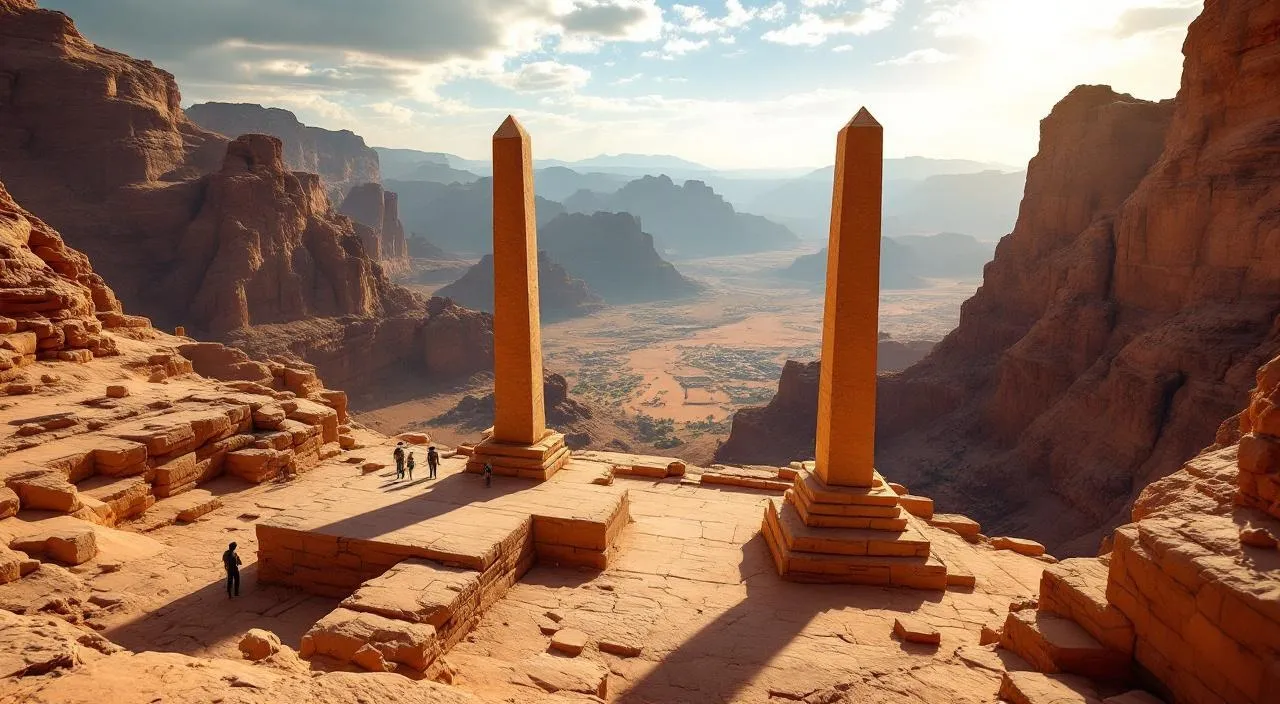
The High Place of Sacrifice (Al-Madhbah in Arabic) is a Nabataean ritual complex at the summit of Jabal Madbah — one of the ridges rising above Petra city. It consists of a rectangular platform with a drainage channel, two altars (one for burnt offerings, one for libations), an obelisk platform above it, and a series of cisterns and processional pathways carved from the summit rock.
It was used by the Nabataeans, the desert trading kingdom that built Petra, for religious ceremonies. Whether these involved animal sacrifice, ritual libations or more complex astronomical observations is a matter of ongoing archaeological debate. What is not debated is the strategic genius of the site’s position: the High Place commands a 360-degree view over all of Petra, a location that would have given these ceremonies immense visible authority.
Today it is one of the most visited secondary sites within Petra after the Treasury and the Monastery — and one of the few that rewards the physical effort of reaching it with a genuinely significant archaeological site at the top, not just a viewpoint.
The climb: what to expect
Route from the Roman Theatre
The ascent begins at the Roman Theatre — the large carved amphitheatre cut into the cliff face that you see approximately 30 minutes after entering the main Siq. The staircase to the High Place starts at the base of the theatre’s south side, clearly signposted.
The 800+ steps are rock-cut into the sandstone cliff face. They are uneven, worn smooth in places and sometimes steep. The average fit person takes 45–60 minutes to reach the top without rushing. The steps are exposed to sun for most of the climb — an early morning start (before 9 am in summer) is strongly recommended.
Physical demand: Moderate. The steps are continuous but there are natural resting points. Anyone who can manage a long staircase in a museum should manage this. Trekking poles help with stability on the worn sandstone.
Footwear: Closed-toe shoes with grip are essential. Flip-flops and sandals are inadequate on the descent.
Views from the top
The summit of Jabal Madbah rises to approximately 1 050 m — not the highest point in the Petra area (Jebel Haroun is higher at 1 350 m) but positioned centrally enough to give views of the entire Petra basin. On clear days the panorama extends to Wadi Araba in the west and the Shara mountains in the east.
From the top you can orient yourself within Petra in a way that is impossible at ground level: the Treasury is visible to the north (though at an angle, not with the famous frontality); the Monastery ridge to the southwest; the Royal Tombs to the east. The scale of the city — vast and hidden in plain sight within these eroded mountains — becomes apparent for the first time.
The ritual platform
The High Place itself consists of:
- Main altar: A rectangular depression in the rock with a channel carved around the perimeter for draining blood or liquid offerings
- Obelisks: Two free-standing obelisks carved from the mountain above the altar platform — unusual in Nabataean architecture
- Libation altar: A second, simpler altar adjacent to the main platform, likely for pouring wine or oil
- Cisterns and channels: The Nabataeans were master water engineers; the complex shows evidence of elaborate water collection from the rock surfaces
Signage: RSCN information panels at the site explain the known archaeological interpretations without overreaching. They are worth reading before descending.
Time to allow
| Activity | Time |
|---|---|
| Ascent from Roman Theatre | 45–60 min |
| Exploring the High Place complex | 30 min |
| Descent via Lion Triclinium route | 45–60 min |
| Total round-trip | 2–3 hours |
Add more time if you photograph extensively or want to wait for optimal light on the views.
The descent: Lion Triclinium route
The most rewarding aspect of the High Place visit is not the climb up — it is the descent on the western side, which leads through a series of rock-cut monuments that most visitors never see because they climb and descend on the same staircase.
The western descent passes:
Lion Triclinium: A carved facade with two lion reliefs flanking the entrance — a rare motif in Petra’s iconography. The interior is a triclinium (dining room) used for memorial feasts. Less ornamented than the Treasury but quietly impressive in its isolated position.
Garden Triclinium: A larger carved complex with a natural garden area adjacent, fed by a spring. Shaded and cool even in summer, with a small pool area.
The Roman Soldier Tomb complex: Three tombs with a notable facade featuring a soldier in Roman armour — an unusual reference to Roman cultural influence in Nabataean art. Adjacent triclinium has a rare preserved interior ceiling decoration.
Wadi Farasa: The descent continues down a sandstone gorge lined with additional tomb facades, water channels and Nabataean graffiti. The gorge floor has a seasonal stream bed and natural shade. This is the quietest, most atmospheric section of Petra for those who find the main colonnaded street overcrowded.
The western descent exits near Qasr al-Bint and the main colonnade street — returning you to the heart of the site from the western direction.
Guided tours including the High Place
A guided Petra tour that includes the High Place of Sacrifice covers the climb, the archaeological context of the ritual platform and the descent via the Lion Triclinium. A good guide makes the difference between a puzzling scatter of carved stone and a coherent understanding of Nabataean religious practice.
The Petra 3-hour private guided tour with hotel pickup is the best standalone option for visitors who want professional context for the High Place and main site without a full-day commitment. For visitors coming from Amman, the Petra private day trip from Amman covers both the main Siq and the High Place within a full-day format.
Practical tips
Water: The climb is exposed and dehydrating. Carry at least 1.5 litres. There is no water source between the main colonnaded street and the summit.
Sun protection: The staircase faces south and receives direct sun until early afternoon. Hat and sunscreen are essential.
Timing: The optimal combination is to walk through the Siq and past the Treasury (morning light on the facade is best before 11 am), then climb to the High Place (11 am–1 pm in cooler months; 8–10 am in summer), and descend via the Lion Triclinium to the main site for a late lunch at the Basin Restaurant.
Return from the High Place: If doing the same-direction descent (back via the staircase instead of the western route), leave enough knee energy — the worn sandstone steps are harder to descend than ascend.
Petra’s other high places and sacred sites
The High Place of Sacrifice is the most accessible and best-preserved of Petra’s several elevated sacred sites, but it is not unique. The Nabataeans created multiple high places throughout the Petra area, each serving ritual functions in the city’s religious landscape.
Zibb Atuf high place: Located further south on the Jabal Madbah ridge, this smaller site has two obelisks cut from the rock (as opposed to the High Place’s obelisks slightly above it). These obelisks are unusual in Nabataean architecture and their specific function debated — possibly boundary markers, possibly cult objects representing deities.
The Deir Plateau: The plateau above the Monastery (Ad Deir) contains several smaller ritual installations — carved niches, libation channels and the remains of a sacred precinct that archaeologists have not fully mapped. The Petra back door approach passes through the edge of this area.
Golden hour at the summit: If timing your visit around light matters, our golden hour at Petra guide explains exactly when the Treasury and Monastery catch direct sun — useful for sequencing the High Place climb around the best photography windows elsewhere in the site.
Jebel Haroun (Aaron’s Tomb): The highest point in the Petra region at 1 350 m, visible as a white dome from much of the site. According to Islamic, Jewish and Christian tradition, this is the burial site of Aaron, brother of Moses. A Muslim shrine sits at the summit; pilgrims from the region visit throughout the year. Reaching the summit requires a full-day hike (4–5 hours each way from the main Petra site) and significant fitness. A guide is essential.
Conway Tower: At the southeastern edge of the Petra basin, a small circular tower with unclear function — possibly a watchtower, possibly a religious installation. The view from this tower encompasses the entire site and is significantly less visited than the High Place or the Monastery.
The Roman Theatre: context before the climb
The Roman Theatre is where the High Place ascent staircase begins, and it merits 20–30 minutes before you start climbing.
The theatre is entirely rock-cut — the seating tiers are carved from the sandstone hillside rather than constructed. This is consistent with Nabataean engineering practice: they would always use the existing rock rather than build from scratch if the geometry worked. The theatre seats approximately 8 500 people, placing it among the larger theatres in the Roman East (though not the largest — Bosra in Syria has a better-preserved theatre seating 15 000).
The theatre is well-documented as Nabataean in origin, later modified by the Romans after 106 AD. The cavea (seating area) has clear Nabataean-era phase markings. The stage building (scaena frons) visible today is largely a Roman reconstruction.
Behind the theatre, cut into the same hillside, are the Royal Tomb facades — the Urn Tomb, Silk Tomb, Corinthian Tomb and Palace Tomb. These can be visited before or after the High Place climb. The Urn Tomb is the largest and most impressive; its interior chamber (converted to a Byzantine church in 447 AD, evidenced by a Greek inscription above the entrance) is open to the air and acoustically unusual.
Combining with the Monastery
Ambitious hikers who want to combine the High Place with the Monastery climb in a single day should plan carefully. Both are significant climbs and doing them both comfortably requires an early start, good fitness and a full day ticket.
A recommended sequence for a 2-day Petra visit: Day 1 — Siq, Treasury, High Place of Sacrifice via western descent, Royal Tombs. Day 2 — Petra back door via Little Petra, Monastery, and the lower city. Visitors wanting to combine both Petra days with comfortable Wadi Musa accommodation and a private guide can book the Petra 2-day overnight tour from Amman to handle the full package.
The Nabataeans and sacrifice: what we know
The “High Place of Sacrifice” name has always been slightly presumptuous — archaeologists debate the exact function of the site. The physical evidence is clear enough: drainage channels for liquid, an altar platform with contained perimeter, a secondary altar for a different type of offering. What was sacrificed, and in what context, is less certain.
The Nabataeans left almost no written texts about their religion. What scholars piece together comes from references in Diodorus Siculus and other classical authors, from the physical evidence of sacred sites, and from comparative religion — examining how neighbouring peoples (Phoenicians, Egyptians, Edomites) conducted similar rituals.
What is generally accepted:
- Animal sacrifice formed part of Nabataean religious practice, as it did for most ancient Semitic cultures
- The drainage channel and perimeter groove were designed to contain and direct blood or other liquids away from the ritual platform
- The secondary altar was likely used for libation offerings — wine, oil, water — poured in honour of the deity
- The site’s elevated position was deliberate — proximity to the sky and remoteness from the everyday city were important components of Nabataean sacred geography
- Allat, Dushara and Al-Uzza were the principal Nabataean deities; the High Place may have been associated with Dushara, the chief male deity
The site was also a meeting point with the divine through shared meals — triclinia (dining halls) appear throughout Petra’s religious landscape, where the community consumed sacrificial offerings in a communal feast that renewed the covenant between people and god.
The descent via Wadi Farasa in detail
The western descent from the High Place through Wadi Farasa is a complete archaeological trail in itself. Walking it slowly with the following in mind transforms it from a descent route into one of Petra’s most informative walks.
Lion Triclinium: The two lion reliefs flanking the entrance are eroded but still clearly legible. Lions were associated with the Nabataean goddess Al-Uzza, who had lion attributes (sometimes depicted with lion-headed faces). Their placement at a triclinium entrance suggests the building may have been dedicated to her cult. The interior chamber is well-preserved — standing inside and looking up at the carved ceiling gives a sense of the enclosed, theatrical quality that the Nabataeans created in their rock-cut spaces.
The Egyptian Cistern: Carved into the cliff face above the Wadi Farasa path, an extensive cistern system served the garden area and the resident population of this part of the city. A carved channel directs runoff from the cliff face above into the cistern opening — a typical Nabataean passive water collection design.
The Garden Triclinium complex: The largest building in the Wadi Farasa descent. The natural spring here (currently reduced to a seep but once more substantial) made this location particularly valuable — water in the desert equals power. The triclinium was probably used for banquets associated with the nearby tombs, with spring water available for ritual purification.
The Roman Soldier Tomb: The three-facade complex with the Roman soldier relief is one of Petra’s most unusual monuments. The soldier is depicted in Roman military dress — segmented armour, gladius at hip — in a Nabataean carved context. This is not a Roman monument; it is a Nabataean monument incorporating Roman iconography, probably from the 1st century AD when Roman cultural influence was penetrating Petra before the formal Roman annexation in 106 AD.
Wadi Farasa gorge: The lower section of the descent follows a natural gorge with sandstone walls that display spectacular colour banding. In spring, the gorge holds a seasonal stream, and the walls are covered in water-dependent plants — maidenhair fern, creeping plants in the rock crevices. The sound of water in this section stands in sharp contrast to the dry heat of the High Place above.
What to eat and drink in Petra
The High Place descent via Wadi Farasa exits near Qasr al-Bint, which is adjacent to the Basin Restaurant — Petra’s best on-site lunch option. The Basin serves buffet lunch (approximately 20 JOD per person) and is one of the few places within the site with reliable shade, tables and sanitation. The buffet includes Jordanian staples: mansaf (rice with lamb in yogurt sauce), maqluba (upside-down rice), salads, and fresh bread.
For visitors on a budget, a simpler option is the Bedouin tea and bread stalls scattered throughout the lower city. Hummus with pita bread costs 2–3 JOD and sustains well during a long day.
Water is available for purchase at the Basin Restaurant and at several points along the main colonnaded street. Do not rely on finding water in the canyon sections above the main city.
Frequently asked questions about High Place of Sacrifice, Petra
Is the High Place of Sacrifice the highest point in Petra?
No — Jebel Haroun (Aaron’s Tomb) at 1 350 m is significantly higher and visible from the High Place to the south. Jebel Haroun is a separate 4–5 hour round-trip hike from the main Petra site, considerably more demanding than the High Place route.
Are there donkey rides to the High Place?
Donkeys and horses are offered at various points in Petra. However, the staircase to the High Place is not accessible by animal — the steps are too narrow and steep. Any offers to ride “to the top” involve animals carrying you to the base of the staircase only.
What is the best time of day for photos at the High Place?
Late afternoon (4–5 pm) gives warm, angled light on the altar complex and the best illumination of the valley below. Morning light is cooler and works for the panorama. Avoid midday in any season — harsh overhead light flattens the carved details.
Do I need a guide to find the route?
The ascent staircase is well-signposted from the Roman Theatre. The descent via the Lion Triclinium requires attention to the junction signs. A guide is not essential but makes the descent route significantly easier to follow and provides context for the monuments en route.
Petra: private 3-hour guided tour with hotel pickup
Short on time in Petra? A 3-hour private guided tour covers the Siq, Treasury and High Place of Sacrifice with expert archaeological context — ideal for day-trippers.
Can I visit the High Place of Sacrifice if I only have one day in Petra?
Yes, but you need to prioritise. The High Place adds 2–3 hours to the standard Treasury–Siq visit. If your one day is limited by arrival time (e.g., arriving from Amman at 11 am), choose between the Monastery and the High Place rather than attempting both.
Which is more worthwhile: the High Place of Sacrifice or the Monastery?
Both are worth doing if you have two days, as covered in our one day vs two days in Petra guide. If forced to choose one, the High Place is shorter (2–3 hours vs. 3–4 for the Monastery round-trip), reaches a genuine archaeological site rather than a viewpoint alone, and offers the western Lion Triclinium descent as a bonus. The Monastery facade itself is the larger, more photogenic monument, so photographers with limited time often prioritise it instead.