| Where | Japanese Garden (open water), Tala Bay (static/dynamic training) |
| Cost | Equipment rental around 30–50 JOD/day; courses priced seasonally |
| Best for | Recreational reef exploration to 10–20 m |
| Schools | Freedive Aqaba, Apnea Camp Aqaba |
| Golden rule | Never freedive alone |
Freediving in Aqaba: an honest assessment
Aqaba is not yet a major freediving destination in the way that Cyprus, Egypt’s Dahab or Indonesia’s Tulamben are. That is the honest starting point. The infrastructure for breath-hold diving — dedicated training pools, competition platforms, specialist instructors with deep diving experience beyond 40 m — is still developing.
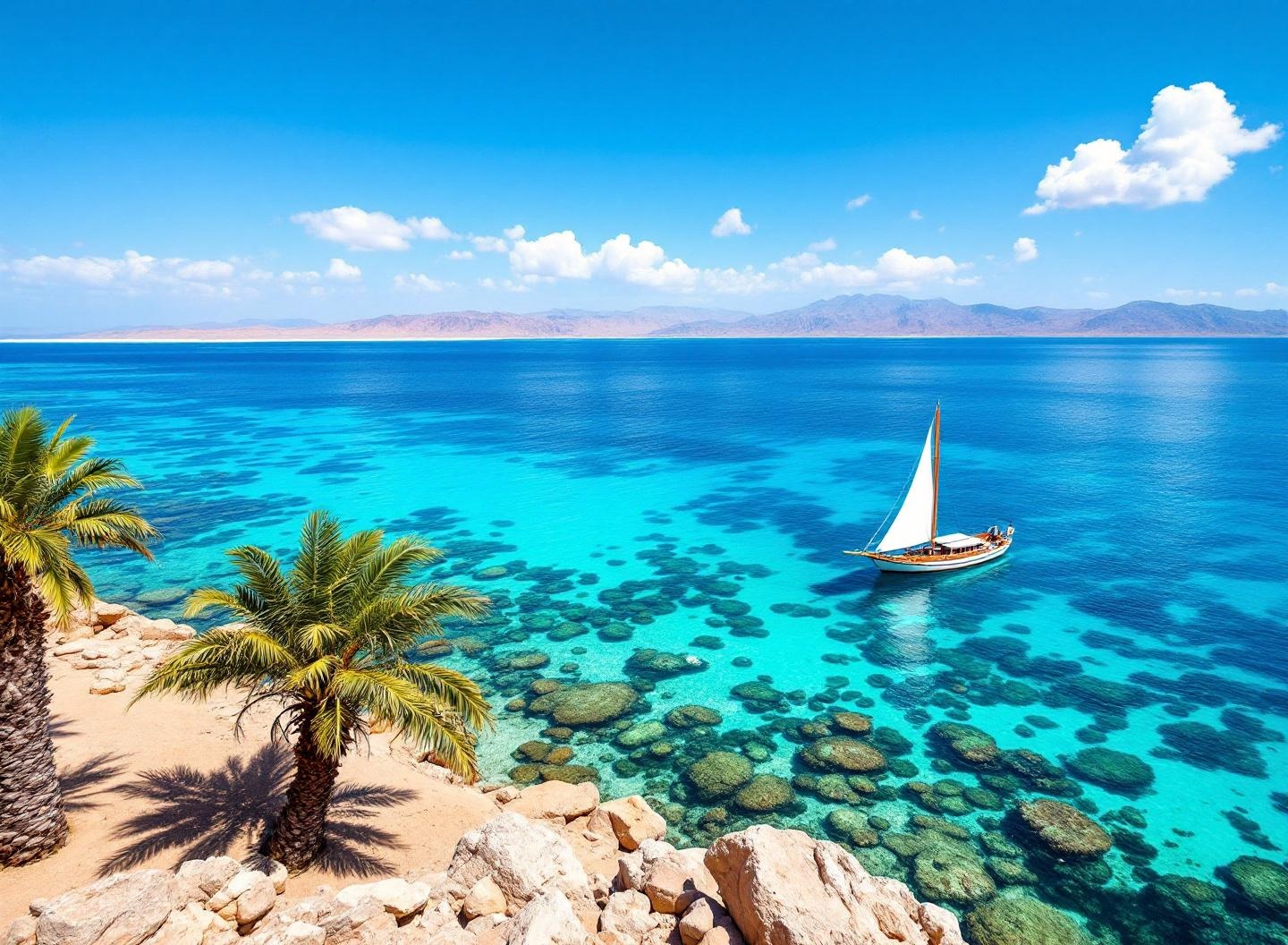
What Aqaba does offer is exceptional: some of the most sheltered, clear and biologically rich shallow water in the Red Sea, a growing community of local freedivers, and access to the same reef sites that make Aqaba a world-class scuba destination. For recreational freedivers who want to explore a reef to 10–20 m in flat conditions with extraordinary marine life, Aqaba delivers very well.
Freediving schools in Aqaba
Freedive Aqaba
The most established freediving school in the city, offering AIDA and PADI Freediver courses from beginner level (AIDA 1 / PADI Freediver) to more advanced certifications. The school uses the Tala Bay pool for confined water sessions and the south coast reef sites for open-water dives. Instructors speak English and Arabic; some speak additional European languages.
Courses offered:
- AIDA 1 / Intro to Freediving: 1 day, theory + pool + open water introduction
- AIDA 2 / PADI Freediver: 2–3 days, 20 m depth target, pool and open water
- AIDA 3 / Advanced Freediver: 3–4 days, 30+ m depth, equalization and safety techniques
- Freediving in the sea (no course): guided freedive sessions for certified freedivers
Contact: check the Freedive Aqaba page on social media or via the larger Aqaba dive centre networks for current pricing, which is updated seasonally. For scuba-trained divers exploring the same reef sites, the Aqaba 2-boat dives for certified divers is an ideal complement. Visitors who want full logistics handled — hotel transfers, equipment, guide — can book the Aqaba scuba diving experience with transfers directly.
Apnea Camp Aqaba
A newer operation that runs intensive weekend and week-long apnea camps combining pool training, yoga and breathwork sessions with open-water reef dives. More structured than a standard course, suitable for intermediate freedivers wanting to improve technique. Camp format means accommodation is often included in the package price.
The camp format suits visitors who have a week in Aqaba and want to train seriously. Shorter intro sessions are also available.
Training within scuba dive centres
Several of Aqaba’s scuba dive centres — notably Aqaba International Dive Center and Sinai Divers — offer entry-level freediving as an add-on to their regular schedule. These sessions are instructor-led and appropriate for curious snorkellers wanting a first taste of breath-hold diving without committing to a full course.
Best sites for freediving
Japanese Garden (6–15 m)
The ideal open-water freediving site in Aqaba for recreational depths. The reef sits at 6–15 m with calm entry, exceptional visibility and rich marine life. Shore entry from the public car park. See our Japanese Garden guide for full details on the site.
For freedivers, the site offers:
- Long horizontal swims over the coral plateau at 6–10 m
- Vertical descents to 12–15 m for deeper training
- Dense marine life for wildlife interaction
- No boat traffic in the inner zone before 10 am
Best time: Mornings on weekdays. Weekend afternoons can see significant boat traffic.
Tala Bay (static training / dynamic apnea)
Tala Bay is a resort bay with sheltered, flat water that has become a training base for local freedivers. The protected bay area is used for static apnea (breath-holds on the surface), dynamic apnea (underwater swimming on a single breath), and shallow equalization practice.
Non-resort visitors may need to pay a day-use fee (10–15 JOD) to access the Tala Bay beach. Arrange through the Tala Bay resort reception.
Power Station (15–40 m)
For advanced freedivers targeting deeper dives (25–40 m), the Power Station reef wall offers the best depth profile from a shore entry. The wall drops steeply from 15 m to beyond 40 m. Advanced freedivers train here for constant weight dives and no-limit style descents, though the latter requires specialised safety protocols.
Note: Deep freediving (below 20 m) without a trained buddy and rescue diver present is genuinely dangerous. Shallow water blackout — loss of consciousness on ascent due to hypoxia — claims lives every year. Never dive deep alone.
Berenice Beach Club (shallow static)
The calm, sheltered beach at Berenice Beach Club is suitable for static apnea training on the surface and shallow reef dives in the first 3–5 m. Day-use fee applies (approximately 10 JOD). The reef directly in front of the club has accessible coral starting at 2 m depth.
Equipment: what you need and rental costs
Freediving gear differs meaningfully from scuba equipment. The priorities are low drag, streamlined profile and a low-volume mask that equalises easily at depth.
Essential freediving equipment
| Item | Notes | Rental cost/day |
|---|---|---|
| Low-volume mask | Critical — standard scuba mask adds too much drag | 5–8 JOD |
| Long freediving fins | Carbon or fibre glass blades for efficiency | 10–15 JOD |
| 3 mm wetsuit (one-piece) | Reduces heat loss and improves buoyancy | 8–12 JOD |
| Weight belt (rubber) | To compensate wetsuit buoyancy | Included with wetsuit |
| Lanyard (safety) | Attaches diver to buoy line for deep dives | Provided in courses |
| Dive buoy + line | For open-water depth training | 5–8 JOD |
Total rental package: 30–50 JOD per day from a specialist freediving school. Scuba dive centres that rent freediving gear tend to stock entry-level equipment only (low-volume masks, short-blade fins) for 20–35 JOD.
Buying equipment in Aqaba
Specialist freediving gear is not widely available for purchase in Aqaba. If you have specific preference for carbon fins (Omer, Mares, Cressi) or a particular mask brand (Sphera, Salvimar), bring it from home. Basic freediving gear (starter fins, low-volume masks) is available at larger dive shops.
Safety: the most important section
Freediving carries real risks that differ from scuba. The primary danger is shallow water blackout — loss of consciousness caused by oxygen depletion on the ascent. This can happen to experienced freedivers on shallow dives and has killed people who appeared to be in perfect condition.
The rule is absolute: never freedive alone. Every dive, regardless of depth, requires a trained buddy on the surface ready to enter the water immediately if you do not surface or show signs of distress.
Additional safety considerations in Aqaba:
- Marine Park boat traffic: Be visible at the surface. Use a freediving buoy with a dive flag, especially at Japanese Garden.
- Current: Rare in the Gulf of Aqaba but possible near the Power Station. Check conditions before deep dives.
- Depth progression: Increase depth gradually. The equalization learning curve is non-linear — many divers plateau at 15–20 m until they master frenzel equalization.
- Never hyperventilate before a dive. Hyperventilation artificially extends breath-hold time by reducing CO2 but does not increase oxygen — it is the primary cause of shallow water blackout.
All courses at Freedive Aqaba and Apnea Camp include dedicated safety and rescue training.
Breath-hold diving in Jordan’s cultural history
Before sport freediving existed, breath-hold diving in the Red Sea and Gulf of Aqaba was a livelihood. Pearl diving (historically practised throughout the Gulf region including the northern Red Sea), sponge harvesting and fish spearing were all conducted on a single breath by divers who had no training system, no coaching and no safety protocols — only accumulated community knowledge passed between generations.
The tradition of Arab pearl divers (ghawwas) centred primarily on the Persian Gulf (Bahrain, Kuwait, the UAE), but the fishing communities of the Red Sea’s northern reaches — including the Jordanian and Saudi sides of the Gulf of Aqaba — practised similar techniques for fish and seafood harvest. The craft was largely abandoned in the 20th century as commercial fishing methods, petrochemical wealth and declining pearl market prices made it uneconomic.
Some of the older Bedouin guides in Aqaba have family memory of this tradition. Conversations with these guides — available through the freediving schools — can connect the modern sport to its pre-sport origins in a way that enriches the experience beyond technique instruction.
The revival of freediving as a sport discipline in Jordan dates to the 2000s. Jordanian freedivers have begun competing internationally, and the sport has attracted both urban Jordanians from Amman and international visitors who base themselves in Aqaba specifically for training.
Combining freediving with other activities
A freediving training session typically occupies a morning (pool work) and an afternoon (open water). This leaves evenings free for Aqaba’s restaurants and waterfront, or for planning a day trip to Wadi Rum (1 hour from Aqaba) or Petra (2 hours by road).
Visitors who want to combine scuba and freediving in Aqaba should be aware of the separation rule: do not freedive within 24 hours after a scuba dive without following proper surface interval protocols.
The private Red Sea diving tour from Aqaba is the closest GYG offering to a freediving experience — it is a scuba tour but can accommodate beginners and includes the same reef sites that freedivers visit. For dedicated freediving courses, book directly with Freedive Aqaba or Apnea Camp.
The freediving community in Aqaba
Aqaba has a small but active freediving community, driven largely by Jordanian military and sports divers who compete at national level. The Jordan Freediving Association hosts local competitions periodically — worth checking if your visit coincides with one. The Aqaba King Hussein Youth City swimming complex is used for pool-based competition.
The community is welcoming of visiting freedivers. Connecting via freediving Facebook groups (search “Freediving Jordan” or “Apnea Jordan”) is the most reliable way to find training partners and local knowledge before arrival.
Freediving technique: what to work on before your Aqaba trip
Aqaba’s calm conditions make it a good environment for learning or improving freediving technique, but arriving with some preparation significantly improves what you can achieve in a limited time.
Equalisation: This is the primary limiting factor for most beginners. The Valsalva manoeuvre (pinching the nose and blowing gently) works to about 15–20 m for many people. Beyond that depth, the increasing pressure requires the Frenzel technique — a complex tongue-and-throat manoeuvre that must be learned on dry land before you can execute it underwater. YouTube tutorials (search “Frenzel equalisation tutorial”) and the instructional materials from Freedive Aqaba are good starting points.
Relaxation and breathing-up: The correct pre-dive breathing protocol is slow, diaphragmatic breathing — expanding the belly before the chest — for 2–3 minutes before a dive. This is the opposite of hyperventilation. The goal is to lower your heart rate and relax your body’s diving reflex. Yoga and meditation practice improve this capacity significantly.
Streamlining: Keeping arms by your sides (not out front), toes pointed and a relaxed but hydrodynamic body position reduces drag dramatically. The difference between a tense, thrashing freediver and a relaxed, streamlined one is often 5–8 m of additional depth before the same level of discomfort.
Finning technique: Freediving fins (long, flexible blades) require a slow, powerful kick from the hip — not the rapid ankle kick used for surface swimming. Aim for one kick cycle every 2–3 seconds on descent.
If you can arrive at Aqaba having practised equalisation daily for two weeks and with a basic understanding of breathing technique, you will progress much faster with the school’s instruction.
Equipment deep dive: choosing freediving fins
The question of fins comes up constantly for freedivers visiting Aqaba. Your choice of fin depends significantly on your level and what you plan to do.
Bi-fins (standard finning):
- Entry level: Cressi Gara 2000, Salvimar Hero — fibreglass blades, good value, available in some Aqaba dive shops
- Intermediate: Omer Stingray Carbon, Beuchat Mundial Elite — carbon blades, significantly more efficient, reduce leg fatigue on repeated dives
- Advanced: Omer Stingray Carbon or equivalent with matched foot pockets for your foot size — the foot pocket fit matters as much as the blade
Monofin: Used by competitive freedivers for constant weight discipline. Not widely used for reef exploration — hard to manoeuvre in confined spaces. Freedive Aqaba has monofins available for training in the pool component of courses.
Footwear for Aqaba’s reef: The shore entry at Japanese Garden (concrete step) benefits from a 3 mm neoprene bootie that protects the foot and provides grip on the entry ledge. Ensure your foot pocket fits with the bootie before travelling.
The psychology of freediving
Freediving requires a different psychological relationship with the body than scuba diving. Scuba provides life support — the tank is there, the regulator is there, you can breathe whenever you want. Freediving removes that safety net and asks you to trust your body’s capacity.
The mammalian diving reflex that all humans (and other mammals) possess is the physiological basis of freediving. On immersion of the face in water, especially cold water, several changes occur: heart rate slows (bradycardia), blood redistributes from the extremities to the core (peripheral vasoconstriction) and the spleen contracts to release stored oxygenated red blood cells. These responses are involuntary and increase diving performance.
What the mind can interfere with is the ability to relax enough to allow these reflexes to operate. Stress, anxiety and tension suppress the diving reflex and increase oxygen consumption. The paradox of freediving is that the desire to go deeper often prevents it — relaxation and acceptance of depth, rather than effort, is what produces better results.
The Bedouin guides who teach freediving in Aqaba often have an instinctive understanding of this principle drawn from generations of pearl diving and traditional fishing in the Gulf of Aqaba.
Aqaba: private scuba diving in the Red Sea
Prefer scuba but want the same Aqaba reefs? This private Red Sea scuba tour covers Japanese Garden and the best Aqaba dive sites with a dedicated instructor.
Frequently asked questions about Freediving in Aqaba
Do I need to be a strong swimmer to learn freediving in Aqaba?
Yes — basic swimming competency is required. You should be comfortable in open water for 15–20 minutes without assistance. Most schools require a 200 m swim as part of the entry assessment for AIDA/PADI courses.
What depth can I reach as a beginner in Aqaba?
Most beginners reach 5–10 m on a first-day open-water session. After a full AIDA 2 course (2–3 days), 15–20 m is a realistic target for most people. Reaching 20 m consistently requires practising equalization before the trip.
Is Aqaba better for freediving than Dahab?
Dahab (Egypt, 50 km south by road via Israel/ferry) has deeper training platforms (the Blue Hole reaches beyond 100 m) and a larger established freediving community. For beginner and intermediate freedivers focused on reef exploration, Aqaba’s Japanese Garden and Tala Bay are equivalent or better. For deep training and competition preparation, Dahab has the edge.
Can I bring my own carbon fins as carry-on luggage?
Carbon fins exceed most airlines’ carry-on length limits (typically 55 cm). They must travel as checked baggage, usually requiring a specific fin bag and possibly an oversized luggage fee. Budget airlines servicing Aqaba are strict on this — check with your carrier in advance.
Is there a decompression risk with freediving?
Decompression sickness is possible in freedivers who make many repetitive deep dives without adequate surface intervals. It is rare compared with scuba but has been documented in competitive freedivers. The risk is minimal for recreational divers making occasional dives to 15–20 m with adequate surface intervals (at least 1:2 ratio of dive time to rest time).
How does freediving in Aqaba compare to scuba diving there?
Both access the same reef sites, but the experience differs fundamentally. Our Aqaba diving guide covers scuba in full — the short version is that scuba gives longer bottom time and access to deeper wrecks and reef walls, while freediving offers a quieter, more physically engaged encounter with the shallower reef at Japanese Garden and similar sites.