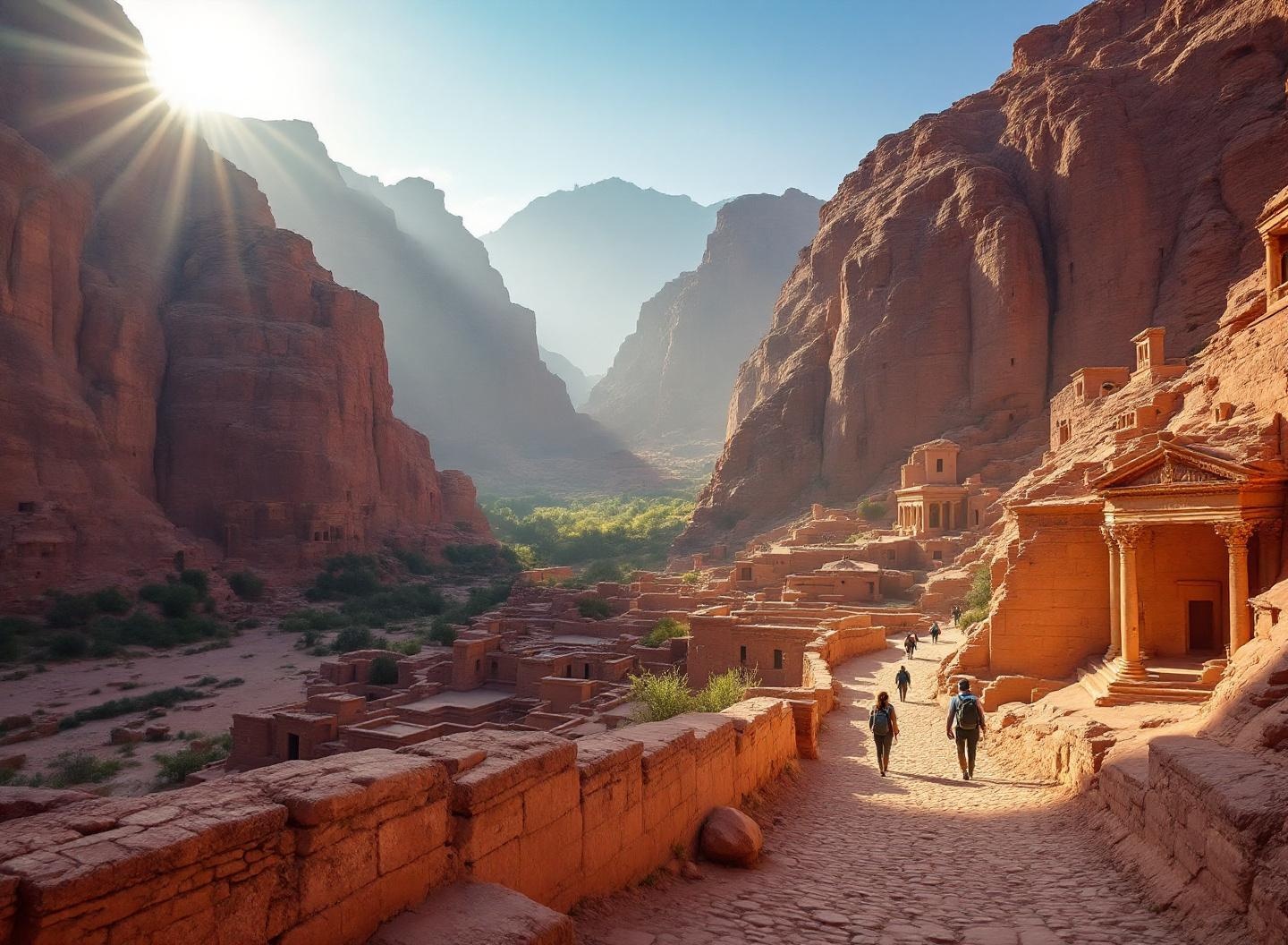
What is the Dana to Petra trek
The Dana to Petra trek is Section 6 of the Jordan Trail, connecting the Dana Biosphere Reserve in the south of Jordan’s central highlands to the ancient Nabataean city of Petra. At 80 km, it is the single most rewarding long-distance walk in the country — and one of the most spectacular in the Middle East.
The route descends from the cool plateau village of Dana (1 500 m) through a series of dramatic wadis, crosses the floor of the Wadi Araba valley at below sea level, climbs through the Shara highlands, passes through the Nabataean complex of Little Petra (Siq al-Barid), and completes with a descent into Petra from the back — arriving at the Monastery (Ad Deir) through a ravine that most Petra visitors never find.
This is not a walk for those who prefer manicured trails and infrastructure. The route crosses remote terrain, requires GPS navigation in places, and passes through Bedouin-managed land where the only shade is your hat. But for hikers willing to commit, it delivers scenes — dawn over Wadi Feynan, the silence of Wadi Araba at sunrise, the first glimpse of Petra’s rose sandstone — that are genuinely rare.
Route overview by day (4-day itinerary)
The four-day format is the most commonly offered by guided operators. Independent hikers often extend to 5–7 days to take in side trails.
Day 1: Dana village to Wadi Feynan Ecolodge
Distance: 20–23 km | Ascent/descent: Primarily downhill, 1 200 m descent
The first day is the longest and the most visually arresting. Starting from Dana village — reachable by road from Amman (3–4 hours) or Karak (2 hours) — the path drops through Dana Nature Reserve’s main wadi. Juniper trees give way to fig and tamarind as the altitude falls. Ibex (Nubian ibex) are often spotted on the cliff faces in the first kilometres.
By midday the vegetation thins to desert scrub. The path follows Wadi Dana to its junction with Wadi Feynan. The landscape shifts from green to copper-red — the soil is saturated with ancient copper ore, and 8 000-year-old mining sites appear as dark pits in the valley floor.
Accommodation: Feynan Ecolodge — one of National Geographic’s “Unique Lodges of the World”. Solar-powered, candlelit at night, with a Bedouin cook preparing traditional meals. Staying here is an experience in itself; book well in advance (3–6 months ahead in peak season). See our Wadi Feynan hikes guide for details on the ecolodge and surrounding trails.
Day 2: Wadi Feynan to Rajef village
Distance: 18–22 km | Character: Flat valley floor crossing Wadi Araba
Day 2 is the logistically unusual stage: the route crosses the Wadi Araba depression — the geological rift valley that forms the border between Jordan and Israel. The valley floor sits below sea level at this point, and the terrain shifts from rocky wadi to flat, featureless desert pan.
Navigation is GPS-dependent across the open floor. Temperatures can be extreme — this section should be started before 6 am in spring to complete the valley crossing before midday heat. Water carries are critical: there is no source on the valley floor.
The afternoon climb to Rajef village is steep and tests legs already tired from Day 1. A Bedouin family hosts hikers overnight with simple but generous meals.
Day 3: Rajef to Little Petra (Siq al-Barid)
Distance: 16–20 km | Character: Climbing through sandstone highlands
Day 3 enters Petra’s geological territory — the sandstone formations of the Shara mountains that give the entire Petra area its distinctive rose-and-cream colouring. The trail passes through the village of Baydha (Beidha), adjacent to a Neolithic archaeological site that predates Petra by 7 000 years.
Little Petra (Siq al-Barid) — free to enter with a Petra ticket — appears at the end of a narrow canyon entrance reminiscent of a smaller version of the main Petra Siq. The carved facades, Nabataean cisterns and painted ceiling of the “Painted House” triclinium reward a slower pace. Overnight either at a camp adjacent to Little Petra or in a guesthouse in Wadi Musa.
Day 4: Little Petra to Petra via the back door
Distance: 6–8 km | Character: Canyon descent to the Monastery
The final section is what makes the Dana–Petra trek unique among Jordanian hikes. Instead of entering Petra through the main Siq with thousands of other tourists, this route descends through a narrow ravine (the “back door”) that leads directly to the Monastery (Ad Deir) at the top of the site.
Arriving at the Monastery from above — with the 47 m carved facade suddenly revealed below you at the end of the canyon path — is one of the great “reveal” moments in walking travel. From here, the whole of Petra lies below. Hikers can spend the afternoon exploring before exiting via the main Siq or returning the back-door route.
A Petra entry ticket is required; the Jordan Pass covers this. See our Petra back door guide for a detailed description of this specific section, and our Monastery Petra hike guide for the Monastery approach from inside the site.
Difficulty assessment
| Factor | Rating | Notes |
|---|---|---|
| Total distance | Moderate | 80 km over 4–7 days |
| Elevation change | Moderate–hard | 1 500 m descent + significant reascent |
| Technical difficulty | Low | No scrambling or climbing required |
| Navigation | Moderate | GPS essential; not all sections are marked |
| Water management | Hard | No sources on Day 2 valley crossing |
| Heat exposure | Moderate–hard | Open terrain with limited shade |
Honest verdict: This is not a beginner trail. A fit person who walks regularly and has some multi-day hiking experience can complete it. Someone who is new to multi-day hiking should do at least one 2-day practice walk before committing to Dana–Petra.
Operators and guided options
The following operators are the most frequently recommended for guided Dana–Petra treks. All are based in Amman or Petra and use local Bedouin guides:
Experience Jordan — well-established operator with strong community-guide relationships along the route. Packages typically 4 or 5 days.
Wild Jordan — run by RSCN (Royal Society for the Conservation of Nature). Strong environmental ethos, profits support reserve management. Higher price point but excellent guides.
Adventure Jordan — competitive pricing, flexible itinerary. Good option for smaller groups.
All-inclusive guided treks (guide, meals, accommodation, transfers) typically cost 600–1 200 USD per person depending on group size and accommodation standard. Larger groups bring per-person costs down significantly.
Pre-booked options with logistics handled: the Amman: Dana to Petra 4-day trekking adventure covers guide, meals and accommodation from a fixed price. The Jordan Trail Dana to Petra 4-day trekking tour follows the official Jordan Trail alignment with a licensed Jordan Trail Association guide.
Independent hiking
Self-guided hiking on the Dana–Petra route is possible and legal. You need:
- Official Jordan Trail GPS tracks (downloaded from jordantrail.org)
- Gaia GPS or Komoot with offline maps
- Sufficient water capacity for the Day 2 valley crossing (minimum 4 litres)
- Advance booking of accommodation at Feynan Ecolodge (mandatory) and Rajef camp
Independent costs: approximately 150–250 JOD total for accommodation and meals along the route (excluding Petra entry).
Best season
March to May: Optimal. Wildflowers in Dana, cooler temperatures, good visibility. Snow possible in late February on the Dana plateau — add one day buffer.
October to November: Second choice. Cooling after summer, stable conditions, Petra in peak season (positive for transport connections at the end).
Avoid June to September: The Wadi Araba crossing on Day 2 becomes genuinely dangerous in high summer (temperatures exceed 45°C on the valley floor). Several hikers have required evacuation from this section in July and August.
Packing essentials
- Trekking poles (strongly recommended for the Dana descent)
- Minimum 3-litre water capacity (4 litres for Day 2)
- Lightweight sleep system (ecolodge and camps provide bedding, but a sleeping bag liner adds comfort)
- Headtorch with spare batteries
- Blister treatment (10–20 km/day on rough terrain generates blisters even with broken-in boots)
- Jordan Trail map app (Gaia GPS with downloaded Jordan topo)
- Sun protection: hat, long sleeves, SPF 50+
Combining with other Jordan highlights
The trek naturally bookends with two of Jordan’s great destinations: Dana is easily reached via the King’s Highway from Amman (3–4 hours), and Petra connects directly to Wadi Rum (1 hour 45 min) and Aqaba (2 hours). A logical itinerary is: Amman → Karak castle (King’s Highway stop) → Dana → trek → Petra → Wadi Rum → Aqaba. See our south Jordan itinerary for a structured version of this route. Visitors who want a guided introduction to Dana before committing to the full trek can book the Dana Biosphere Reserve full-day hiking tour from Amman as a standalone day trip.
Geology of the Dana-to-Petra route
The most extraordinary thing about the Dana-to-Petra trek is the geological transition it traverses. In four days of walking, you move through 600 million years of rock history — from the basement granite exposed at the canyon floors to the Cambrian sandstone that gives Petra its rose colour.
Dana highlands (Section start): The plateau at Dana sits on Cretaceous limestone — the same rock type that underlies most of Jordan’s central plateau. The limestone weathers into the stepped, terraced landscape visible from Dana village. Below the limestone, in the deeper canyons, ancient basement rocks appear.
Wadi Feynan floor: The copper mineralisation that defines Wadi Feynan is associated with Cambrian sandstone and the contact zones between younger sedimentary layers and older metamorphic basement. The green and blue colours of the soil are malachite (copper carbonate), formed when copper sulphide deposits oxidised over millions of years.
Wadi Araba crossing (Day 2): The valley floor is a rift depression — part of the Great Rift Valley system that runs from Turkey to Mozambique. The flat valley bottom is filled with recent alluvial sediment (silts and gravels from seasonal flooding) covering the older rift geology below. Walking across the valley floor you are walking on the recent geological skin of one of the planet’s great geological features.
Shara mountains and Petra (Days 3-4): The sandstone of Petra is Cambrian in age — approximately 500 million years old. The red, cream and purple banding visible in the cliff faces represents different periods of sand deposition, subsequently lithified and uplifted. The Nabataeans exploited this rock’s workability (relatively soft, consistently grained) to carve their city from the cliff faces.
Understanding these geological layers transforms the visual experience of the walk. The landscape is not arbitrary — every colour and texture is a record of deep time.
The Nabataean legacy along the route
The Dana-to-Petra trek is not just a natural landscape route — it follows corridors that the Nabataeans used for 500 years. The Nabataeans were the Arab trading kingdom that controlled the incense route from Arabia to the Mediterranean between approximately 400 BC and 106 AD, when the Romans absorbed their territory.
Evidence of Nabataean activity appears at multiple points on the trek:
Water systems: The Nabataeans were desert water engineers without peer. Along the Dana-Petra route you will encounter cisterns cut into rock faces, channels designed to divert flash flood water into storage tanks, and dams that controlled seasonal flow. These structures are often still partially functional after 2 000 years.
Inscriptions and graffiti: The sandstone of the Shara highlands is covered in Nabataean inscriptions — names, dates, prayers, dedications. Most are carved at eye height on natural waypoints — passes, water sources, canyon walls. A guide who reads Nabataean script can translate them.
Caravanserai remains: Several sites on the route show the remains of caravanserai — way stations for the merchant camel trains that carried frankincense, myrrh, spices and silk through this landscape. Beidha (near Little Petra) contains the most complete remains.
Little Petra itself: As the trek approaches its conclusion, Little Petra (Siq al-Barid) is a near-complete Nabataean site. It functioned as the commercial gateway to Petra proper — merchants would trade here, rest their camel trains and then enter the main city for the larger commercial exchange.
Accommodation options in detail
Feynan Ecolodge (Night 1)
Located on the Jordan Trail at the base of Wadi Dana, Feynan Ecolodge is the most discussed and most booked accommodation on the route. Built without mains electricity, illuminated by candles and solar power, run with food prepared by local Bedouin women, it represents the apex of community-based tourism in Jordan.
Book 4–8 weeks in advance in spring. Rates: approximately 120–160 JOD per person full board. The ecolodge offers guided night walks to observe the extraordinary dark-sky conditions in the valley. See our Wadi Feynan hikes guide for full details.
Rajef camp (Night 2)
Rajef is a Bedouin village in the uplands above Wadi Araba. Accommodation is in a family homestay — basic, clean, with a shared bathroom. Meals are generous (rice, grilled meat, salad, flatbread). The village is at approximately 900 m elevation; nights can be cold in spring.
Price: 15–25 JOD per person with dinner and breakfast. A contribution of 2–3 JOD for a hot shower is appreciated.
Little Petra / Wadi Musa (Night 3)
Several camp options exist near Little Petra (Siq al-Barid). Most guided operators book a Bedouin camp with tents and a fire. Budget options are also available in Wadi Musa town (8 km from Little Petra) for those preferring a hotel. Budget hotels in Wadi Musa range from 25–50 JOD per person; mid-range 50–90 JOD.
Wildlife along the route
The Dana-to-Petra corridor passes through some of the best wildlife habitat in southern Jordan, though sightings depend heavily on timing and quiet walking. Nubian ibex are the most reliable sighting, particularly on Day 1 as the trail descends through Dana Reserve’s rocky slopes — early morning departures improve your odds significantly, since ibex are most active before the heat builds. Griffon vultures soar over the canyon on thermals most days, visible from Dana village and along the upper sections of the descent.
Striped hyena calls are sometimes heard at night from Feynan Ecolodge or the Rajef homestay, though actual sightings are rare. The Wadi Araba crossing on Day 2, despite its stark appearance, supports desert specialists like sand cats and various reptile species, though these are almost never seen by day-hikers. A guide with wildlife-tracking experience — standard with most operators — substantially improves the odds of spotting tracks and signs even where the animals themselves stay hidden.
Frequently asked questions about Dana to Petra trek
Do I need a guide for the Dana to Petra trek?
A guide is not legally required but is strongly recommended. Navigation on Day 2 (Wadi Araba crossing) and some sections of Day 3 is difficult without local knowledge. A guide also arranges water resupply, communicates with village hosts and provides cultural context. Cost: 40–60 JOD per day.
Can I carry my own tent and camp wild?
Wild camping is permitted on most sections with landowner permission (easily obtained through your guide). However, the infrastructure of Feynan Ecolodge and the Rajef homestay is one of the trek’s highlights — wild camping here would mean missing significant experiences. A tent becomes useful on the extended 6–7 day version.
What is the entry fee for Dana Biosphere Reserve?
Dana Biosphere Reserve charges an RSCN conservation fee of 7–15 JOD depending on which trails you access. This is separate from the Petra entry ticket. Jordan Pass does not cover Dana entry fees.
Are there mules or baggage transfer services?
Yes — most guided operators arrange mule baggage transfers so hikers carry only a day pack. Ask specifically when booking. Independent hikers can arrange mule handlers through Feynan Ecolodge.
How do I get to Dana village to start the trek?
From Amman: rent a car or hire a private taxi (100–140 JOD). The King’s Highway via Karak is 4 hours. A public bus from Amman to Qadsiyyeh (the junction village below Dana) operates twice daily from Amman’s south bus station (Wahadat). From Qadsiyyeh, Dana village is a 7 km uphill walk or a short taxi ride.
How does the Dana-Petra trek compare to shorter Dana hikes?
If 4–7 days is too much commitment, the Dana Biosphere Reserve has shorter trails within the reserve itself — the Wadi Dana trail (14–16 km, one day, descending to Feynan Ecolodge) captures much of the same landscape transition in a single day rather than the full multi-day trek to Petra. It is the natural fallback for hikers who want the Dana experience without the four-day commitment.
What fitness level do I need for the trek?
Regular walking fitness and some multi-day hiking experience are enough — this is not a technical mountaineering route. Anyone who can comfortably walk 15–20 km on rough terrain for consecutive days, carrying a day pack, will manage. If you have never done a multi-day trek before, a shorter 2-day practice hike beforehand is a sensible way to test your gear and pacing.
Amman: Dana to Petra 4-day trekking adventure
Ready to hike Dana to Petra? This 4-day guided trek covers guide, meals and camp accommodation — the easiest way to book the full route.