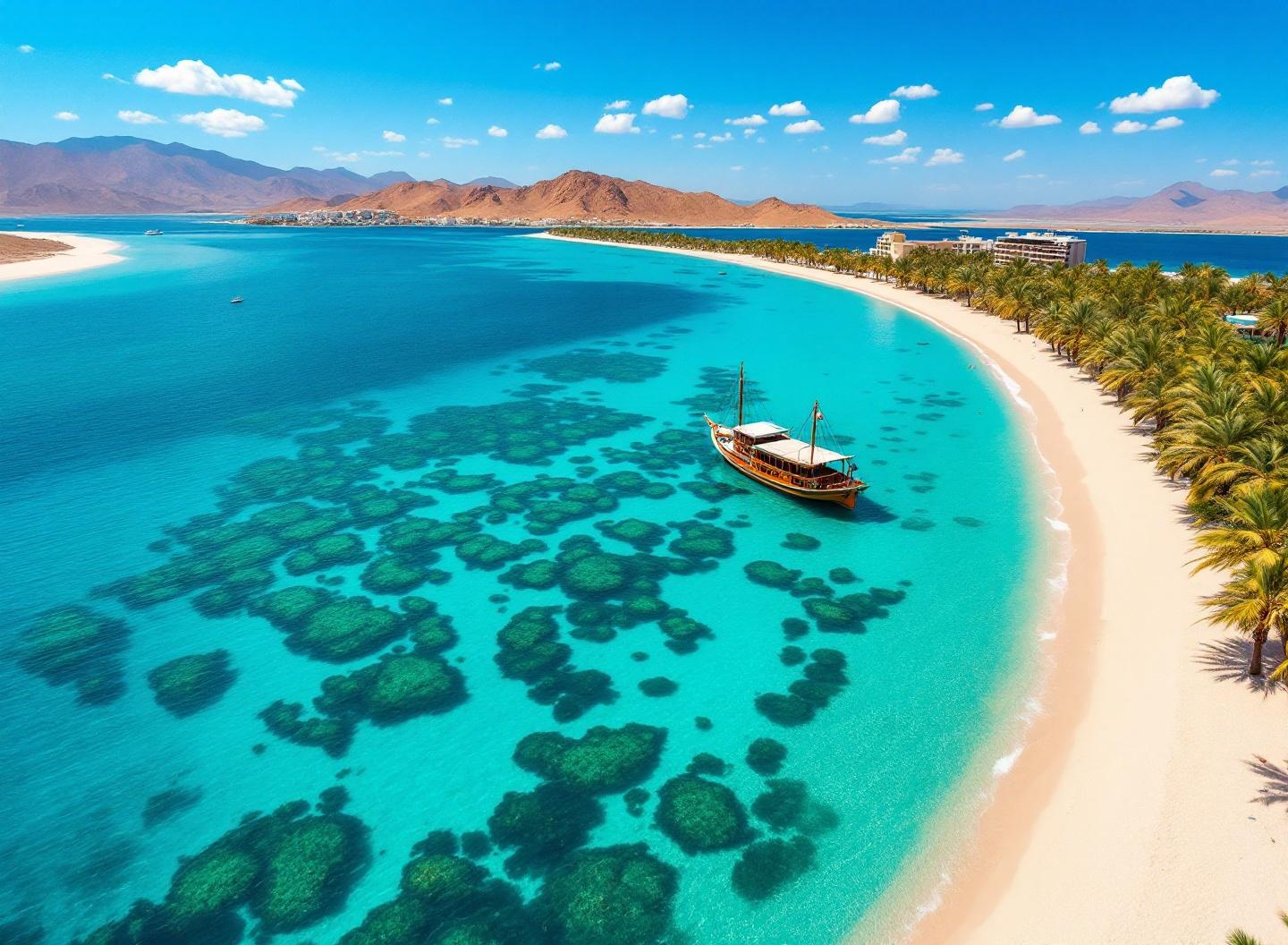
| Where | Japanese Garden (7 km south of Aqaba centre) or Berenice Beach Club |
| Cost | Free shore access, or around 10 JOD beach club day use |
| Time needed | 2–3 hours for shore snorkelling, half day for a boat trip |
| Best time | Before 10 am for calm water and low boat traffic |
| Getting there | Taxi (5–7 JOD one-way) or hotel/tour pickup |
Snorkeling in Aqaba: what makes it special
The Gulf of Aqaba holds the world’s northernmost coral reef system — a fact that surprises most visitors who associate Red Sea reefs with Egypt. Aqaba’s reefs benefit from lower tourism pressure than Sharm el-Sheikh, effective Marine Park protection along 17 km of coast, and warm water year-round (22–27°C).
For snorkellers, the main advantage over scuba diving is simple: nearly all the most colourful life in Aqaba sits in the top 5 m. Hard corals, thousands of reef fish, lionfish, and garden eels are accessible without any certification. Many of the same sites that certified divers visit for their deeper topography are equally rewarding at the surface.
Shore snorkeling spots (free or low-cost)
Japanese Garden — the best all-rounder
The Japanese Garden is the reference point for snorkeling in Aqaba, and for good reason. A public car park on the south coast road (roughly 7 km from the city centre) gives direct access to a gently shelving reef that runs from the shallows out to about 15 m depth.
At the surface level — 2 to 5 m — snorkellers encounter massive brain corals, branching staghorn corals, carpet anemones with resident clownfish, pufferfish, pipefish, and dense schools of anthias. Lionfish and scorpionfish rest on the coral heads; neither is aggressive. Visibility is typically best before 10 am.
Entry is from a concrete step into the water. There is no sandy beach here — water shoes or dive booties are highly recommended. No facilities (no toilets, no shade); bring water and sun protection. See the complete breakdown in our Japanese Garden dive site guide.
Practical details: Free. No equipment rental on site. Take a taxi south (~5–7 JOD one-way) or arrange hotel transport. Avoid visiting Friday afternoon and Saturday when local families crowd the area.
Public beach near the Marine Park entrance
A small public beach adjacent to the Marine Park administration point on the south coast road. Shallower reef than Japanese Garden — good for absolute beginners and children. No fees, minimal facilities.
Tala Bay
Tala Bay is a resort development about 17 km south of central Aqaba with a private beach and its own reef. Non-guests can sometimes access the beach for a day-use fee (10–15 JOD). The reef here is good and the beach is clean and shaded.
Beach clubs with snorkeling access
Berenice Beach Club
The most comfortable shore snorkeling experience in Aqaba. Berenice Beach Club charges a day-use fee of roughly 10 JOD (which often includes a food-and-drink credit). The club sits directly above a quality reef, provides shaded loungers, equipment rental and a restaurant. Mask and snorkel rental typically 3–5 JOD.
The combined boat tour and Berenice Beach Club day use is one of the best value packages on offer: the glass boat and snorkeling tour with Berenice Beach Club day use adds a glass-bottomed boat ride plus guided snorkeling with beach club access for the afternoon.
Boat snorkeling trips
Boat trips are the most efficient way to reach the best spots — including the surface view of the Cedar Pride wreck and sites that are difficult to reach by shore.
Half-day boat snorkeling trip (2–3 hours)
The standard offering from most operators: a motorised boat takes 6–12 people to two or three snorkeling sites with a guide. Includes equipment, guide and water. Cost: approximately 25–35 JOD per person. Typical stops include Japanese Garden, The Tank, and one outer reef site.
The Aqaba Red Sea snorkeling boat trip with buffet lunch is one of the top-rated half-day options, adding a buffet meal aboard.
Full-day snorkeling trip (5–6 hours)
Covers more ground — up to five sites including the outer reefs south toward the Saudi border. Lunch included. Cost: approximately 45–55 JOD per person. Best for dedicated snorkellers who want variety.
Guided shallow-reef tour with equipment and transfer
For travellers staying outside the south beach area, a pickup-included snorkeling tour removes the logistics headache. The snorkeling in the Red Sea with equipment and free transfer package covers equipment, guide and hotel pickup.
What you’ll see in the water
The list of common sightings from the surface in Aqaba is impressive for a reef that lies within swimming distance of shore:
- Reef fish: anthias, parrotfish, surgeonfish, wrasse, grouper, triggerfish
- Coral life: staghorn, brain, table, mushroom and fire corals
- Unusual species: pufferfish, pipefish, lionfish resting on coral
- Occasionally: turtles (rare but reported near outer reefs), small octopus under coral ledges
- Cedar Pride from the surface: the wreck is visible as a dark silhouette in 10–12 m of visibility from the surface — a dramatic sight for non-divers
Depth at most shore snorkeling sites: 0–5 m in the inner zone, 5–12 m at the outer reef edge. No freediving certification is required to explore these depths safely.
Equipment: bring your own or rent
Bring your own if you snorkel regularly — a silicone mask and open-heel fins take up minimal luggage space and make a significant difference to comfort. A wetsuit or rash guard is advisable even in summer to avoid sun exposure and abrasion.
Renting in Aqaba: Most operators include basic snorkel sets (mask + snorkel + fins) in their tour price. Beach clubs rent sets for 3–5 JOD. Full fins rental at dive shops: 5–8 JOD. Wetsuit rental: 8–12 JOD.
Combining snorkeling with diving and freediving
Many visitors start with snorkeling and progress to a Discover Scuba Diving session on the same day. The two activities complement each other well — snorkel the shallows in the morning, dive with an instructor in the afternoon. If you are interested in breath-hold diving, Aqaba also has dedicated training available as outlined in our Aqaba freediving guide.
Getting to the snorkel sites from Aqaba city centre
Taxi: Most reliable for one-off shore dives at Japanese Garden. Agree on a price before departure — 5–7 JOD southbound from the city centre. Careem (the regional Uber equivalent) is more transparent on pricing.
Tour operator pickup: Included with most boat trips. Arrange from your hotel.
Rental car: Useful if you plan multiple days of self-guided snorkeling. The south coast road runs directly past all sites. Parking is free.
Budget breakdown for a snorkeling day in Aqaba
| Option | Cost |
|---|---|
| Shore snorkeling at Japanese Garden (self-guided, own equipment) | Free |
| Shore snorkeling at Japanese Garden (gear rental from nearby shop) | 5–10 JOD |
| Berenice Beach Club day use + own equipment | 10–15 JOD |
| Half-day boat trip (equipment included) | 25–35 JOD |
| Full-day boat trip with lunch | 45–55 JOD |
| Glass boat + snorkeling + Berenice day use | 35–50 JOD |
How snorkelling in Aqaba compares with other Red Sea destinations
Visitors who have snorkelled elsewhere in the Red Sea often ask how Aqaba compares. The honest answer involves trade-offs.
Aqaba vs Sharm el-Sheikh (Egypt): Aqaba’s reefs are in better overall health due to stricter Marine Park enforcement and lower visitor numbers. Sharm has a wider variety of sites, including the extraordinary Ras Mohammed National Park with its pelagic fish and sharks. For a shore-snorkelling experience with dense coral in a walkable distance of hotels, Aqaba wins. For total biodiversity and dramatic walls, some Sharm sites have the edge.
Aqaba vs Dahab (Egypt): Dahab’s Blue Hole lagoon is one of the world’s most famous snorkelling/diving sites — a circular lagoon with a 100 m-deep vertical blue hole accessible from a sandy beach. The experience is unique and worth the journey if you are committed to the Red Sea. Aqaba’s Japanese Garden is richer in shallow coral biodiversity than Dahab’s beach sites. For shore snorkelling variety, Aqaba is competitive. Dahab requires crossing the border (Eilat crossing from Aqaba) and adds transit time.
Aqaba vs Hurghada (Egypt): Hurghada’s reefs have been under significantly more pressure from tourism development than Aqaba’s. Boat snorkel tours in Hurghada often visit heavily visited sites with visible coral degradation. The Giftun Islands National Park outside Hurghada has better reefs than the near-shore sites. Aqaba’s marine park reefs are in better condition than Hurghada’s standard tour circuit sites.
Aqaba vs Eilat (Israel): Eilat is 6 km from Aqaba across the border. The Israeli side of the Gulf has its own excellent coral reserve (the Coral Beach Nature Reserve). Marine biologically, both sides of the Gulf share the same reef ecosystem. Aqaba’s main advantages over Eilat for snorkelling: lower prices, more accommodation options, and none of the border crossing overhead if you are already in Jordan.
Overall: For visitors planning a Jordan itinerary who want to add snorkelling, Aqaba is the obvious and best choice without requiring additional border crossings or detours.
Tips for first-time snorkellers in Aqaba
- Arrive early. The Japanese Garden is significantly calmer before 9 am — fewer boats, better visibility, cooler temperature.
- Wear reef-safe sunscreen. Standard chemical sunscreens are harmful to coral; mineral (zinc) sunscreens or a full rash guard are better choices.
- Don’t touch anything. Jordan’s Marine Park regulations prohibit touching or collecting coral and marine life. Fines apply.
- Hydrate before entering. The desert heat dehydrates you quickly even near the water.
- Check wind conditions. A south wind (Shamal) can reduce visibility significantly on the northern sites.
- Book the Aqaba Marine Park zone. Not every tour goes inside the protected zone. Confirm with the operator that mooring buoys are used to avoid anchor damage.
Understanding Aqaba’s underwater geography for snorkellers
One thing that surprises new snorkellers in Aqaba: the reef starts almost immediately at the waterline. Unlike tropical destinations where you wade through 50 m of shallow sandy beach before reaching coral, at Japanese Garden and several other Aqaba sites the fringing reef begins within 5 m of shore. This means snorkellers enter productive reef habitat in seconds.
The inner zone (0–5 m) is the snorkelling sweet spot: shallow enough to see the bottom clearly, deep enough for the reef to be fully developed. Coral coverage in this zone at Japanese Garden exceeds 50% — far higher than at many Egyptian Red Sea sites. The reason is the Marine Park protection that has allowed the reef to recover and expand since 1997.
The outer zone of most shore snorkelling sites (5–15 m) is accessible to confident snorkellers willing to freedive briefly. The coral here transitions from the mixed inner garden to larger table corals and gorgonian fans. The fish life in this zone is larger — parrotfish, Napoleon wrasse and grouper patrol the coral heads.
Safety on Aqaba’s reefs
The Gulf of Aqaba is generally calm and safe for snorkellers but some specific hazards deserve mention:
Boat traffic: The south coast road sees significant boat traffic, especially on weekends. Snorkellers should use a brightly coloured dive buoy and flag, particularly when swimming away from shore. The morning window before 10 am has the lowest boat traffic on most weekdays.
Fire coral: Millepora fire coral is present on all Aqaba reefs. Contact causes an immediate burning rash. It looks like yellowish branching coral with a slightly fuzzy texture. Never touch any coral, but be particularly careful near branching formations in the 2–6 m zone. Treatment: rinse with seawater (not fresh water), apply hydrocortisone cream.
Urchins: Long-spined black sea urchins hide under ledges and in rock crevices. Wearing water shoes prevents the most common type of urchin injury (stepping on one in shallow water near the entry point).
Lionfish: Present and common at Japanese Garden and other sites. Not aggressive but equipped with venomous spines. They sit motionless on coral — your hand on a ‘rock’ that turns out to be a lionfish is how most stings happen. Never touch anything on the reef.
Scorpionfish: Even better camouflaged than lionfish, sitting on coral rubble and sand in very shallow water. The same rule applies: don’t touch the bottom.
Current: Rare in the Gulf of Aqaba but can develop near headlands (Power Station, Black Rock) when wind picks up. If snorkelling at these sites, check wind conditions before entering.
Snorkelling with children in Aqaba
Aqaba is a reasonably child-friendly snorkelling destination. Key considerations:
Suitable sites for children: Japanese Garden inner zone (2–4 m, no strong current), Berenice Beach Club (sandy beach entry, shallow reef), The Tank (6 m, accessible from a boat with a guide).
Minimum age guidance: Children 6 and above can typically snorkel independently in calm conditions if they are comfortable swimmers. Younger children can use a snorkel vest or pool noodle in shallow water. Life jackets are available on all boat trips.
Reef interaction: Teach children the no-touch rule before entering — reef fish are habituated to humans and will approach closely if you hover still. Standing on coral destroys it.
Boat snorkelling: A guided boat trip is safer for children than independent shore snorkelling — guides are in the water and can assist if a child is uncomfortable. The snorkeling boat trip with buffet lunch is well-suited for families with the adult supervision and structured format.
The wider Red Sea reef system in context
Aqaba’s reef is the northernmost extension of the Indo-Pacific reef province — the same ocean system that produces the Great Barrier Reef, the Maldives and the Coral Triangle. The Red Sea is an enclosed arm of the Indian Ocean, and its relative isolation has produced some endemic species found nowhere else.
For snorkellers, the notable Red Sea endemic species in Aqaba include:
- Red Sea sailfin tang (Zebrasoma desjardinii) — a large, oval-bodied surgeonfish with intricate patterning
- Red Sea raccoon butterflyfish (Chaetodon fasciatus) — white body with black vertical bars, more vivid than its Indo-Pacific relatives
- Klunzinger’s wrasse (Thalassoma rueppellii) — electric blue and green male fish, one of the most colourful on the reef
- Sudan butterflyfish (Chaetodon mesoleucos) — white with orange and black tail, strictly Red Sea endemic
These species make Aqaba’s reef distinctive from sites in the Maldives or Thailand, even though the basic reef structure is similar.
Day trip logistics
Aqaba combines well with neighbouring attractions: the Wadi Rum desert is 1 hour north, Petra is 2 hours. A morning snorkeling tour and an afternoon departure for Wadi Rum is a realistic schedule. For multi-day planning, see our south Jordan itinerary.
Frequently asked questions about Aqaba snorkeling guide
Is snorkeling in Aqaba suitable for children?
Yes — the inner reef at Japanese Garden is 2–3 m deep and ideal for older children (8+) who are confident swimmers. Life jackets are available on all boat trips and recommended for younger children. Berenice Beach Club’s beach entry (no step entry) is easier for families.
Do I need a Marine Park permit to snorkel?
Individual snorkellers do not pay a direct gate fee. Boat operators pay a mooring fee (2–5 JOD per boat) that covers the site use. Shore access at public sites is free.
Is the water clear enough to see the coral from the surface?
At Japanese Garden the visibility is typically 10–15 m in the inner zone — you can see the coral bottom at 4–5 m depth from the surface in flat conditions.
What is the best month for snorkeling visibility?
November through February delivers the best visibility (25–40 m), though the air temperature is cooler. April and May combine warm weather with still-excellent visibility before summer heat and occasional haze reduce conditions slightly.
Can I snorkel to the Cedar Pride wreck?
The wreck sits at 25–30 m depth so scuba diving is required to reach the structure itself. However, the wreck is visible as a dark shape from the surface in good visibility — some boat trips include a surface pass over the wreck for non-divers. Read the complete story in our Cedar Pride wreck guide.