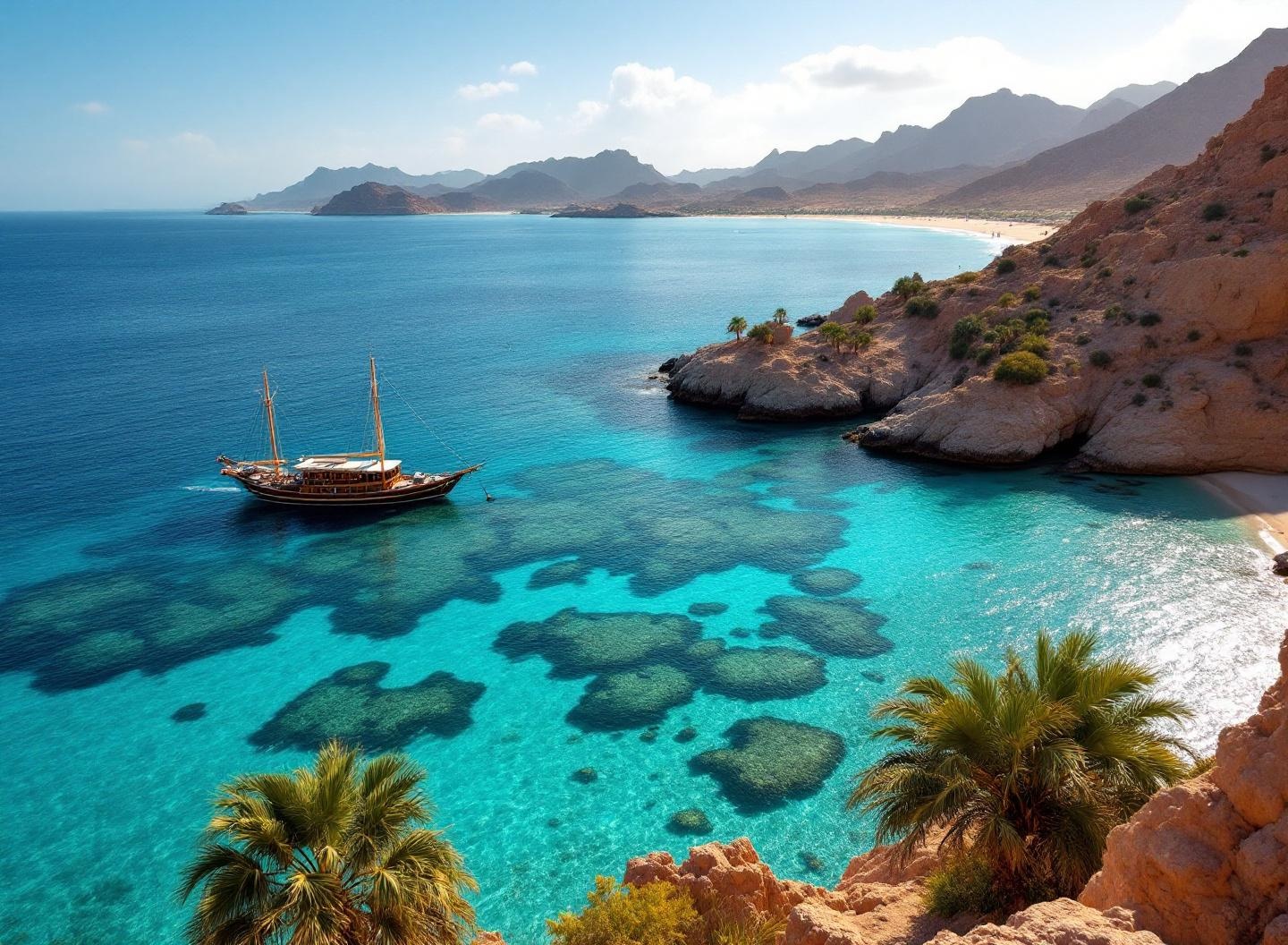
| Where | South coast road, Aqaba, from the Marine Park admin point to the Saudi border |
| Cost | Free for individual visitors; 2–5 JOD mooring fee per boat |
| Best for | Snorkellers, divers and non-swimmers via glass-bottom boat |
| Time needed | Half day minimum, full day to combine with Berenice Beach Club |
| Getting there | Taxi (6–9 JOD) or self-drive along King Hussein Street |
What is the Aqaba Marine Park
The Aqaba Marine Park (AMP) was established in 1997 under the authority of the Aqaba Special Economic Zone Authority (ASEZA). It covers approximately 17 km of coastline on the northern tip of the Gulf of Aqaba — the entire stretch of Jordan’s Red Sea coast south of the city — from the Marine Park administrative point to the Saudi border.
The park operates under no-take, no-anchor regulations enforced by ASEZA rangers who conduct periodic patrols both on the water surface and underwater. The result is a reef system that has shown measurable recovery since the 1990s, with coral cover increasing on monitored transects and fish biomass significantly higher than in adjacent unprotected zones.
What is protected inside the Marine Park
The Marine Park covers all marine life and geological features within its boundary:
- All coral species (hard and soft)
- All fish species
- All invertebrates (sea urchins, sea cucumbers, nudibranch)
- Sand and rubble substrates (no collection of shells or stones)
- Historical structures (Cedar Pride wreck, The Tank)
Violations are subject to fines of 50–500 JOD under ASEZA’s environmental protection regulations.
Key sites within the Marine Park
Japanese Garden
The most visited site in the park — a fringing reef from shore with coral gardens at 6–15 m depth and snorkeling accessible from 2 m. Dense with pufferfish, lionfish, anemonefish and brain corals. Full details in our Japanese Garden guide.
Cedar Pride wreck
Jordan’s flagship dive site. The 80 m Lebanese cargo ship was sunk in 1985 and now lies at 25–30 m, colonised by soft corals and patrolled by Napoleon wrasse. Advanced certification recommended. Full details in our Cedar Pride wreck guide.
The Tank
A military tank placed deliberately on the seabed at 6 m depth, fully encrusted in coral. Accessible to snorkellers and Discover Scuba Diving participants. The site is marked by a mooring buoy and visible from the surface in clear conditions. One of the more unusual dive sites in the Red Sea.
Power Station reef
Named after the power plant on the adjacent shoreline. The reef wall drops from 5 m to beyond 40 m — one of the best wall dives in Aqaba. Large Napoleon wrasse, barracuda schools and occasional eagle rays frequent the deeper sections. More challenging than Japanese Garden but within Advanced Open Water scope.
South Beach reefs
The southern section of the Marine Park, closer to the Saudi border, contains less-visited fringing reef patches with higher probability of pelagic sightings. Typically reached by boat.
Gorgonian sites
Two adjacent sites — Gorgonian I and Gorgonian II — named for the enormous sea fan gorgonians that cover the slope from 20 m downward. Among the most visually dramatic sites in the park for wide-angle photography.
Fees and permits
For individual visitors (walkers, snorkellers, shore divers): No entry fee for the public beach access points within or adjacent to the Marine Park. Individual divers and snorkellers do not pay a park gate fee.
For boat operators: A mooring fee of 2–5 JOD per boat is collected from operators using designated mooring buoys. This fee is typically included in tour prices. There are 11 designated mooring sites in the park; anchor dropping is prohibited.
Dive operators: Required to hold an ASEZA licence to operate within the Marine Park. All reputable Aqaba dive centres are licenced. Check that your operator uses mooring buoys and not anchors — a key indicator of compliance.
The Jordan Pass does not cover Marine Park boat fees. See our Jordan Pass guide for clarification on what the Pass includes.
Getting to the Aqaba Marine Park
The Marine Park administrative building serves as the formal entrance point on the south coast road, approximately 10 km south of central Aqaba. However, individual sites like Japanese Garden and the Cedar Pride wreck are accessed from their own car parks further south. There is no single gate through which all visitors must pass.
By taxi: 6–9 JOD from central Aqaba to the Marine Park entrance. For Japanese Garden or Cedar Pride, slightly more. Self-drive: The south coast road (King Hussein Street) runs along the entire Marine Park length. Free parking at each site. On a tour: All boat snorkeling and diving tours depart from the marina or from beach access points and include the mooring fee in the tour price.
For a ready-booked snorkeling experience with hotel pickup, the Red Sea snorkeling boat trip with buffet lunch covers multiple Marine Park sites in a half day. The glass boat and snorkeling with Berenice Beach Club day use adds a beach club element for a more relaxed format.
Conservation status and coral health
Aqaba’s reefs were surveyed in 1994 and found to be already degraded by boat anchoring, sewage outflow and unregulated fishing. The Marine Park establishment reversed this decline. By 2010, monitored transects showed coral cover had increased from roughly 30% to over 50% on key sections of the reef.
The park has not escaped all pressure: bleaching events in 2015 and 2019 caused some coral mortality, though at lower intensity than equivalent bleaching on Egyptian Red Sea reefs. The 2019 bleaching — driven by the abnormally warm summer — affected approximately 15% of monitored coral colonies in the northern park zone.
Overall the health of Aqaba’s reef is significantly better than the unprotected section north of the city, which has suffered from Aqaba’s industrial port expansion and boat traffic.
Rules for visitors
All visitors — whether snorkelling, diving or arriving by boat — are expected to follow Marine Park regulations:
- Do not anchor. Use designated mooring buoys only.
- Do not touch coral or marine life. Even gentle contact causes damage and stress to coral colonies.
- Do not collect. No shells, coral fragments, sand or any marine material.
- Do not feed fish. Disrupts natural feeding behaviour and ecosystem balance.
- Do not litter. No disposal of any waste from boats or at shore entry points.
- Use reef-safe sunscreen. Chemical filters (oxybenzone, octinoxate) are harmful to coral — use mineral (zinc oxide) alternatives.
- Stay at designated mooring sites. Boats may not drift anchor or tie to coral.
Wildlife calendar
The Marine Park’s reef communities are present year-round but certain species have seasonal peaks:
| Month | Notable sightings |
|---|---|
| October–February | Best visibility, Napoleon wrasse most active |
| March–May | Nudibranch season, spawning corals, whale sharks (rare, offshore) |
| June–August | Sea turtles (rare, outer reefs), glassfish spawning |
| September–November | Eagle rays near deeper sites, good visibility recovering |
Night diving and special permits
Night diving within the Marine Park is permitted with a licenced operator. ASEZA requires operators to inform the Marine Park management of night dive schedules. Independent night dives from shore are technically permitted but carry risks (boat traffic, orientation) that make a guided option strongly preferable.
Underwater photography for commercial use (film crew, professional nature documentary) requires prior approval from ASEZA’s environmental department.
Visitor experience: what a day in the Marine Park looks like
For a visitor without diving certification who wants the full Marine Park experience, here is a realistic day structure:
7:30 am: Taxi or tour pickup from Aqaba centre. Head south on the coast road.
8:00–8:30 am: Arrive at Japanese Garden car park. Rent equipment from a nearby shop (if not brought your own) or join a guided shore snorkel group. Enter the water immediately — morning conditions are optimal. Spend 60–90 minutes snorkelling the inner reef.
10:00 am: Exit the water and drive 1.5 km south to the Cedar Pride mooring marker. If booked on a boat snorkel trip, make a surface pass over the wreck. Non-swimmers view from the glass-bottomed boat option.
11:00 am: Continue south to Berenice Beach Club. Pay day-use fee (10 JOD includes lounger and towel). Swim, lunch at the beachside restaurant. The reef immediately in front of Berenice is shallower and calmer than Japanese Garden — ideal for children or less confident swimmers.
3:00 pm: Return to Aqaba centre. The entire south coast road trip covers approximately 17 km and visits three distinct reef environments within the Marine Park.
Alternative (boat tour): The Red Sea snorkeling boat trip with buffet lunch replaces the above with a guided boat format visiting 2–3 sites, including a buffet lunch on board, for a similar total cost.
Marine Park accessibility and special needs visitors
The Aqaba Marine Park’s sites have varying accessibility:
Shore entries: The Japanese Garden entry (concrete steps) requires the ability to step down ~50 cm into water and manage on uneven surfaces. Not wheelchair-accessible. Tala Bay resort provides an easier beach entry via a ramp — call the resort in advance to confirm ramp availability.
Boat tours: Most Marine Park boat tours use medium-sized fibreglass boats with ladder entry from the water. For people with limited mobility, a glass-bottomed boat viewing option is available that does not require entering the water.
Berenice Beach Club: The beach itself is accessible from the parking area via a short path. Beach wheelchairs are available for water entry — call the club in advance to arrange.
Senior visitors who are strong swimmers can typically access all shore snorkel sites. Those with significant mobility limitations should plan around the boat viewing option.
Combining a Marine Park visit with Aqaba sightseeing
The Marine Park occupies the southern coastal strip of Aqaba. After a morning of diving or snorkeling within the park, the afternoon can be spent in Aqaba’s city centre, at Berenice Beach Club or planning the following day’s trip to Wadi Rum (1 hour north) or Petra (2 hours). For a broader overview of the city, see our Aqaba destination guide.
History of the Aqaba Marine Park
The Aqaba Marine Park’s creation in 1997 was the outcome of a decade of conservation advocacy driven largely by the Jordanian diving community and supported by King Hussein’s personal commitment to the Red Sea.
Prior to 1997, the south Aqaba coastline was largely unregulated. Fishing boats anchored anywhere, drag nets were occasionally used in shallow water, and tourist dive boats dropped anchors directly on coral. Aerial survey photographs from 1994 showed anchor scars on every major coral formation south of the city, and transect surveys found coral cover below 30% in the most-visited areas.
The formal designation as a protected area gave ASEZA (established in 2001, after the Marine Park) its enforcement mandate. Moorings were installed in 11 locations; ranger patrols — both surface and underwater — began. A conservation levy on tourist boats was introduced.
By 2005, coral cover had measurably increased on monitored transects, and anchor damage had declined by an estimated 85% according to RSCN monitoring reports. The Marine Park is now considered one of the more successful examples of small-scale marine protected area management in the Middle East — not because the challenges disappeared, but because the combination of enforcement, community involvement and economic incentive (dive tourism benefits from healthy reefs) aligned.
The 11 mooring sites
The 11 mooring buoys within the Aqaba Marine Park are the primary mechanism for preventing anchor damage. Each mooring consists of a heavy block cemented to the seabed, with a chain running to the surface buoy. Boats attach to the surface buoy with a mooring line — no anchor required.
The moorings are positioned at the most-visited dive and snorkelling sites and are maintained by ASEZA. During peak season (July–August and October–November) the most popular moorings (Japanese Garden, Cedar Pride) can be occupied throughout the day. Operators work around this by staggering departure times.
Independent boats (not licensed dive centres) are required to use moorings and must pay the mooring fee at the Marine Park admin point or via a registered operator. Anchoring within the Marine Park boundary is a fineable offence. Rangers conduct surface and occasional underwater patrols.
Coral species of the Aqaba Marine Park
The reef within the Marine Park contains a mixture of hard coral (hermatypic, reef-building) and soft coral species typical of the northern Red Sea.
Dominant hard coral genera:
- Acropora (staghorn and table forms) — the most species-rich genus on the reef
- Porites (massive, boulder forms) — the longest-lived colonies; some estimated at 200+ years old
- Platygyra (brain coral) — common on the plateau zones
- Stylophora (brush/cauliflower coral) — abundant in the inner reef shallows
- Pocillopora (cauliflower coral) — preferred habitat for small damselfish
Notable soft coral genera:
- Dendronephthya (carnation coral) — the spectacular red, orange and yellow soft corals covering the Cedar Pride
- Sinularia — finger-leather corals common on the shaded vertical faces
- Sarcophyton (mushroom leather coral) — large yellow-green colonies on moderate slopes
Conservation note: Fire coral (Millepora dichotoma and M. platyphylla) is a hydrozoan rather than a true coral, but forms significant structural elements on Aqaba’s reefs. It causes a painful sting — the burning sensation from brushing your arm against it on a reef is unpleasant and lasts 20–30 minutes. Respect it and avoid contact.
Economic importance of the Marine Park
The Aqaba Marine Park directly supports a significant local tourism economy. Conservative ASEZA estimates put the annual economic value of dive and snorkel tourism in the Marine Park at 15–20 million JOD (approximately 20–28 million USD), incorporating operator revenues, hotel bookings driven by diving, restaurant and equipment rental spending.
This economic framing has been critical to the park’s political sustainability. When industrial development proposals (port expansion, industrial land use) have encroached on the Marine Park’s buffer zone, the established economic case for reef protection has provided a counter-argument. The reef is not preserved because it is beautiful — it is preserved because it is economically productive.
Frequently asked questions about Aqaba Marine Park
Is there an entrance fee for Aqaba Marine Park?
Individual visitors (shore snorkelling, walking) pay no entry fee. Boat operators pay a mooring fee of 2–5 JOD per vessel, which is included in most tour prices.
Can I snorkel independently in the Marine Park?
Yes. The public access points at Japanese Garden and the beach near the Marine Park entrance are free to use. No permit or guide is required for surface snorkelling from shore.
Is the Marine Park different from the Aqaba Special Economic Zone?
The Marine Park is a designated protected area within the broader Aqaba Special Economic Zone (ASEZA). ASEZA administers the park, while the Special Economic Zone covers all of Aqaba’s land area for investment and customs purposes. For visitors, the relevant rules are the Marine Park regulations.
Are there glass-bottomed boat tours that don’t require getting in the water?
Yes — the glass boat tour at Berenice Beach Club includes a glass-bottomed viewing experience suitable for non-swimmers. You can see the coral and fish without entering the water.
What is the best way to spend a full day in the Marine Park?
Morning boat dive (Japanese Garden + Cedar Pride) for certified divers, or a morning snorkeling boat trip for non-divers, followed by lunch at Berenice Beach Club, afternoon beach, and a sunset from South Beach. See the full Aqaba diving guide and snorkeling guide for planning details.