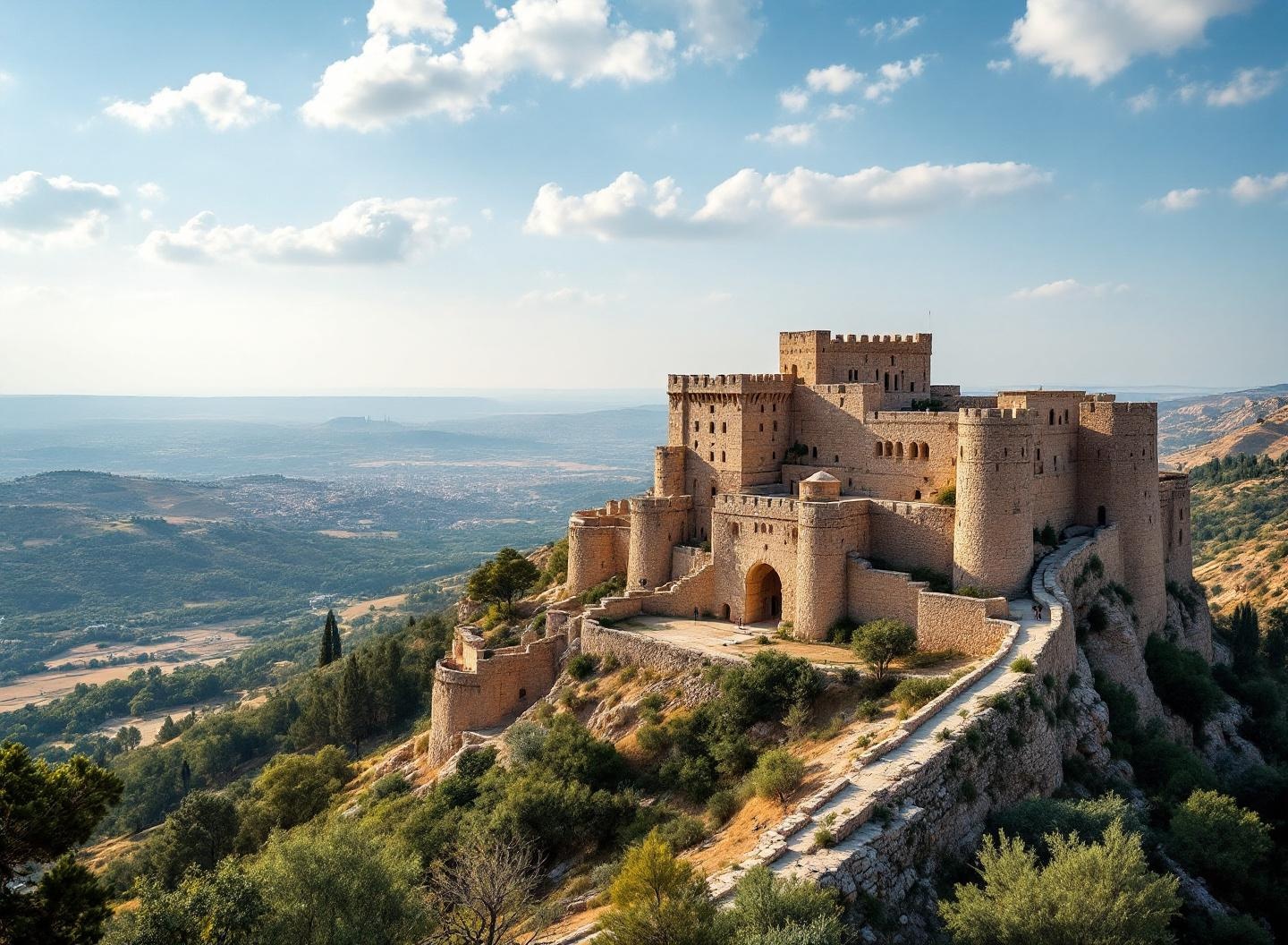
| Where | Ajloun highlands, ~1hr from Amman |
| Cost | ~7 JOD reserve entry; eco-cabins 50–90 JOD/night |
| Time needed | 1.5–4 hours depending on trail |
| Getting there | Car via Route 35, or bus to Ajloun town + taxi |
| Best time | March–May for wildflowers and mild temperatures |
Why hike Ajloun
Most visitors to Ajloun come primarily for Ajloun Castle — the imposing 12th-century Ayyubid fortress visible for miles across the northern Jordan hills. The forest reserve, however, is the better reason to stay longer. Ajloun Forest Reserve is one of the very few places in Jordan where you can walk through genuine forest — oak, wild pistachio, strawberry tree, carob — under a leafy canopy that feels entirely unlike the arid landscapes of Petra or Wadi Rum.
This is Jordan’s Mediterranean fringe, where the hills receive enough winter rainfall to support deciduous woodland. In spring, the forest floor is covered in wildflowers — cyclamens, anemones, wild orchids, poppies. In autumn, the oak canopy turns gold-orange before leaf fall. In summer, the shade provides relief from the heat that bakes the rest of the country.
RSCN has developed the reserve with four marked hiking trails of varying difficulty, overnight eco-cabins that can be booked in advance, and a programme of nature guides who provide context for the wildlife and plants you encounter.
The four trails of Ajloun Forest Reserve
Roe Deer Trail (8.5 km, moderate, 3–4 hours)
The longest and most rewarding trail in the reserve, named after the small roe deer that inhabit the deeper forest areas. The trail loops through the densest oak and pistachio woodland, crosses several seasonal stream beds (wadis) and gains and loses enough elevation to give views over the surrounding hills and valleys.
Roe deer sightings are possible but not guaranteed — the animals are shy and most active at dawn and dusk. More reliably spotted are the stone martens that raid picnic areas, the many species of woodland birds (European bee-eater, black redstart, lesser kestrel, Bonelli’s eagle) and, in spring, the wildflower display on the forest floor.
Difficulty: Moderate — some steep sections and rough terrain underfoot. Solid walking shoes required.
Soap House Trail (3 km, easy, 1–1.5 hours)
A shorter loop that passes an RSCN soap-making workshop where local women produce traditional olive and herb soaps using age-old methods. The trail is surfaced and easy underfoot. Products are available for purchase at the workshop — the soap is genuinely excellent and the visit supports local women’s income.
Best for: Families with young children, older visitors, those wanting an easy walk with a cultural component. A morning start allows time for the workshop visit plus Ajloun Castle in the afternoon.
Prophet’s Trail (6 km, moderate, 2–3 hours)
A pilgrimage-themed route that passes a hillside associated with local religious tradition and traverses the reserve’s most biodiverse mid-level woodland. The trail has panoramic views toward the Jordan Valley on clear days.
Wildlife highlight: The reserve supports breeding pairs of short-toed snake eagles, which can be seen soaring above the forest canopy.
Eagle’s Trail (4 km, moderate, 2 hours)
The most exposed trail in the reserve, climbing to the reserve’s highest viewpoint with clear-day visibility as far as the Jordan Valley and the hills of Palestine. Named for the raptors — Bonelli’s eagle, long-legged buzzard and short-toed snake eagle — that regularly patrol the ridge.
Shorter and steeper than the Roe Deer Trail. Good for those with limited time who want maximum elevation reward.
Wildlife in Ajloun forest
Ajloun Forest Reserve is one of the best wildlife-watching sites in northern Jordan. The combination of forested habitat, rocky limestone outcrops and seasonal streams creates a rich mosaic:
Mammals: Roe deer (Capreolus capreolus), stone marten (Martes foina), wild boar (Sus scrofa — present but rarely seen by hikers), red fox, Palestinian painted frog (in wetland areas), striped hyena (occasional — more easily detected by tracks and scat than by direct observation)
Birds: European bee-eater (April–September), Syrian woodpecker, Eurasian scops owl, lesser kestrel, Bonelli’s eagle, Palestine sunbird (male: iridescent green-blue), European roller
Reptiles: Starred agama lizard (bright blue-headed males on sun-warmed rocks), Hermann’s tortoise, Montpellier snake (non-venomous, fast-moving)
Spring flowers: Wild cyclamen, red anemone, Phoenician juniper, wild orchids (Anacamptis spp.), asphodel, Judas tree (masses of pink flowers in March before leaves emerge)
RSCN eco-cabins: staying overnight
Ajloun Forest Reserve offers one of the most comfortable eco-lodge stays in Jordan. The RSCN operates a cluster of well-maintained wooden cabins on the forest edge with private terraces looking into the trees. Each cabin sleeps 2–4 people and includes basic kitchen facilities, a private bathroom and bedding.
Cost: Approximately 60–90 JOD per cabin per night, including forest entry. Dinner and breakfast available from the on-site kitchen (15–20 JOD per person). Book through the RSCN website (rscn.org.jo) — the cabins book out in spring (March–May) and autumn weekends, so reserve at least 2–4 weeks in advance.
Staying overnight allows early morning and late afternoon wildlife watching when animals are most active. The dawn chorus in Ajloun forest is one of the unexpected pleasures of a Jordan trip.
Reserve fees and entry
| Item | Cost |
|---|---|
| Reserve entry (day visitor) | ~7 JOD per person |
| Trail guide (optional) | 15–20 JOD per group |
| Eco-cabin (per night) | 60–90 JOD |
| Soap House Trail (separate small fee) | 3 JOD |
Jordan Pass does not cover Ajloun Forest Reserve entry. Ajloun Castle entry, which is a separate site 2 km from the reserve, can be covered by Jordan Pass.
Combining Ajloun with Jerash
Ajloun and Jerash form the classic northern Jordan day trip from Amman. Most visitors do Jerash in the morning (allow 3–4 hours for the Roman city) and Ajloun Castle in the afternoon. Adding the reserve trails makes this a full day or an overnight.
Driving time: Amman to Jerash: 50 minutes. Jerash to Ajloun: 25 minutes.
Pre-booked day trips combining both sites: the Ajloun day trip and lunch with local family from Amman adds a home-cooked lunch component, providing genuine cultural contact in addition to the sightseeing. The Jerash and Ajloun Castle day trip with hike from Amman specifically includes a hiking element in the itinerary.
For a broader overview of the northern Jordan region, see our Jerash guide and north Jordan itinerary.
The Oak Trail: a cultural walk through food history
One of the least-marketed but most culturally interesting aspects of Ajloun Forest Reserve is the edible landscape it contains. The reserve’s ecological diversity extends to plants that have sustained human communities in this region for thousands of years.
Carob (Ceratonia siliqua): The long brown pods of the carob tree were a primary sugar source before refined sugar was widely available. The pods contain up to 50% natural sugars and were eaten directly, ground into carob flour or boiled into a syrup called dibs el-kharrub. Carob trees in Ajloun are hundreds of years old — their gnarled trunks a testimony to long habitation of this landscape.
Wild pistachio (Pistacia palaestina): The ancestor of the cultivated pistachio. The small, astringent nuts are edible and were harvested by village communities for millennia. The resin (mastic) tapped from related Pistacia lentiscus species was historically used as a chewing gum, a food preservative and a medicine.
Cyclamen (Cyclamen persicum): The tubers are edible (after preparation to remove toxic saponins) and historically eaten as a famine food. The beautiful pink flowers appear in autumn in Ajloun’s forest — one of the most distinctive signs of the Mediterranean season.
Mushrooms: Ajloun’s oak forest produces seasonal mushrooms, particularly in autumn after the first rains. RSCN guides on the Roe Deer Trail can identify edible species (various Boletus and Amanita) that local families have traditionally collected. The reserve has informal collection protocols — small personal quantities are tolerated; commercial collection is prohibited.
Wild herbs: Sage (Salvia officinalis), thyme (Thymus spp.) and oregano grow throughout the reserve’s open rocky sections. These herbs flavour the tea served at village homestays and are sold dried at the soap house cooperative.
Walking the Roe Deer or Prophet’s Trail with a guide who can identify and contextualise these plants transforms the hike from a nature walk into a living ethnobotany lesson.
Getting to Ajloun
From Amman by car: 1 hour via the highway toward Jerash (Route 35), then south toward Ajloun on Route 5. The reserve entrance is signed.
By public bus: Regular minibuses from Amman’s Abdali bus station to Ajloun town (1 hour, ~2 JOD). From Ajloun town, a short taxi ride (2–3 JOD) to the castle or reserve entrance.
Shared taxi from Jerash: Shared (servees) taxis run between Jerash and Ajloun throughout the day (25–30 minutes, 1–2 JOD per person).
Best season to visit
March to May is outstanding — wildflowers in full bloom, cool temperatures for hiking, all bird species present and displaying.
September to November is pleasantly cool, with excellent visibility from ridge trails. Autumn leaf colour develops in late October.
December to February is cold (potential frost and occasional snow on the hilltops) but the forest takes on a stark beauty and the reserve is uncrowded. Trails can be muddy after rain.
June to August is warm but the forest canopy provides meaningful shade, making midday hiking more tolerable than it would be on exposed Jordanian trails. Still, mornings are significantly better.
Tips for first-time visitors
- Arrive at the reserve as early as possible (opening time: 8 am) for the best wildlife sightings
- The Soap House Trail is the best easy option for families; the Roe Deer Trail for those wanting a full morning
- Bring snacks and water — the reserve café has limited offerings on weekdays
- A pair of binoculars transforms the wildlife experience
- The best photographs of roe deer are taken by visitors who wait quietly near water sources at dawn
Ajloun’s forest in ecological context
Ajloun Forest Reserve is part of the larger Mediterranean woodland zone that once covered much of the Levant. Before widespread deforestation for agriculture and building materials over the past 2 000 years, oak and pistachio woodland covered the hills from Turkey through Syria, Lebanon, Palestine and Jordan. What remains in Ajloun is a fragment of that original forest cover — scientifically significant as a remnant ecosystem.
The dominant species are:
- Valonia oak (Quercus aegilops) — the primary canopy tree, deciduous, supports dozens of insect species including the Ajloun oak gall wasp
- Pistacia palaestina (Palestine pistachio) — smaller, multi-stemmed, with aromatic foliage; related to the cultivated pistachio but bearing tiny inedible fruit
- Arbutus andrachne (strawberry tree) — distinctive red-orange peeling bark, white spring flowers, red berries attractive to birds; evergreen
- Quercus calliprinos (Palestine oak) — evergreen oak, gall-producer, important for insects and small mammals
- Pinus halepensis (Aleppo pine) — not native to Ajloun but widely planted in reforestation schemes; forms the uphill edge of some reserve sections
The forest floor in spring carries an extraordinary diversity of bulb-forming plants that have evolved to exploit the brief window between winter cold and summer drought: cyclamens (Cyclamen persicum), crown anemones (Anemone coronaria — the red anemones), star-of-Bethlehem (Ornithogalum spp.), asphodel (Asphodelus ramosus), and several orchid species (Orchis, Anacamptis, Ophrys).
Ajloun Castle: the historical context for the forest visit
Ajloun Castle — visible from many points in the reserve — is inseparable from the forest’s own history. The castle was built in 1184–85 by Izz al-Din Usama, a nephew of Saladin, on the site of an earlier monastery. Its purpose was to control the Jordan Valley crossings and protect the iron mines of the Ajloun hills from Crusader raids from their fortifications at Belvoir (Israel) across the valley.
The castle’s construction required enormous quantities of oak timber from the Ajloun forest — for scaffolding, formwork and fuel. Medieval deforestation around Ajloun for castle construction, agricultural terracing and charcoal production reduced the forest extent significantly. What you walk through today is a partially recovered forest, much of it the result of 20th-century planting combined with natural regeneration.
Visiting the castle (separate site, 2 km by road from the reserve; covered by Jordan Pass) alongside the reserve creates a satisfying combination — the military history of the ridge above and the ecological history of the forest below.
Castle practicalities: Open daily 8 am–6 pm (4 pm in winter). Entry: 3 JOD without Jordan Pass. Allow 1–2 hours for a full visit including the towers and the view from the top.
The RSCN approach to eco-tourism in Ajloun
The Royal Society for the Conservation of Nature (RSCN) manages Ajloun Forest Reserve under its Wild Jordan umbrella — the same organisation that runs Mujib Biosphere Reserve and Dana Nature Reserve. Wild Jordan’s business model is explicitly designed to make conservation self-funding: tourism revenue covers ranger salaries, trail maintenance, animal surveys and conservation science.
At Ajloun, this model includes:
- The Soap House: The women’s cooperative that produces and sells soap uses wild olive oil and locally harvested herbs. The income goes directly to the cooperant women’s households — it is not corporate social responsibility but genuine economic empowerment.
- Guide fees: Local men trained as RSCN guides earn their income from trail guiding. This creates an economic incentive for local communities to protect wildlife (dead ibex = lost guiding income) rather than exploit it.
- Eco-cabin hospitality: The kitchen and cleaning staff at the eco-cabins are recruited from the three nearest villages. Cabin revenue stays largely in Ajloun.
This is the model that the World Bank and various development agencies cite as one of the more successful examples of conservation financing through eco-tourism in the Middle East.
Practical logistics for a day visit from Amman
Most visitors pair Ajloun with Jerash in a single day from Amman. Here is a realistic logistics plan:
7:30 am: Depart Amman by car or private driver (50 minutes to Jerash via Route 35) 8:30–12:00: Jerash Roman city (allow 3–4 hours; arrive as it opens for minimal crowds) 12:30–13:30: Lunch in Ajloun town (simple restaurants serving hummus, grilled meats, falafel) 14:00–17:30: Ajloun Forest Reserve — Soap House Trail (1 hour) + Ajloun Castle visit (1.5 hours) 18:30: Return to Amman
This schedule is comfortable for adults and manageable for families with children 6+. It does not include the longer Roe Deer Trail — for that, a dawn start or an overnight at the eco-cabins is required.
Private driver: Arranging a private driver for the Jerash–Ajloun day costs 50–80 JOD from Amman depending on the vehicle. Most hotels in Amman can arrange this.
Pre-booked day tours: For visitors who prefer a structured format, the Ajloun day trip and lunch with local family from Amman adds a genuine home-cooked lunch experience that is difficult to replicate independently.
Frequently asked questions about Ajloun forest reserve
Is Ajloun forest suitable for families with toddlers?
The Soap House Trail (3 km, surfaced, easy) is manageable for young children with a pushchair or carrier. The longer trails (Roe Deer, Eagle’s) are not pushchair-friendly but manageable for children who can walk 6–8 km on uneven terrain. The eco-cabin setting is ideal for a family overnight.
Is a guide necessary for the reserve trails?
Guides are optional on all four trails. Trails are marked (coloured blazes on trees/rocks) and the GPS track is available from RSCN. A guide adds significant value for wildlife spotting and plant identification — the roe deer are found in specific areas known to experienced guides.
What is the difference between Ajloun Castle and Ajloun Forest Reserve?
Ajloun Castle is a 12th-century Islamic fortress on a hilltop 2 km from the reserve entrance — one of Jordan’s most impressive medieval military monuments. The reserve is a protected natural woodland managed by RSCN. Both are worth visiting; they are separate sites with separate fees.
Can I see roe deer reliably?
Roe deer sightings are most likely on the Roe Deer Trail at dawn or dusk with an RSCN guide. The reserve population is stable but the animals are shy. Sighting probability on a dawn guided walk: approximately 50–60% on any given day.