| Where | Amman — Rainbow Street, West Amman, Downtown, Shmeisani |
| Cost | around 7-15 JOD per portion depending on restaurant |
| Best for | one proper sit-down mansaf meal, not a snack |
| Booking | recommended at Sufra and Reem Al Bawadi on weekends |
| Pair with | a walking tour of downtown or a cooking class |
What mansaf actually is
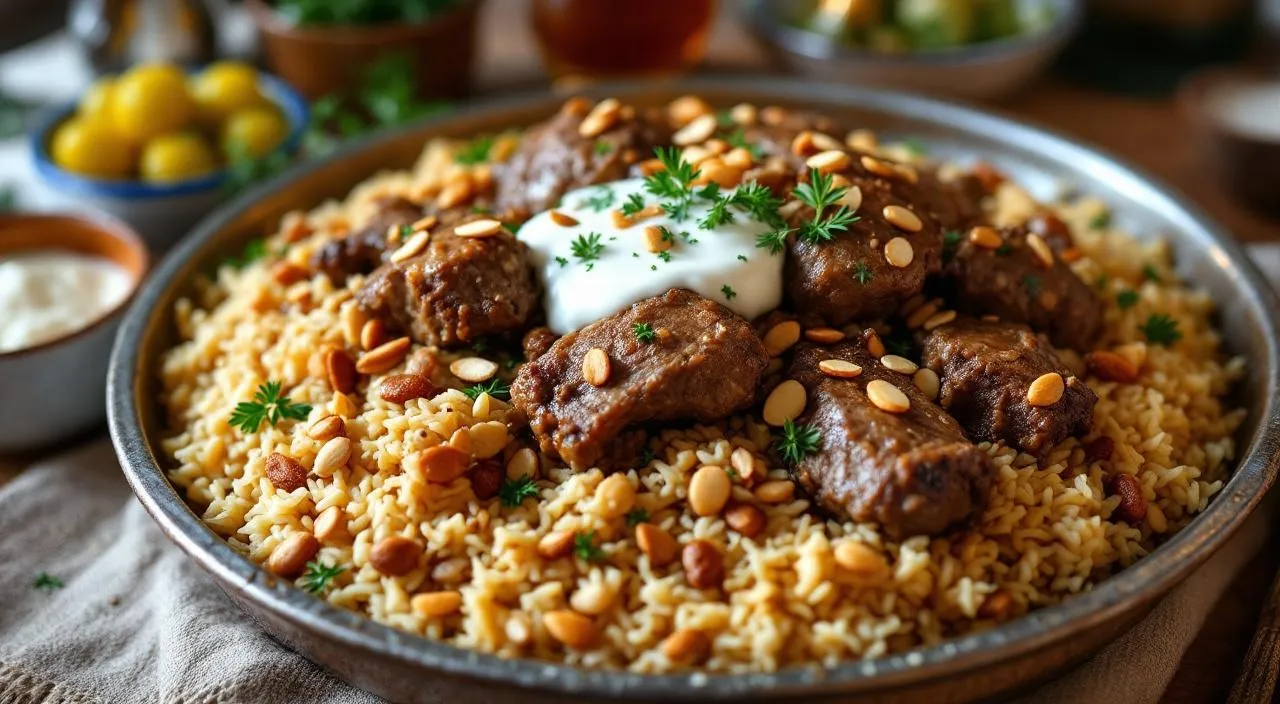
Jordan’s national dish is not a simple thing to describe to someone who has never eaten it. It is lamb — slow-cooked until the meat falls from the bone — served over a layer of thin flatbread, over a generous bed of saffron-tinged rice, with a ladling of jameed: the dried, fermented yogurt sauce made from goat’s milk that gives mansaf its distinctive tangy, almost funky depth.
The name comes from the Arabic for “large tray.” It is served communally, on a platter large enough for six people to eat from simultaneously. The ritual of eating mansaf properly — and there is a ritual — involves standing around the platter, eating with your right hand, rolling the rice and meat into a ball, and dipping it in the jameed sauce. Bread is used as a scoop. Cutlery is technically available but is a signal that you are treating this as ordinary food, which it isn’t.
Mansaf is eaten at weddings, at funerals, to celebrate the birth of a child, to seal a business deal, to mark the arrival of an honored guest. Understanding where to eat it properly in Amman is understanding something real about Jordanian hospitality.
Our mansaf guide covers the dish in detail. Here we focus specifically on the five Amman restaurants where we would send anyone with one meal to spend.
Restaurant 1: Sufra — the benchmark
Location: Rainbow Street, Jabal Amman Price: 12-15 JOD per portion (approximately 17-21 USD) What to know: Sufra is widely regarded as one of Amman’s finest traditional Jordanian restaurants, and its mansaf is the benchmark against which others are measured.
The restaurant occupies a converted 1940s villa, with stone walls, wooden furniture, and a terrace overlooking Rainbow Street. The atmosphere is elegant without being stiff — families, couples, and tourists all mix comfortably.
Sufra’s jameed is made in-house, and the fermentation is deeper and more complex than you’ll find at cheaper venues. The lamb is generous — you will not leave hungry. The rice is cooked with saffron and garnished with toasted almonds and pine nuts.
Book ahead on weekends. This is Amman’s answer to a special-occasion restaurant, and it fills up.
What to order alongside mansaf: the hummus (made fresh, with properly good olive oil), the moutabel (smoky eggplant dip), and the kibbeh. Skip the entire menu except for these, finish with knafeh, and call it a night.
Restaurant 2: Reem Al Bawadi — the scale experience
Location: Mecca Street, West Amman Price: 9-13 JOD per portion What to know: Reem Al Bawadi is everything Sufra is not, in the best way. It is enormous — one of the largest traditional Jordanian restaurants in Amman, seating hundreds across multiple terraced levels. It is loud, it is busy, and the mansaf comes out on platters so large you can practically use them as mattresses.
This is where Jordanian families come for special occasions. Weddings parties book out sections of the terrace. On a Thursday evening, the energy is extraordinary — Arabic music, the sound of a hundred conversations, servers navigating between tables carrying towers of food.
The mansaf here is more rustic than Sufra’s but served with pure generosity. The jameed sauce arrives in a separate vessel and you pour it to your preference. The rice portions are absurdly large. This is communal eating as it was designed to be.
Reem Al Bawadi is also excellent for meze — the cold mezze spread includes more than 30 options, and ordering five or six to start before the mansaf is the correct approach.
Restaurant 3: Hashem Restaurant — the institution
Location: Downtown Amman, near the Roman Theatre Price: 2-4 JOD for breakfast/lunch staples; mansaf variants available at lunch What to know: Hashem is listed in every travel guide, recommended by every local, and is genuinely worth the hype. It has been serving the same breakfast of hummus, falafel, and ful medames for over 50 years from a narrow two-floor building in downtown Amman.
Hashem does not serve traditional platter mansaf — but it does serve a lunch-time lamb with yogurt preparation that shares mansaf’s DNA. For the purist wanting the full ceremonial dish, go to Sufra or Reem Al Bawadi. For a version of the flavor profile in a setting that is quintessentially Amman, Hashem is worth understanding.
What you should absolutely eat here: the hummus (2 JOD for a generous bowl), the falafel (extraordinary, with herbs throughout the mixture), and the shakshouka for breakfast. Arrive hungry and plan to sit for an hour.
Restaurant 4: Tawaheen Al Hawa — the local’s choice
Location: Shmeisani area Price: 8-11 JOD per portion What to know: Less touristed than Sufra, more refined than Reem Al Bawadi. Tawaheen Al Hawa (“The Wind Mills”) occupies a pleasant space in Shmeisani with a local clientele — you are less likely to hear English at the surrounding tables here.
The mansaf is excellent: good quality lamb, proper jameed, and portion sizes calibrated for normal human beings rather than competitive eaters. The knafeh that follows is some of the best in Amman.
This is where we would go on a second or third Amman visit when the novelty of being conspicuously a tourist has worn off and we want to eat properly in a real neighborhood restaurant.
Restaurant 5: Dar Al Mushkah — near the Roman Theatre
Location: Downtown Amman, near the Roman Theatre Price: 7-10 JOD per portion What to know: Dar Al Mushkah is our pick for visitors who want to combine downtown sightseeing with a proper mansaf experience without traveling to Rainbow Street or West Amman.
The setting is a restored traditional stone house, which is pleasing. The mansaf is competent rather than outstanding, but for the downtown location and the atmospheric setting, it earns its place on this list.
Arrive for a late lunch (2-3pm) when the tourist rush has subsided. The service becomes considerably more attentive.
Which restaurant should you choose
| Restaurant | Best for | Price/portion |
|---|---|---|
| Sufra | first-timers, special occasions | 12-15 JOD |
| Reem Al Bawadi | big groups, loud family energy | 9-13 JOD |
| Hashem | breakfast staples, not full-platter mansaf | 2-4 JOD |
| Tawaheen Al Hawa | locals’ favorite, second/third visit | 8-11 JOD |
| Dar Al Mushkah | combining with downtown sightseeing | 7-10 JOD |
If you only have one meal in Amman for mansaf, go to Sufra. If you want the full communal-eating spectacle, go to Reem Al Bawadi on a Thursday evening.
Learning to make mansaf: Beit Sitti cooking class
If eating mansaf once is good, learning to make it is a different category of experience. Beit Sitti (“My Grandmother’s House”) is an Amman cooking school run by three sisters in a traditional house in Jabal Amman. The concept is simple: local women, mostly in their 50s and 60s, teach travelers to cook Jordanian food.
A Beit Sitti session costs approximately 35-45 JOD (50-63 USD) per person for a 2-3 hour class that includes a full meal. The mansaf class is not always available — it is one of several options that rotate — but booking ahead gives you the option to request it.
We have recommended Beit Sitti to everyone we know visiting Amman, regardless of whether they have particular interest in cooking. The experience of sitting in someone’s kitchen, learning to make jameed sauce from scratch while the instructor’s grandchildren run through the room, is the kind of authentic cultural exchange that travel promises and rarely delivers.
Women-led food tour through Amman's culinary sceneThe ritual of eating mansaf
This deserves its own section because eating mansaf “correctly” is part of understanding the dish.
Eating with your right hand: This is not arbitrary etiquette. In Arab culture, the left hand is considered impure (associated with bathroom functions). Eating with the right hand is expected. If you are left-handed, make an effort with the right at the shared platter.
Rolling the rice ball: Experienced mansaf eaters take a handful of rice, roll it quickly in the palm while simultaneously pressing in a piece of lamb, and then consume it in one efficient motion. This takes practice. You will be terrible at it at first and that is fine.
Standing vs. sitting: Traditional mansaf is eaten standing around the platter. Modern restaurants often serve it at tables with chairs. Either is fine, but understanding the standing tradition puts the communal nature of the dish in context.
The jameed sauce: Pour it over everything. Do not be shy. The jameed is the point of the dish.
Bread: The flatbread under the rice is not decorative. It absorbs the jameed and becomes extraordinarily delicious toward the end of the meal. Eat it.
Don’t leave the platter empty: In traditional contexts, leaving a small amount of food on the platter signals that you were fed enough. Eating every grain of rice to the last suggests you were not given enough. This is host context — at a restaurant it matters less, but the custom is worth knowing.
Prices, timing, and booking
Mansaf ranges from 7 JOD (100 USD) at casual lunch venues to 15 JOD ($21 USD) at upscale restaurants. Add 15-20% for drinks, bread, and mezze starters. For two people with drinks, budget 30-40 JOD (42-56 USD) at a mid-range venue.
Lunch (12pm-3pm) is the primary mansaf service at most restaurants. Some serve it through dinner, but the freshest preparation is typically at lunch.
Reservations are recommended at Sufra and Reem Al Bawadi on weekends. For the others, walk-in is usually fine.
Amman city walking tour: local culture, hidden places & foodRounding out the meal
Mansaf rarely arrives alone. Most of the restaurants above open with a mezze spread, so read our levantine mezze guide before you order so you don’t fill up before the main platter arrives. For dessert, knafeh is the standard closer across Amman — our knafeh guide explains the difference between the Nabulsi and Amman-style versions you’ll see on menus. And if mansaf is your entry point into Jordanian food more broadly, the Jordanian food essentials guide covers everything else worth ordering on the trip.
Several of these restaurants sit close enough to downtown sights to combine easily: Hashem and Dar Al Mushkah are a short walk from the Roman Theatre and the Amman Citadel, so a lunch stop fits naturally into a downtown sightseeing morning. For the fuller picture of eating well across the city, our Amman food tour guide and the women-led food tour both go beyond mansaf into the markets and street food scene. The Amman destination page ties the food, sights, and neighborhoods together.
Frequently asked questions about Where to eat mansaf in Amman
What does mansaf taste like?
Tender slow-cooked lamb with a distinctive tangy, fermented yogurt sauce (jameed) over saffron rice. The flavor is savory, slightly funky (from the fermentation), and deeply satisfying. It is not spicy.
How much does mansaf cost in Amman?
A standard portion costs 8-15 JOD (11-21 USD) at sit-down restaurants. Budget restaurants may serve smaller portions for 5-7 JOD. This typically includes enough for one person.
Is mansaf available for vegetarians?
Traditionally, no — mansaf is a lamb dish. Some restaurants offer a vegetarian-adjacent version with yogurt rice and vegetables, but this is not really mansaf in the traditional sense.
Can you eat mansaf with cutlery?
Cutlery is available at most restaurants. Eating with your hands from a shared platter is traditional and optional. Many visitors do both — hands for the experience, fork for when the hand technique fails.
Which restaurant is best for a first-time visitor?
Sufra, without much hesitation. It’s the benchmark version of the dish, the atmosphere is comfortable for tourists and locals alike, and the rest of the menu (hummus, moutabel, kibbeh) gives a fair sample of Jordanian cooking beyond mansaf alone.
Is mansaf served for dinner or only lunch?
Lunch (roughly 12pm-3pm) is when mansaf is freshest and most widely available, since it’s traditionally a midday dish. Some restaurants, including Sufra and Reem Al Bawadi, also serve it at dinner, but if mansaf is the priority, plan for lunch.