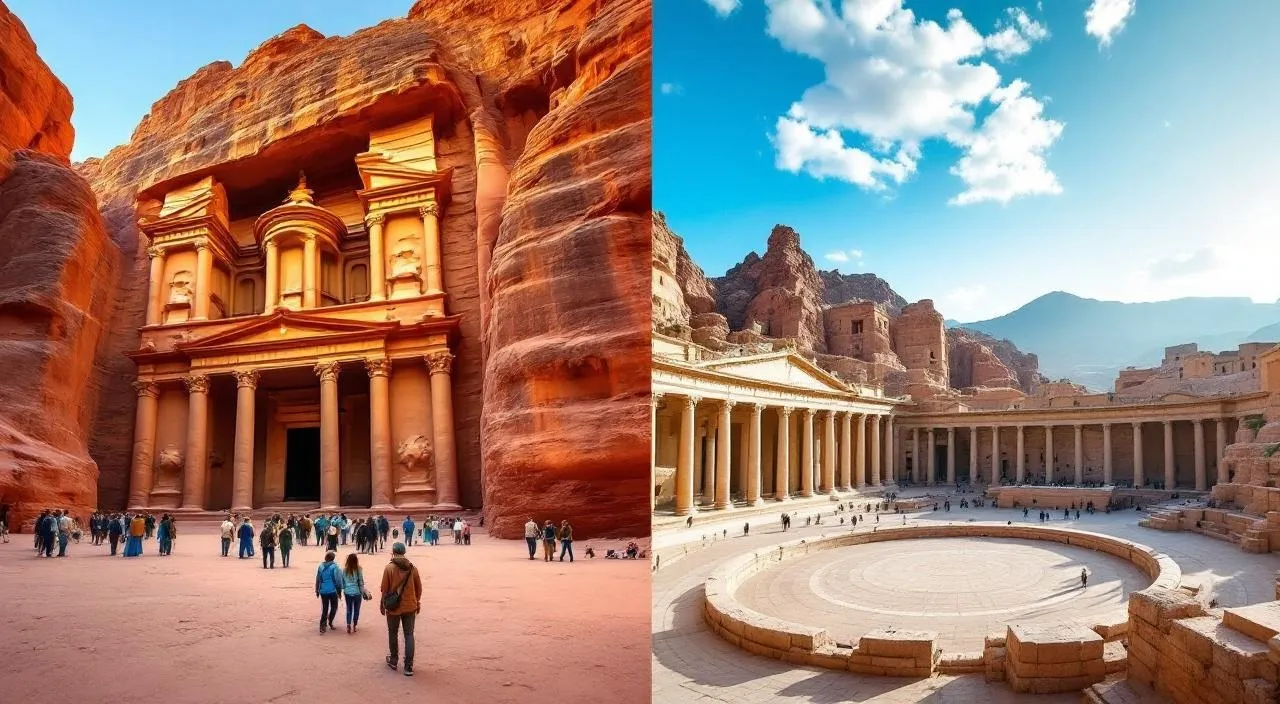
| Jerash | 50min north of Amman, half-day visit, largely flat |
| Petra | 3hrs south of Amman, 1-2 full days, stairs and climbing |
| Cost | Both covered by the Jordan Pass; Jerash ~10 JOD alone |
| Can you skip one | Skip Jerash on a short trip; Petra is non-negotiable |
| Best for both | 7+ day itineraries — visit Jerash en route north, Petra south |
First: let’s clear up the “Roman” question
Travel descriptions routinely call Petra a “Roman site.” This is technically misleading and requires a quick correction, because understanding what each city actually is changes how you think about the comparison.
Jerash is Roman. Genuinely, completely Roman. The city was originally Gerasa, one of the great cities of the Roman Decapolis — a confederation of ten Hellenistic-Roman cities in the eastern empire. What you see at Jerash — the cardo maximus, the forum oval, the temples, the colonnaded streets, the hippodrome, the triumphal arch — is a Roman planned city, built by Roman architects and administrators, showing Roman urbanism at its most confident.
Petra is Nabataean. The Nabataeans were an extraordinary Arab trading civilization that built their capital city — literally carved it — into the rose-red sandstone of southern Jordan over roughly the 3rd century BC to the 1st century AD. The Treasury, the Monastery, the Royal Tombs — these are Nabataean architecture.
However, Petra also has Roman layers. The Romans annexed the Nabataean kingdom in 106 AD and turned it into the province of Arabia Petraea. The Colonnaded Street in the main valley is a Roman construction. The temenos gate and the Qasr al-Bint temple show Roman influence. So Petra is a Nabataean city with significant Roman-era modifications.
For visitors: Jerash feels Roman in its planning, its grid streets, its monumental civic spaces. Petra feels otherworldly in its carved facades, its canyon setting, its sheer geological drama. Both have Roman layers. Only Petra has a Siq.
What Jerash does better than Petra
Urban wholeness
Jerash is, among the best-preserved Roman cities in the world outside Italy itself, one of the most complete. Pompeii and Herculaneum benefit from volcanic preservation; Jerash’s preservation is a result of centuries of relative abandonment followed by careful excavation.
What you see at Jerash is a city. Not a set of impressive ruins scattered across a site, but a city: streets you can walk from end to end, civic spaces that make sense in relationship to each other, temples that faced forums that led to colonnaded markets. You understand what it was like to live here in ways that scattered ruins don’t allow.
The Oval Plaza (Forum) is particularly spectacular — an elliptical colonnaded space unlike anything else in the Roman world, with original paving still in place. Walking across it feels like walking into something that was designed to make you feel small and impressed. It succeeds.
The human scale
Jerash is comprehensible in a way Petra sometimes isn’t. You can see the whole site from elevated points, understand the layout, walk every significant street in a full day. It is a city on a human scale.
This has practical implications for visitors who are less physically fit, have less time, or find Petra’s canyon walking and stair-climbing demanding. Jerash is largely flat, the paths are generally clear, and the major monuments are within easy walking distance of each other.
The living presence
Jerash sits adjacent to a modern city of 50,000 people. Locals use the site for evening walks. Families picnic near the Oval Plaza on Fridays. There are craft vendors and tea sellers who have been working the site for decades. This makes Jerash feel like an inhabited place, not just a preserved one.
Petra’s surrounding town (Wadi Musa) is entirely a tourist service infrastructure. The ancient city itself is genuinely empty of residents. There is something beautiful about that, and something slightly sterile.
For the full breakdown of what to prioritize inside the site, see our complete Jerash guide.
From Amman: Jerash half day tourWhat Petra does better than Jerash
Sheer physical drama
Nothing prepares you for the Siq. Nothing prepares you for the Treasury. We have both visited many archaeological sites on multiple continents, and Petra’s first-encounter impact — the narrow slot canyon that suddenly opens to the towering carved facade — remains in a category by itself.
Petra was not built to be seen from the outside. It was built into the rock. The architecture is the geology. This is something no Roman planned city achieves and no other ancient site in Jordan approaches.
The scale is also genuinely astonishing. The Monastery (Ad Deir) is larger than the Treasury, and most visitors don’t even make it there — it requires 800 stairs from the basin. The Royal Tombs are vast. The whole site covers 264 square kilometers, though the core visitor circuit focuses on the central valley.
Depth of experience
Petra rewards time in a way Jerash does not. You can see the essential Jerash in four hours. You can spend two full days in Petra and still feel you’ve only seen the surface.
The trails beyond the main valley — the High Place of Sacrifice, the Monastery hike, the back routes into the hidden valleys — reveal a site of extraordinary depth. There is no equivalent in Jerash.
The Nabataean civilization itself
Petra is evidence of a civilization that history nearly forgot. The Nabataeans controlled the ancient spice and frankincense trade routes, built a hydraulic system in a desert that still astonishes engineers, and created an architectural vocabulary — the carved rock facades, the rose-red stone — that is genuinely unlike anything else on Earth.
Learning about the Nabataeans at Petra is different from learning about the Romans at Jerash. Romans are everywhere in Europe and the Mediterranean — we live in their urban grid, we use their legal frameworks, we have their mythology. The Nabataeans are less familiar, and Petra makes them real.
If you’re deciding how much time to allocate, our Petra 1 day vs 2 days breakdown goes deeper into what each additional day actually buys you, and the complete Petra guide covers logistics for the whole site.
Petra: private 3-hour guided tour with hotel pickupThe comparison: practical decision guide
| Factor | Jerash wins | Petra wins |
|---|---|---|
| Time available | Half a day sufficient | 1-2 full days optimal |
| Physical fitness | Less demanding, largely flat | More demanding, stairs and climbs |
| First-time Jordan | Important but not the primary draw | Non-negotiable |
| Architecture/urbanism | Roman urbanism at its best | Nabataean rock-carving unmatched |
| Emotional impact | High | Extraordinary |
| Cost | ~10 JOD entrance, or Jordan Pass | Jordan Pass strongly recommended |
| Crowds | Moderate in peak season | Can be intense at peak hours |
Our recommendation
If you have 7+ days in Jordan: visit both. This is the most common advice we give, and it is the most honest. Jerash is a 45-minute drive from Amman and can be combined with a morning city visit or an afternoon at the Dead Sea. It is genuinely one of the great archaeological sites of the world and deserves several hours.
Petra is a different experience on a different scale, and it typically requires a dedicated overnight stay (the journey from Amman is 3 hours; attempting it as a day trip is possible but exhausting and insufficient).
On a 7-day Jordan trip, a logical structure is: Day 1-2 Amman (include Jerash day trip), Day 3 drive south with Dead Sea stop, Day 4-5 Petra (two days minimum), Day 6 Wadi Rum, Day 7 Aqaba or return.
If you have 5 days or fewer: Petra is non-negotiable. Drop Jerash and do not regret it. The Petra experience is qualitatively different from anything else on the itinerary and must be given time.
If you have physical limitations: Consider Jerash over Petra. The majority of Petra’s most important sites involve significant walking and stair-climbing. Jerash is largely accessible and equally impressive from a Roman history perspective.
If you’re primarily interested in archaeology: Don’t make us choose. The Nabataean genius at Petra and the Roman urbanism at Jerash represent different civilizational achievements. Seeing both in context is how you understand the layered history of this region.
Getting to both sites
Jerash from Amman
50-minute drive north of Amman. Day trips are the standard approach. JETT and private buses operate from the Amman bus terminal. Car rental or a private driver from Amman are the most flexible options — see our Jerash from Amman guide for the full range of transport options and prices.
Petra from Amman
3 hours by car (Desert Highway) or 4 hours (King’s Highway, scenic). JETT buses operate from Amman’s Wihdat station — affordable (around 11 JOD one way) but the schedule requires checking. Most visitors fly into Amman and drive south; the Petra from Amman guide breaks down every option including private transfer prices.
Can you do both in one trip?
Easily. Jerash is on the way north; Petra is in the south. A standard Jordan circuit visits Amman-Jerash-Dead Sea-Petra-Wadi Rum-Aqaba. Jerash and Petra are never direct route alternatives — they are on different ends of the country.
The verdict
Petra is the reason most visitors come to Jordan. The Treasury is the image on every brochure, the UNESCO World Heritage designation, the Indiana Jones location, the Dune backdrop. It deserves every bit of its reputation.
Jerash is the reason you should stay long enough in Jordan to discover what else is here. It is extraordinary in its own right — among the best-preserved Roman cities on Earth — and it receives a fraction of Petra’s attention.
Visit both if you can. If you must choose, visit Petra. But plan to come back for Jerash.
Frequently asked questions about Petra vs. Jerash
Is Jerash better than Petra?
They are not comparable in the same category. Jerash offers the finest Roman urbanism in Jordan; Petra offers a Nabataean rock-carved city that has no equivalent anywhere. Both are extraordinary and serve different purposes.
How long do you need for Jerash?
3-4 hours for a thorough visit. 5-6 hours if you want to attend the gladiatorial show (held in the reconstructed hippodrome) and linger at the Oval Plaza and temples.
Is Jerash included in the Jordan Pass?
Yes. The Jordan Pass covers Jerash entrance. Petra entrance (1, 2, or 3 days depending on tier) is also included.
Which is bigger: Petra or Jerash?
Petra covers a much larger area (264 sq km protected area, with the core valley covering several kilometers). Jerash’s archaeological site is approximately 2km by 1km. Petra takes significantly longer to explore fully.