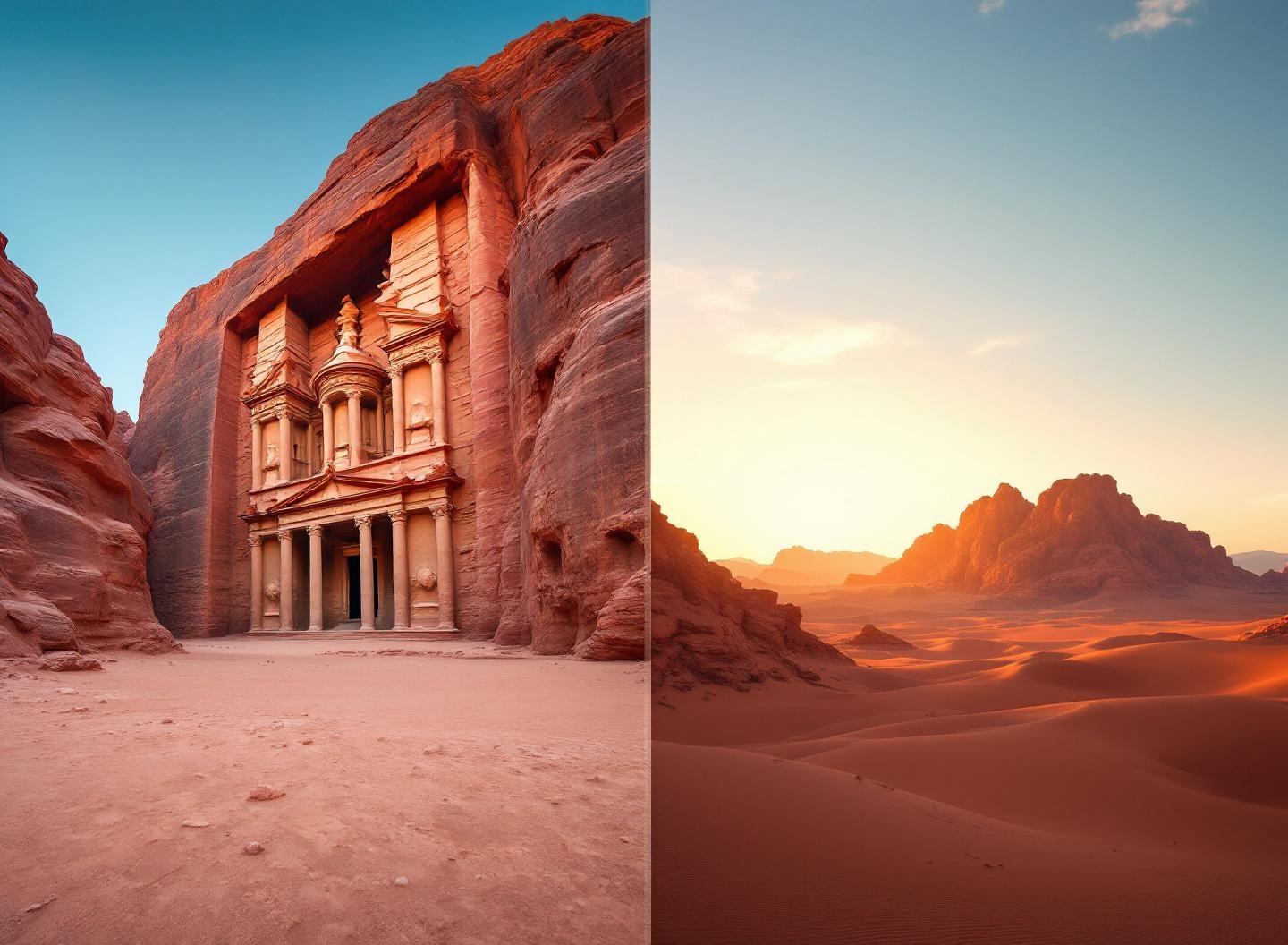
The honest budget picture in 2026
Jordan has a reputation as an expensive destination. This reputation is partly earned — Petra’s entrance fee is significant, Wadi Rum’s camp prices have risen, and the mid-range hotel market is pricier than comparable destinations in Southeast Asia.
But Jordan on a backpacker budget is entirely possible. We know this because we have done it, and because we have tracked costs carefully from travelers who have done it recently. The numbers below are real 2026 figures — not best-case estimates, not worst-case padding, but what an organized, budget-conscious traveler actually spends.
| Backpacker total (10 days) | Around 965 USD excluding accommodation and transport, ~365 USD excluding flights as well |
| Biggest fixed cost | Jordan Pass, around 105 USD |
| Cheapest daily spend | Food, around 18 USD/day |
| Least negotiable cost | Wadi Rum camp (rates on each camp’s site) |
| Best time to go for value | Shoulder season — cheaper camps and hotels |
If this is your first trip, read it alongside the first-time Jordan guide and the wider plan your Jordan trip overview, which explain how the pieces fit together before you start counting dollars. The money side is covered in more depth in Jordan currency and money.
The 10-day backpacker budget: line by line
Flights: ~600 USD (round trip, European origin)
Budget for 550-700 USD return from Western Europe (London, Paris, Frankfurt). Budget airlines including Ryanair and Wizz Air occasionally offer cheaper options, particularly to Aqaba rather than Amman. North American travelers should budget 700-1,100 USD depending on origin city.
These figures assume booking 8-12 weeks ahead and reasonable flexibility on dates. Flying midweek typically saves 50-100 USD versus weekend departures.
Visa: 0 USD (Jordan Pass covers it)
If you are buying the Jordan Pass (which you should, for any visit that includes Petra), the visa is included. The Jordan Pass costs 70 JOD for 1 Petra day, 75 JOD for 2 Petra days, 80 JOD for 3 Petra days.
The standalone visa costs 40 JOD (~56 USD). So the net cost of the Jordan Pass over visa alone is:
- 1 Petra day: 30 JOD net (~42 USD)
- 2 Petra days: 35 JOD net (~49 USD)
Petra’s standalone entrance for visitors staying at least one night in Jordan is 50 JOD for one day, 55 JOD for two days and 60 JOD for three days (per the Petra Development and Tourism Region Authority). The math is straightforward: the Jordan Pass costs less than the visa plus the Petra ticket, and everything else (Jerash, Mount Nebo, the Citadel, and 40+ other sites) is included for free.
Jordan Pass cost: 75 JOD per person (2-day Petra tier) = ~105 USD. This replaces the visa + Petra entrance.
Accommodation: check each property’s own rates
Hostels, guesthouses and camps are private businesses that set and change their own rates, and there is no official price list, so we do not quote a per-night figure. Check the booking page or official website of each place. Where to look for a budget bed:
- Amman: hostel dorms and small boutique hostels in Jabal Amman. Cliff Hotel and Sydney Hotel are long-established budget names.
- Wadi Musa/Petra: hostel dorms and budget guesthouses, several within 1km of the Petra visitor center entrance.
- Wadi Rum: this is the budget pressure point. Camps include dinner and breakfast, and the cheapest ones are basic. Compare what is included and read recent reviews rather than choosing on price alone.
- Aqaba: guesthouses. Aqaba has more budget options than its resort reputation suggests.
The hostel social dividend: Amman’s hostel scene is genuinely friendly and international. The networking at budget accommodation often produces shared taxi arrangements (to Petra, from the Dead Sea), which further reduce transport costs.
Food: 15-20 USD per person per day (~180 USD for 10 days)
Jordan’s food is one of the genuine gifts of budget travel here. At budget restaurants and street food stops:
- Breakfast: Hummus, falafel, flatbread — 1-2 JOD (~1.40-2.80 USD). This is the best breakfast in the world at this price point.
- Lunch: Falafel sandwich with pickles and vegetables — 0.50-1 JOD. Or a sit-down place for a chicken shawarma — 2-3 JOD.
- Dinner: A mid-range sit-down restaurant in Amman or Wadi Musa — 5-8 JOD for a generous meal including mezze.
Where the food budget expands: the Petra basin restaurants (captive audience pricing, with no posted price list). Bring your own lunch into Petra to avoid this. The guard at the entrance does not check bags for outside food.
Water: bottled water in Jordan is 0.30-0.50 JOD per 1.5L bottle at supermarkets. Buy at supermarkets, not inside tourist sites.
Realistic daily food budget: 12-18 JOD per day (~17-25 USD). Call it 18 USD average.
Transport: JETT bus, local minibuses and shared taxis
Getting around Jordan on a budget means JETT bus plus local minibuses plus occasional shared taxis:
| Route | JETT / public bus | Notes |
|---|---|---|
| Amman → Petra | see the official JETT site | JETT bus, 3.5 hours |
| Amman → Aqaba | see the official JETT site | JETT bus, 4 hours |
| Wadi Musa → Wadi Rum | price to agree before departure | Shared taxi; ask at your hostel for current options |
| Airport → Amman | see the official operator site | Airport Express bus |
| Amman city transport | fare to agree or check before boarding | Minibuses / shared taxis |
Transport budget: we give no total here, because JETT and the other operators do not publish fares we can quote reliably. Check the official JETT site for the Amman-Petra and Amman-Aqaba buses, then add the shared taxi to Wadi Rum and some Amman city transport once you have agreed the prices.
Car rental is not the budget option — it is the convenience option. A rental car plus insurance plus fuel plus parking for 10 days costs far more than buses (check current rates with the rental company), though it gives you significantly more flexibility. This is the right choice for mid-range travelers; it is not a budget move.
Petra entrance via Jordan Pass: included above
The Jordan Pass at 75 JOD covers Petra (2 days) plus all other included sites. For the budget traveler, this is the calculation:
- Visa: 40 JOD (without pass)
- Petra 2-day entrance: 55 JOD (without pass)
- Total without pass: 95 JOD
- Jordan Pass: 75 JOD
- Saving: 20 JOD (~28 USD), plus free entry to the other included sites
The Jordan Pass is not optional at budget level. It is the single biggest per-person saving available in Jordan. See our full Jordan Pass guide for current tier pricing and which sites it actually covers.
Other activities: ~80 USD
Most of what makes a budget trip memorable is cheap or already covered by the pass. If you want to go deeper on the sites themselves, the Petra complete guide and the Jerash complete guide help you plan each visit so you do not pay for extras you do not need. For a free-to-low-cost day out, the Dead Sea from Amman guide explains the options.
- Dead Sea day: Budget access is possible at public beaches (entry is cheaper than a resort day pass; see the official website of each beach or resort for current rates). Some budget travelers access the Dead Sea via a day-trip arrangement through Amman hostels.
- Jerash: Covered by Jordan Pass
- Wadi Rum jeep tour: Most camps include at least a short jeep tour in the overnight price. If you want a full-day tour from a budget camp, ask the camp for its price.
- Petra by Night: 30 JOD (~42 USD). Controversial in terms of value — a candlelit Siq is atmospheric but the musical performance is brief. Optional at budget level.
Full 10-day backpacker budget summary
| Category | Cost (USD) |
|---|---|
| Flights (economy, European origin) | 600 |
| Jordan Pass (visa + Petra 2 days) | 105 |
| Accommodation (10 nights) | See each property’s rates |
| Food (10 days, 18 avg) | 180 |
| Activities and extras | 80 |
| Total (excluding accommodation and transport) | ~965 USD |
This is an honest backpacker budget. It covers Petra (2 days), Wadi Rum (1 night), Aqaba (1-2 days) and Amman (2 days); accommodation and transport between points are not priced here, so add them from the operators’ own rates. It uses hostels and dorms, public buses, and basic restaurant food.
The mid-range comparison
For context: the same 10-day trip for a couple at mid-range doubles most categories:
| Category | Mid-range couple (USD) |
|---|---|
| Flights (economy) | 1,200 |
| Jordan Pass (2 adults) | 210 |
| Accommodation (10 nights, private rooms) | See each property’s rates |
| Food (10 days) | 500 |
| Activities (Wadi Rum upgrade, Dead Sea resort) | 400 |
| Total (excluding accommodation and transport) | ~2,310 USD |
Mid-range per person: ~1,155 USD, excluding accommodation and transport.
Where the money goes furthest
The best value in Jordan is food. Eating at local restaurants, buying breakfast from the falafel shops, and avoiding tourist-trap pricing inside sites gives you genuinely excellent food at very low cost.
The most important budget decision is transport. The difference between taking the JETT bus (the price is to be checked on the official JETT site) and booking a private car transfer (agree the price in advance) is substantial. Over a 10-day trip with 3-4 long transfers, this alone can make a large difference to the total.
The least avoidable budget item is Wadi Rum accommodation. You cannot do Wadi Rum properly without overnight camping, and the cheapest camps still add a real cost. This is not negotiable without significantly compromising the experience. Our Wadi Rum overnight camps guide breaks down what you actually get at each price tier.
Short Wadi Rum jeep tour with Bedouin tea — a budget-friendly add-on if your camp package doesn’t include oneIf you would rather compare options before paying for anything extra, the Wadi Rum jeep tours compared guide lays out what different formats include, and our Wadi Rum Bedouin camp experience post describes what a night at a basic camp is really like. For the latest camp pricing context, see the Bedouin camp prices update.
Food is where a budget trip pays you back in flavour. If you want to spend a little on one guided evening, a local food walk through Amman is a good way to learn what to order for the rest of the trip, and the Amman food tour guide and Jordanian food essentials cover the dishes worth seeking out at cheap local places.
Renting a car vs staying on public transport
The self-drive option is the biggest single lever between the backpacker and mid-range budgets, and it’s worth being explicit about the trade-off. A 10-day rental with insurance and fuel costs considerably more than JETT buses and shared taxis covering the same route (check current rates with the operators). What you gain is flexibility — stopping at Kerak Castle or the Dead Sea highway viewpoints on your own schedule — which the tours vs self-drive guide and the renting a car in Jordan guide cover in more depth, including insurance gotchas specific to Jordan.
Budget tips that actually work
Arrive in Amman, not Aqaba: The Airport Express bus from Queen Alia International Airport runs to the city (check the operator for the current fare). Arriving late and taking a taxi costs more, so agree the price or insist on the meter. The first-night transportation difference is meaningful.
Buy water at supermarkets: Across 10 days, buying water at 0.40 JOD per large bottle instead of 1.50-2.00 JOD inside sites saves approximately 20-30 JOD.
Bring lunch into Petra: The Petra basin restaurants are expensive by Jordanian standards. Sandwiches from Wadi Musa supermarkets are a fraction of the price. Bring enough for a full day.
JETT bus for long distances: The JETT bus is comfortable, air-conditioned, and punctual. The Amman-Petra service departs from the Abdali bus station twice daily. Book ahead at the JETT office in Amman.
Negotiate hostel taxi shares: Ask at your Amman hostel whether anyone else is heading to Petra on the same day. Shared taxis from hostel-organized groups can be comparable to the JETT bus in cost and significantly more flexible.
For the bus side of the plan, the JETT bus guide and the getting around Jordan guide explain how the main routes work. Tipping adds up too, so check tipping in Jordan before you leave, and if you are travelling alone, the solo female travel guide has practical advice on hostels and shared rides. Timing matters for cost as well: the best time to visit Jordan guide helps you pick a shoulder season.
For full itinerary and budget planning, see our 10-day Jordan budget itinerary.
Frequently asked questions about Jordan on a budget in 2026
What is the minimum daily budget for Jordan?
There is no official figure. Food and activities in this guide come to roughly 25-30 USD per person per day (our estimate), to which you add accommodation at the rates each property publishes and transport at the prices you agree.
Is the Jordan Pass worth it on a budget?
Yes, unambiguously. The Jordan Pass saves about 20 JOD (~28 USD) compared to buying a visa and Petra entrance separately. It is the most important single budget decision.
Can you visit Petra on a budget?
Yes. Petra entrance via Jordan Pass is covered. Check the rates of Wadi Musa hostels and guesthouses on their own pages. Food in town is cheap. The main expense is the Jordan Pass purchase itself, which is non-negotiable.
What is the cheapest way to travel between Jordanian cities?
JETT buses on intercity routes (the price is to be checked on the official JETT site). For shorter routes (Wadi Musa to Wadi Rum), shared taxis negotiated through hostels are often the most practical option.
Is a rental car worth it on a budget trip?
Usually not. A 10-day rental with insurance and fuel costs considerably more than buses and shared taxis covering the same route (check current rates). It only pays off if you specifically want to stop at minor sites (Kerak, Shobak, the Dead Sea highway) that public transport doesn’t reach conveniently — otherwise it’s a comfort upgrade, not a budget move.