Why we went to Jordan with kids
Seb was 9, Lena was 6. Our previous family trips had been Italy (too many churches), Portugal (perfect), and one ill-advised week in Vietnam that ended in a stomach-bug hotel room in Hoi An. We were realistic about Jordan: an 8-day trip to the Middle East with two children under 10 is an adventure by definition, and not always in the fun way.
We went anyway. And here is the honest account of what happened.
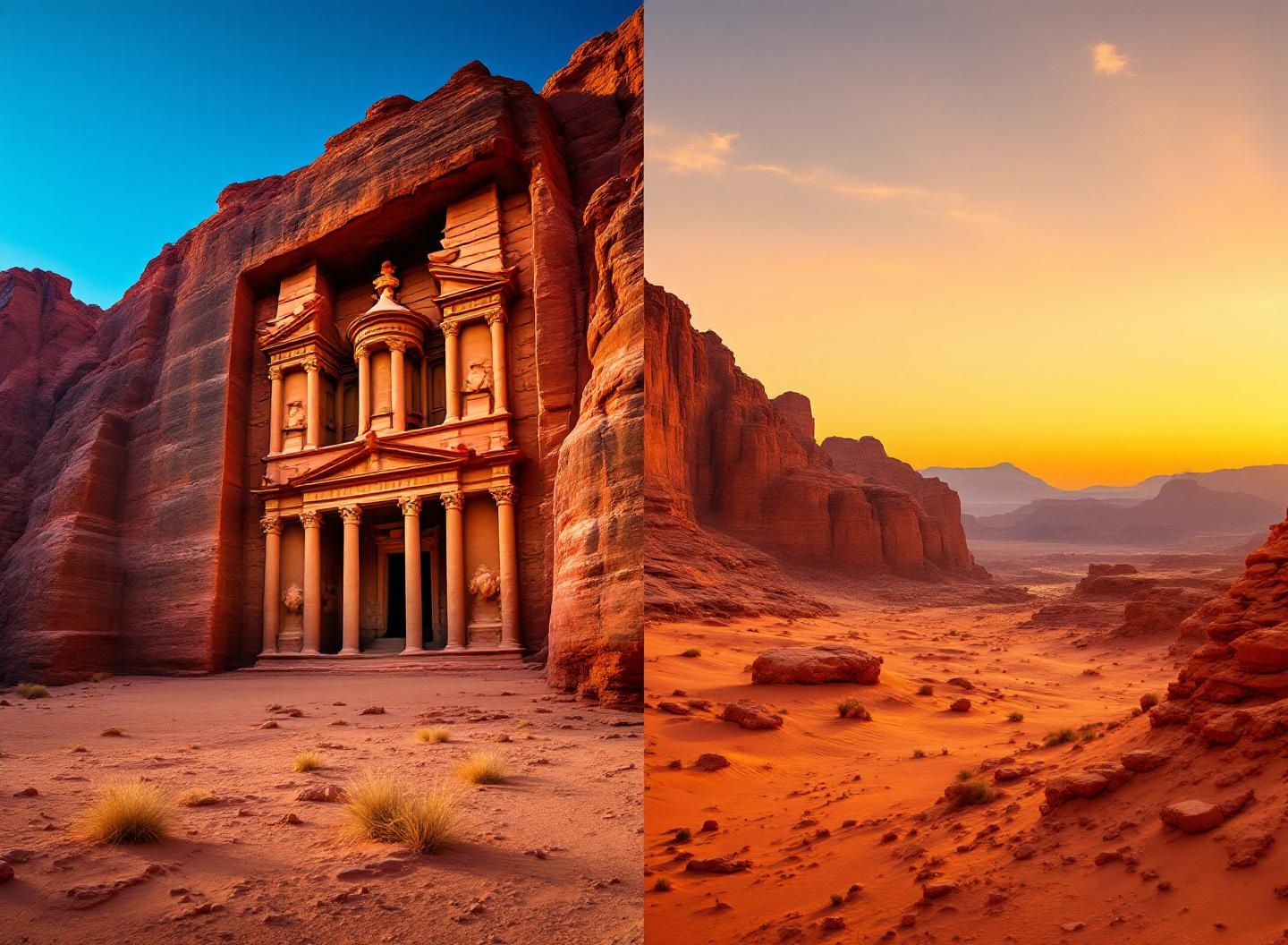
The short version: Jordan worked better with children than we expected. Not effortlessly — there were two difficult days, one genuine disaster (Wadi Mujib was not what we planned), and several moments where we questioned our decision-making. But there were also a camel in Wadi Rum that Lena named Habibi, a Dead Sea mud fight that lasted 45 minutes, and Petra at 7am when the light turns the Treasury rose-gold and both kids went completely silent. Those moments justify everything.
| Best age | From around 5-6, easiest from 7+ |
| Trip length | 8 days covers Amman, Dead Sea, Petra, Wadi Rum, Aqaba comfortably |
| Budget (family of 4, mid-range) | Around 5,000 USD for 8 days |
| Watch out for | Wadi Mujib age/height minimums, Monastery stairs, midday heat |
| Best season | March-April or October-November |
The planning reality: what Jordan offers families
Jordan’s tourist infrastructure is increasingly family-aware. Hotels in Amman and Aqaba are professional at family accommodation. The Dead Sea resorts have proper children’s pools and kid-friendly beach access. Wadi Rum camps can accommodate children comfortably.
What Jordan is not: a theme park. If your children require structured entertainment every hour, Jordan will be difficult. The primary experiences — archaeological sites, desert landscapes, natural environments — are passive in the sense that the place does the work and you need to be in the right state of mind to receive it. Children who are curious, physically active, and can walk 3-5 kilometers without crisis do well. Children who need immediate gratification every 20 minutes will make everyone including themselves miserable.
Our two fell mostly in the first category, mostly.
For a shorter version of this trip, our family Jordan itinerary guide covers a tighter 5-6 day structure, and the general Jordan with kids guide is the place to start if you’re still deciding whether to go at all.
The itinerary: 8 days actual
Days 1-2: Amman
We flew into Queen Alia International Airport and drove directly to our hotel in Jabal Amman — a family room at a mid-range boutique hotel that had good family ratings online. At 85 JOD per night (approximately 120 USD), it was comfortable without being extravagant.
Amman with children: better than we expected. The Citadel is good with kids — the ruins are spread out and children can explore the walls without breaking anything. The Roman Theatre delighted both — the acoustics, the height, the sense of scale. Lena descended the stairs counting each one (she reached 6 and gave up).
The Jordan Museum near the 3rd Circle is excellent with children. The display of the Dead Sea Scrolls (copies), the Ain Ghazal statues (9,000 years old — the oldest large human statues ever found), and the hands-on archaeology elements kept both kids engaged for 90 minutes without a single “can we go yet?”
We ate at Hashem on Day 1 for lunch — the chaos of the small restaurant, the falafel arriving continuously, the hummus eaten with flat bread — was one of the trip highlights. Children love Hashem because the food arrives fast, there is no menu complexity, and the energy is exciting.
Day 3: Dead Sea
The drive from Amman to the Dead Sea is one hour. We booked a day use at the Mövenpick Dead Sea (35 JOD per adult, 15 JOD per child — about 100 USD for the family), which includes sun lounger access, pool use, and beach access.
The Dead Sea experience with children requires a few rules: keep the water out of eyes (seriously — the salt content is such that a drop in the eye is extremely painful), don’t let them drink any (same reason), and remind them that they cannot swim normally — you float, but you cannot turn over, and the buoyancy is disorienting for small people.
Lena loved it immediately. Seb was skeptical, then delighted. The mud application — which is available in buckets from the spa area — became a 45-minute family event that ended with us all looking like terracotta figures and the hotel staff tactfully handing us extra towels.
The pools at the Mövenpick (freshwater) are the real family hit. After the salty Dead Sea, the pool is a relief. Children’s pool for under-8s, main pool for everyone. We spent four hours here.
Days 4-5: Petra
This is where the family travel calculus gets complicated.
Petra with children is genuinely magical for the right children. The Siq — the 1.2 kilometer slot canyon — is adventure on a scale children immediately understand. It is narrow, it is mysterious, it is clearly leading somewhere. Both kids ran (carefully) through it and were effectively primed for the Treasury reveal by the time we got there.
At the Treasury: Seb did the right-hand roll of the rice in his mind that the Indiana Jones movie had evidently burned into his memory and announced that this was “the Grail Temple.” We allowed this interpretation.
What worked: Horse-drawn carriage back from the Treasury for Lena, who was done with walking by 10am. Not the environmental highlight of the trip, but she sat in the carriage looking imperious and it reset her enough for another 2 hours of walking.
What didn’t work: The Monastery. We attempted it on Day 5. The 800 stairs took approximately 90 minutes. Lena made it 400 stairs in, stopped, sat down, and said she was not going further. She was right. Seb and I continued to the top while my wife waited with Lena on a flat rock in the shade. The Monastery is extraordinary. The logistics were a family-travel casualty.
Donkeys: Both children wanted to take donkeys. We talked to the handlers and established the price (25 JOD each way per donkey, negotiated from 40 JOD) before agreeing. The donkeys are experienced, the handlers know the path, and children find this completely thrilling. We did not have a negative experience, though I’ll note that some animal welfare advocates have concerns about Petra’s working animals — this is your call to make as a family.
Day 6: Wadi Rum
Wadi Rum with children aged 6 and 9: legitimately excellent.
The jeep tour concept is perfect for children — you are moving, things are changing, the guide explains things, and when the explanation finishes you can look out at the extraordinary landscape. Neither child is required to walk long distances or be historically educated.
Lena’s camel moment: at a small Bedouin camp stop during the jeep tour, we were offered short camel rides (5 JOD each, completely optional). Lena named her camel Habibi and refused to get off. The guide negotiated a price to stay on for 20 minutes circling a dune. The camel was patient. Lena was in seventh heaven.
Stargazing with children: we stayed at a mid-range camp that had proper beds rather than floor mats (important for children — floor sleeping in a cold desert night is less charming than it sounds). After dinner, the guide took us to an area away from the camp lights and named constellations for 40 minutes. Seb has a telescope at home. This was the best 40 minutes of his trip.
Wadi Rum: 2-hour jeep tour with Bedouin teaDay 7: Aqaba snorkeling
From Wadi Rum to Aqaba is one hour. We checked into our Aqaba hotel (the Kempinski has an excellent family beach setup) and booked a morning snorkel boat for Day 7.
Snorkeling in the Red Sea with children: the equipment hire from the boat was the right choice (clean, fitted properly). Lena, who cannot yet swim independently, wore a life jacket and floated with my wife while looking at the coral below through her mask. She saw a fish. She was satisfied. Seb snorkeled properly for the first time and came up every five minutes to report what he had seen.
The Red Sea in March is perfect temperature (22-23°C water). The boat had shade, juice, and eventually a buffet lunch. Both children declared the snorkeling boat the best day.
Aqaba: Red Sea snorkeling boat trip with buffet lunchDay 8: departure
Half-day in Aqaba before the afternoon flight. Beach. Ice cream. The duty-free shop at Aqaba airport.
What didn’t work: Wadi Mujib
We had originally planned Wadi Mujib as a Day 3 activity before the Dead Sea. Wadi Mujib requires a minimum age of 5 for the Siq Trail and a minimum height recommendation of 110cm. Lena is 105cm. She was turned away at the entry gate.
We should have checked this more carefully in advance. The RSCN age and size requirements for the Wadi Mujib water canyon are genuine, applied consistently, and not subject to parent negotiation. We did not lose a deposit (we hadn’t booked tickets in advance — the booking system is mostly walk-up), but we lost two hours of driving time and had two disappointed children on our hands.
The lesson: check minimum age and size requirements for any physical activity in advance of arrival, not at the gate.
Also: Wadi Mujib is genuinely inappropriate for children under the minimum requirements. The trail involves swimming through fast-moving water, climbing waterfalls with ropes, and navigating canyon terrain that would be genuinely dangerous for small children. The restrictions exist for good reason. Our Wadi Mujib siq trail guide has the full age and height requirements — check it before you build a day around this activity.
The 8 days at a glance
| Day | Base | Family highlight |
|---|---|---|
| 1-2 | Amman | Citadel, Roman Theatre, Jordan Museum, Hashem |
| 3 | Dead Sea | Mud fight, floating, freshwater pools |
| 4-5 | Petra | Siq, Treasury, carriage ride, (Monastery for the fit) |
| 6 | Wadi Rum | Jeep tour, camel ride, stargazing |
| 7 | Aqaba | Red Sea snorkeling boat |
| 8 | Aqaba | Beach, departure |
The real cost: 8 days in Jordan for family of 4 (mid-range)
Let us put real numbers on a mid-range family Jordan trip:
| Category | Cost |
|---|---|
| Flights (family of 4, economy, European origin) | ~2,400 USD |
| Accommodation (8 nights, family rooms) | ~1,200 USD |
| Jordan Pass (2 adults, Petra 2-day) | ~200 USD |
| Jordan Pass (2 children — free under 15 with adult pass, check conditions) | 0 |
| Dead Sea day use (family) | ~100 USD |
| Wadi Rum camp (overnight, meals included) | ~250 USD |
| Aqaba snorkeling (family) | ~120 USD |
| Food (8 days × 80 USD/day for family) | ~640 USD |
| Local transport, taxis, extras | ~200 USD |
| Total | ~5,110 USD |
This is mid-range — family rooms, comfortable hotels, one or two restaurant upgrades, paying for experiences. A budget family trip (hostels with private family rooms, more self-catering, public transport) could come in at 3,000-3,500 USD for the same duration.
Amman: Dead Sea day tour with optional entry fees and lunchPractical tips for family Jordan travel
Jordan Pass with children: Children under 15 typically enter Jordan free, meaning the Jordan Pass for two adults covers the visa for adults (the children’s visa is separate and technically available at arrival, but travel documentation processes for children at Jordanian immigration are worth confirming in advance with your consulate — the rules can be complex for non-standard passport situations).
Wadi Rum camps: Book ahead and specifically request family-friendly accommodation. Ground-floor or cabin accommodation is much easier with children than traditional floor-mat sleeping. Good camps have this — confirm at booking.
Petra donkeys and horses: If you use them, agree the price before your child gets on. Both donkey and horse rides at Petra are legitimate and the animals are generally treated acceptably, but the pricing negotiation happens at the end if you’re not careful.
Food: Jordan’s food is excellent for children — hummus, falafel, grilled chicken, flatbreads, fresh juice. The diet is broadly familiar to Western children without being sterile. Neither of our children struggled with Jordanian food. The exception was the one meal where Seb drank too much fresh-squeezed pomegranate juice and the aftermath was the Hoi An situation all over again, but briefer.
Timing: March-April is ideal for family Jordan travel. Not too hot (20-25°C), wildflowers in the north, comfortable for children walking sites. Avoid July-August (too hot for children in Petra and Wadi Rum) and December-January (cold nights in desert, rain in north, risk of difficult days for small people who need sunshine to stay regulated).
If eight days feels like too much
Some families prefer to trade breadth for depth. Skipping Aqaba entirely and adding a second Wadi Rum night, or basing longer in Petra with a rest day, both work well with young children — the Petra 1-day vs 2-days guide and the Wadi Rum overnight camps guide help with that trade-off. If snorkeling is the priority over the ruins, our Aqaba snorkeling guide covers which boats handle young or nervous swimmers best.
The verdict
Jordan worked for us. The combination of genuinely visual, dramatic experiences (Petra, Wadi Rum) with physically manageable activities (Dead Sea floating, Aqaba snorkeling) and culturally interesting food and people makes it a solid family destination for children who are curious and moderately physically capable.
It is not an easy family trip in the way that Algarve beach resorts are easy. It requires planning, attention to minimum age requirements, and realistic expectations about walking distances and heat.
But the camel named Habibi, the Dead Sea mud fight, the 7am Petra Treasury in the light — these are the experiences children actually remember. Jordan delivers them reliably.
Frequently asked questions about Family travel in Jordan
What age is appropriate for Jordan with children?
Most experiences work well from age 5-6. The Dead Sea works at any age (with safety precautions). Wadi Rum jeep tours are suitable for all ages. Wadi Mujib Siq Trail has a minimum age of 5 and height requirements. Petra’s Monastery requires physical fitness that most children under 7-8 won’t sustain.
Is Jordan safe for families with children?
Yes. Jordan’s safety record for tourists is very good, and families with children are treated with particular warmth by Jordanian people. Children are welcomed everywhere.
What is the Jordan Pass for children?
Children under 15 do not require a Jordan Pass — they can typically enter Jordan free and often receive free or reduced entry at archaeological sites. Confirm current age rules at jordanpass.jo.
Which Jordan experiences are best for children?
In our experience: Wadi Rum jeep tours and stargazing (excellent at all ages), Dead Sea floating and mud (very popular with children), Aqaba snorkeling (from around age 6), Petra Siq and Treasury (from around age 5), Jerash Roman ruins (from around age 7-8 for meaningful engagement).
How much walking should we expect at Petra with kids?
The Siq and Treasury round trip is about 2.4 km on a mostly flat path, manageable for most children from age 5. Beyond the Treasury, the site opens up considerably — budget a carriage or donkey option for tired legs, and treat the 800-step Monastery climb as an optional extra for fitter children rather than a fixed plan.