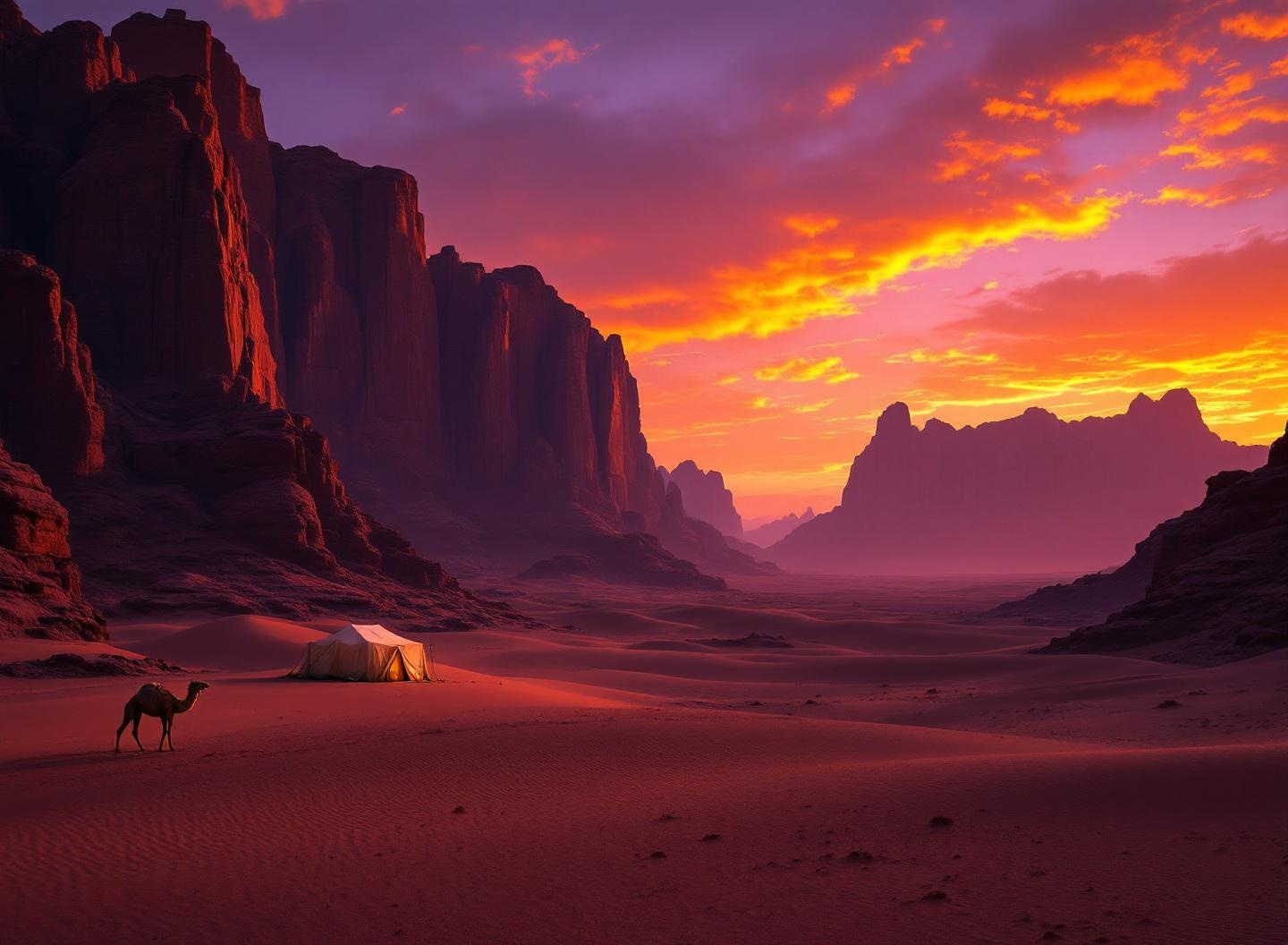
Why Wadi Rum was always going to be Arrakis
Before a single frame of Dune: Part Two was publicly released, photographs from the 2022 shoot were already circulating online — and fans immediately recognized the landscape. Red rock columns rising from rust-colored sand. Silence so complete you hear your own heartbeat. A horizon that suggests no human has ever crossed it.
Denis Villeneuve did not choose Wadi Rum arbitrarily. He had already used it in Dune (2021) for the scenes of Arrakis, and when principal photography for Part Two began in July 2022, his crew returned. The location scouts had clearly done their homework: Wadi Rum’s combination of scale, color, and geological drama is essentially unmatched on Earth.
We visited Wadi Rum in the months following that shoot — before the second film was released, when the desert had returned to its usual magnificent silence — and we traced the specific locations used on screen. This is what we found.
| Location | Screen use | Access |
|---|---|---|
| Khazali Canyon | Fremen hidden passages | Standard jeep tour stop |
| Lawrence’s Spring | Water-source scenes | Standard jeep tour stop |
| Um Ishrin dunes | Arrakis establishing shots | Jeep tour, best at dawn |
| Burdah Bridge / Um Fruth | Aerial rock-spire shots | Scramble hike (Burdah); moderate (Um Fruth) |
The 2022 shoot: what we know
Principal photography for Dune: Part Two ran from July to December 2022, with location work across Jordan, Abu Dhabi, and Budapest. The Wadi Rum portion focused on the desert sequences set on Arrakis itself — the Fremen settlements, the open dune runs, and several key confrontation scenes.
By all accounts, the crew was in Wadi Rum for several weeks. They brought significant equipment into the protected area, coordinating closely with the Wadi Rum Protected Area authority and local Bedouin guides. The logistics of filming in 40-degree summer heat, in a UNESCO-listed wilderness, with a crew of hundreds, is genuinely extraordinary.
For visitors: you cannot see the actual sets because they were struck. What you can see is the landscape itself — the rock formations and dune systems that made Villeneuve choose this place twice.
Khazali Canyon: the Siq scenes
Khazali Canyon — sometimes spelled Khazali Siq — is a narrow slot canyon about 11 kilometers from the Wadi Rum visitor center. Its walls are covered in Nabataean and early Islamic rock inscriptions, some dating to the first and second centuries. It is one of the most photographed locations in Wadi Rum.
In the film, portions of the canyon system appear in sequences depicting the hidden Fremen passages. The narrowing walls, the filtered light, the sense of ancient human presence in an inhuman landscape — Khazali delivers all of it without effort.
Getting there: Khazali Canyon is a standard stop on full-day and half-day jeep tours. It is not accessible by foot from the visitor center in a reasonable timeframe. Your guide will take you there as part of a circuit.
The canyon itself is short — about 100 meters of walkable interior — but the approach through the open desert is part of the experience. Early morning or late afternoon gives the richest light on the inscriptions.
Lawrence’s Spring and the ancient water sources
Lawrence’s Spring sits near a prominent rock face about 8 kilometers from the village. The name comes from T.E. Lawrence, who camped near Wadi Rum during the Arab Revolt and wrote about its springs in Seven Pillars of Wisdom. In practice, it is a modest seep in the rock, surrounded by fig trees and flowers in spring.
Villeneuve’s team used several such water-adjacent locations for scenes involving Fremen knowledge of hidden water. The thematic resonance is obvious: Lawrence himself described the Bedouin’s almost supernatural relationship with water in the desert, and the Fremen’s water mysticism in Herbert’s novel clearly draws from that tradition.
For film location hunters: the spring area has a distinctive rock overhang that appears in wide shots of desert camps in both Dune films. It is not explicitly credited in production notes, but the topography is recognizable.
The great dune fields: Um Ishrin and the red sand dunes
The largest dune system in Wadi Rum lies in the Um Ishrin area, toward the southern reaches of the protected zone. These dunes — reaching 30 to 50 meters — are the ones that appear in the wide Arrakis establishing shots: endless red sand, perfect geometric ridgelines, no shadow of modernity.
In Part Two, the opening sequences on Arrakis use these dunes extensively. Cinematographer Greig Fraser (who won the Oscar for the first film) returned for the sequel, and his compositions emphasize the dunes’ scale against the rock formations behind them.
The dunes are best at dawn, before the wind disturbs the ridgelines. If you are staying overnight in Wadi Rum — which we strongly recommend for the stargazing alone — plan to wake before sunrise and ask your camp to drive you to the dune field.
From Wadi Rum: jeep tour with overnight desert campingJebel Khazali and the rock arch country
The rock arches of Wadi Rum are less famous than Jordan’s answer to Utah — Burdah Bridge is the most spectacular, at roughly 35 meters high — but they appear in the film’s aerial sequences as markers of Arrakis’s geological character.
Reaching Burdah Bridge requires a genuine scramble (experienced hikers only, the final section involves exposed climbing), but the smaller arches in the Um Fruth area are approachable by most visitors. The Um Fruth rock bridge is about 15 meters high and accessible with moderate fitness. Our Wadi Rum hiking trails guide breaks down which routes suit which fitness levels if you want more than the film locations.
Several rock formations near Khazali Canyon appear in wide establishing shots: the distinctive silhouettes that read, on screen, as alien rock spires rising from dunes. In reality they are Precambrian granite and sandstone, approximately 600 million years old.
Lawrence of Arabia: the original Wadi Rum film location
Wadi Rum’s cinema history predates Dune by six decades. David Lean filmed portions of Lawrence of Arabia here in 1962, and the Jordanian government was so pleased with the association that they have cultivated it ever since.
Lawrence’s scenes and Villeneuve’s scenes share some geography: the general area around Jebel Rum, the eastern dune fields, the dramatic rock corridors. The difference is scale and technology — Lean worked with a smaller crew and genuinely primitive desert conditions (no satellite phones, no GPS, water logistics that were genuinely dangerous). His production design is more austere; Villeneuve’s is more operatic.
Comparing the two films in the same location is a quietly amazing experience. The 1962 landscape and the 2024 landscape are identical. Only the human stories on top of them have changed.
Practical information for Dune location visitors
Best time to visit
March to May is ideal — moderate temperatures (20-28°C by day), good light, wildflowers in the valley margins. October and November are equally good and slightly less crowded.
July to August is the season in which Part Two was actually filmed — and it was brutal. Temperatures hit 40-45°C. Villeneuve’s crew worked dawn-to-10am and 4pm-to-dusk. If you visit in summer, follow the same approach.
Getting to Wadi Rum
From Aqaba: 1 hour by taxi or with a tour. From Petra: 1 hour 45 minutes. The desert highway from Amman takes 3.5 hours to reach the visitor center.
Wadi Rum: full day jeep tourWhich tour covers the film locations?
Full-day jeep tours cover the main sites — Khazali Canyon, Lawrence’s Spring, the dune fields, the rock arches. Ask specifically for Khazali and Um Ishrin dunes if you want the most film-recognizable spots. Our Wadi Rum jeep tours compared guide breaks down which operators and durations cover the most film-relevant stops.
Overnight stays let you experience the desert at dawn and dusk — the hours when the film crew actually shot. This is, in our view, non-negotiable for serious Dune fans. See our Wadi Rum overnight camps guide for choosing a camp positioned near the dune fields rather than the village cluster.
Distance from camps to key locations
- From most camps to Khazali Canyon: 15-25 minutes by jeep
- From camps to Um Ishrin dunes: 20-35 minutes depending on camp location
- Lawrence’s Spring: 10-20 minutes
- Burdah Bridge (rock arch hike): 30 minutes’ drive + 1-hour scramble
Beyond the film: why Wadi Rum matters on its own terms
We want to say something clearly: Wadi Rum does not need Dune, or Lawrence, or any film to justify a visit. It is one of the most extraordinary landscapes on Earth on purely geological and experiential terms.
The protected area covers 720 square kilometers of desert, and significant portions of it receive almost no visitors. You can spend a night in a Bedouin camp, eat under the stars, and feel a silence so profound it becomes a physical sensation. That is available to you completely independent of what Denis Villeneuve shot here.
The film locations are a framework — a reason to look more carefully at specific rock formations, to notice the light that made a cinematographer choose this canyon over that dune. But the actual reason to come is the place itself.
For related photography guides, see our Wadi Rum photo spots guide and the Wadi Rum complete guide for planning your visit in full. If Lawrence of Arabia is more your reference point than Dune, our armchair travel guide covers that film’s Wadi Rum connection and more.
Full-day Wadi Rum jeep, camel ride and sandboarding — covers the main dune and canyon locationsFrequently asked questions about Dune
Was Dune: Part Two filmed entirely in Wadi Rum?
No. Production used multiple locations: Wadi Rum and Jordan’s desert for the Arrakis exterior scenes, Abu Dhabi for additional desert work, and studio sets in Budapest for interior sequences. The Jordan portions are identifiable by the distinctive red sandstone formations.
Can you visit the exact spots where Dune was filmed?
The sets themselves were removed after filming, but the landscape locations are accessible. Khazali Canyon, the Um Ishrin dune field, and the rock arch areas near Jebel Khazali are all standard stops on jeep tours and directly correspond to on-screen locations.
When did filming happen?
The Wadi Rum portion of Dune: Part Two shot primarily in July-August 2022, with some additional unit work later in the year.
Is Wadi Rum the same landscape as in the 2021 Dune film?
Yes — Denis Villeneuve used Wadi Rum for both films. Some establishing shots in Part One were actually filmed in Abu Dhabi, but the majority of Arrakis desert sequences in both films use Wadi Rum locations.
Do I need a special permit to visit the Dune filming locations?
No. All the locations covered here — Khazali Canyon, Lawrence’s Spring, the Um Ishrin dunes, Um Fruth rock bridge — are standard stops within the Wadi Rum Protected Area, included in normal jeep tour entry. Only Burdah Bridge requires a genuine scramble and a guide comfortable with exposed sections.