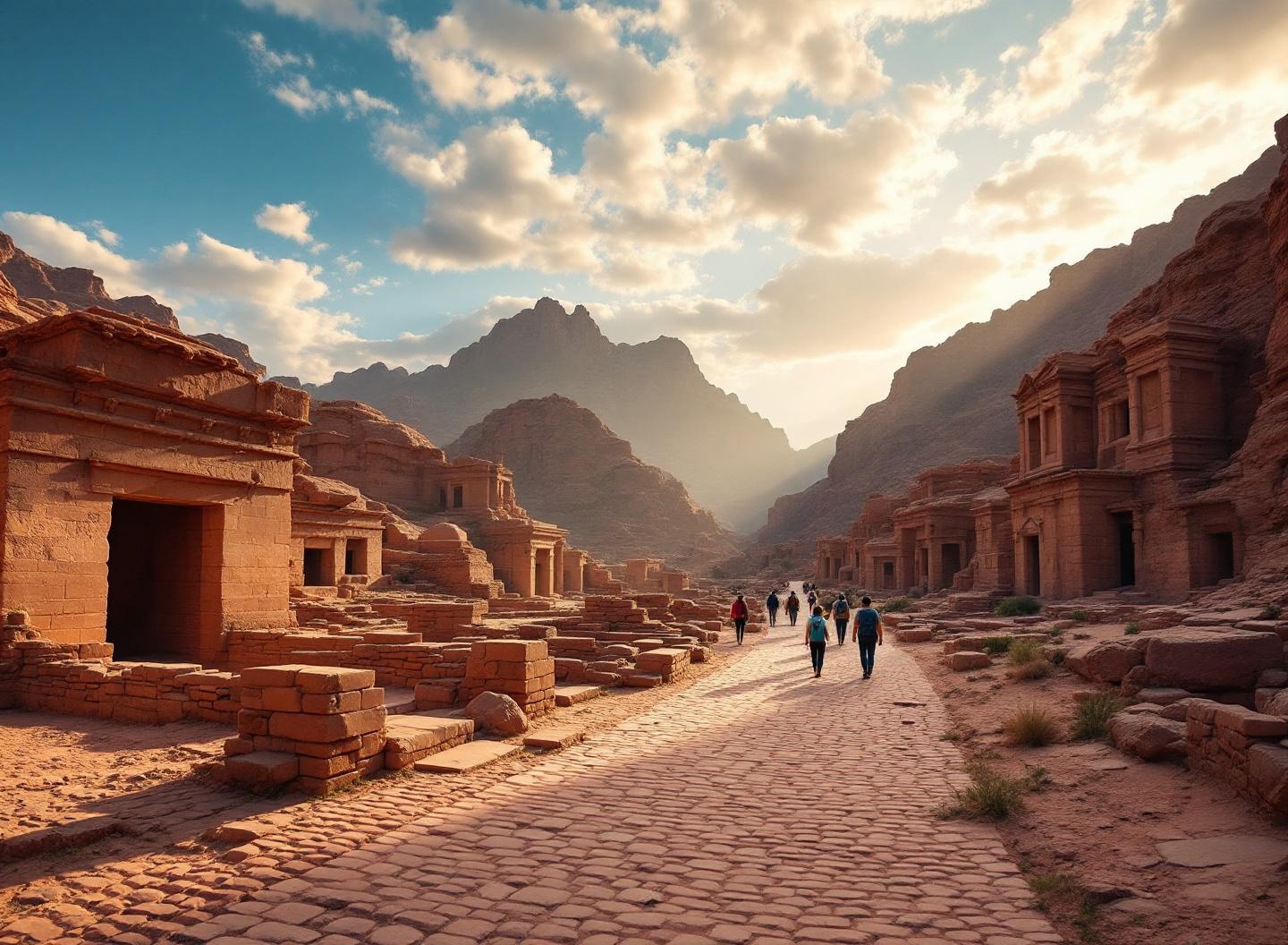
The honest starting point
Most travel content about Petra for people with mobility challenges falls into one of two unhelpful categories: the relentlessly optimistic (“Petra is accessible for everyone!”) and the dismissive (“It’s too difficult, you shouldn’t try”). Neither reflects reality.
Here is what is actually true: Petra has significant terrain challenges. A substantial portion of the site — the Monastery, the High Place of Sacrifice, the back routes — is genuinely inaccessible for wheelchair users and very difficult for anyone with significant mobility limitations. There is no point pretending otherwise.
What is also true: the core of Petra — the Siq, the Treasury area, the Colonnaded Street, the Basin, and parts of the Royal Tombs approach — is accessible with planning and the right support. A wheelchair user can have a meaningful, extraordinary experience of Petra. It requires knowing exactly what is possible before you arrive, not discovering the limitations in the Siq with no plan. Our broader Jordan accessibility guide covers the rest of the country if Petra is one stop on a longer trip.
This guide gives you that honest picture.
| Accessible core | Siq, Treasury plaza, Outer Siq, parts of Colonnaded Street |
| Not accessible | Monastery, High Place of Sacrifice, back trails, Royal Tombs upper terraces |
| Electric cart | Around 20-50 JOD one way, entrance to Treasury only |
| Best time | Early morning (6am opening), before cart demand peaks |
| Recommended guide | One with specific accessibility experience — ask before booking |
The Siq and Treasury: the accessible core
The road surface
The Siq — the 1.2 kilometer slot canyon that leads to the Treasury — has a paved surface for most of its length. This is the “Roman Cardo” pavement, part of the original Nabataean-era road that was improved during the Roman occupation period. It is relatively flat and, for most of its length, wide enough for a standard wheelchair.
There are sections where the pavement is uneven and some areas of loose gravel at the sides. An able-bodied companion assisting with a manual wheelchair needs to be prepared for some effort, particularly at the slightly sloped entry sections. A power wheelchair would need careful navigation.
The Siq is approximately 3-10 meters wide and narrows significantly at certain pinch points. Standard wheelchairs pass through these sections. Wide mobility scooters may not.
The Treasury (Al-Khazneh)
The Treasury’s famous facade comes into view at the end of the Siq, across a flat sandy plaza. This plaza is accessible by wheelchair. You can approach directly to within 20-30 meters of the facade — close enough for extraordinary photographs and for the full emotional impact of arrival.
The important caveat: the interior of the Treasury is off-limits to visitors (it has been for decades — the interior is fragile and was used for storage). You are seeing and experiencing the facade, not going inside. This applies to all visitors, not just those with mobility challenges.
The Outer Siq and Colonnaded Street
Beyond the Treasury, the path widens into what is called the Outer Siq or the facade gallery — a stretch of tombs and carved facades on both sides. From here, the path continues to the Colonnaded Street (the main street of ancient Petra) and eventually to the Basin area with the restaurants and museum.
This stretch — approximately 1.5 kilometers from the Treasury to the Basin — is on mixed terrain. Parts are paved with original or restored stonework. Parts are compacted earth and gravel. A wheelchair can travel this route, but it requires reasonable upper body strength or an assistant, and some sections require careful navigation.
The Basin area has accessible toilet facilities (the toilets in Petra are basic throughout, but the main restaurant area has better facilities).
Electric carts: the accessibility game changer
Petra offers electric cart service from the visitor center entrance to the Treasury. This is, for many visitors with mobility limitations, the most important thing to know.
How the carts work
Battery-powered carts run on the main path from the visitor center entrance through the Siq to the Treasury area. The service is not advertised with maximum prominence, but it exists and can be requested.
Cost: Approximately 20-50 JOD per person each way depending on negotiation, time of day, and how far the cart takes you. The price is not fixed — negotiate before boarding.
What the cart covers: The cart travels through the Siq and deposits you at the Treasury plaza. It cannot go beyond the Treasury into the Colonnaded Street area (the terrain changes and the path narrows in different ways).
Return journey: The cart can also return you from the Treasury to the entrance. This is worth arranging in advance — drivers often disappear, so get a contact number or agree to a pickup time.
Horse carriages: Separate from the electric carts, horse-drawn carriages also run from the entrance to the Treasury. For some mobility challenges, the carriage provides more stability than the cart. For wheelchair users, neither carriage nor cart accommodates a standard wheelchair — you would need to transfer into the vehicle. Discuss practicalities with your companion.
Our recommendation
Call ahead to Petra’s visitor center (through your hotel if easier) and ask specifically about electric cart availability and accessibility accommodation. Staff with advance notice can arrange specific support that walk-in visitors may not know to request.
From Amman: private driver and car service for 1–8 daysWhat is genuinely inaccessible
The Monastery (Ad Deir)
We have to be absolutely clear: the Monastery is not accessible for wheelchair users or anyone with significant mobility limitations.
Reaching Ad Deir requires climbing approximately 800 rock-cut steps from the Basin area. This is a genuine mountain climb, approximately 45-60 minutes each way for a fit person. There is no alternative route. There is no cart service. There is no way around the steps.
This is the hard reality of Petra’s most dramatic second-act. The Monastery is, by many accounts, even more impressive than the Treasury — it is certainly larger. For visitors who cannot make the climb, we are sorry. The same geological conditions that make it spectacular make it inaccessible.
What you can do: the view of the path toward the Monastery, from the Basin area, conveys something of the scale. There are also excellent photographs available. This is cold comfort, we know.
The High Place of Sacrifice
The High Place of Sacrifice — the ridge above the Outer Siq with dramatic views across Petra — requires climbing rock-cut steps from the main path. Approximately 700-800 steps to the summit. Not accessible.
The back routes (Wadi Muthlim, Little Petra trail)
These hiking routes involve scrambling over rocks and uneven natural terrain. Not accessible.
The Royal Tombs upper terraces
The Royal Tombs are visible and approachable from the Colonnaded Street, and the lower approach areas are accessible. The upper terraces, reached by stairs carved into the cliff face, are not.
Dead Sea and Wadi Rum: accessibility notes
Since many Petra visitors also visit these sites, we include brief notes:
Dead Sea
The major Dead Sea resorts — Mövenpick Dead Sea, Kempinski Ishtar, Marriott — all have wheelchair-accessible public areas. The Mövenpick Dead Sea is particularly noted for its beach access design, with a gentle ramp system to the water.
Floating in the Dead Sea requires getting in and out of extremely salty, buoyant water. The unusual physics of the Dead Sea (you cannot sink) actually makes this easier for some mobility challenges, but getting up from a floating position without handholds is genuinely difficult. The resort beaches have beach entry chairs available on request.
Wadi Rum
Wadi Rum’s jeep tours are accessible for most wheelchair users — you are lifted into a 4x4 vehicle (assistance required) and then driven through the landscape. Many camps have accessible ground-level sleeping arrangements (the traditional Bedouin tent is on the floor, which is actually manageable for some mobility challenges; others prefer raised beds, which some camps can arrange).
The experience of the desert landscape — the rock formations, the dunes, the stargazing — is available to anyone who can make the jeep transfer. The hiking components are not. See our Wadi Rum destination guide for camp options, some of which have raised-bed arrangements on request.
Amman and other stops
Amman’s Citadel has uneven ancient terrain but paved viewpoints and accessible parking near the main overlook; the downtown souks are flatter but crowded, with uneven pavement in places. If Amman is part of your itinerary, our Amman destination guide has neighborhood-level detail, and a private driver (rather than public taxis) removes a lot of friction for transfers between sites — see the private driver guide for how that compares to self-driving.
Planning your visit: practical steps
Before you go
- Contact Petra’s visitor center in advance about electric cart availability and any specific accessibility accommodation.
- Book a private guide with specific accessibility experience — not all guides are equally prepared.
- Choose accommodation in Wadi Musa (the town near Petra) that is accessible. Some guesthouses have significant steps to rooms.
- Plan your visit for early morning — the cart service is more available before the main tourist rush.
On the day
- Arrive at 6am when the site opens — before the electric cart services get booked out.
- Immediately speak to staff about cart arrangements.
- Plan to reach the Treasury area, spend time there, and then go as far as the Colonnaded Street and Basin on the onward path if energy and terrain allow.
- Accept that the Monastery is not your objective. The Treasury, the Siq, and the tomb facades are genuinely extraordinary, and they are reachable.
Hiring an accessibility-specialist guide
We strongly recommend engaging a guide with specific accessibility experience. Jordan’s tourism sector has improved significantly in this area over recent years, but the improvement is uneven.
Some operators have guides who have worked with wheelchair users, seniors with limited mobility, and visitors on walking frames before. These guides know which paths to take, where the terrain changes, and how to calibrate the visit for realistic expectations.
Ask specifically when booking: “Do you have a guide with experience supporting visitors with mobility challenges?” The answer will tell you a lot about whether to book.
The emotional dimension
We want to acknowledge something that travel content often ignores: visiting a site that was clearly not designed for accessible tourism, and navigating the gap between what you hoped to experience and what is actually possible, can be difficult emotionally.
Petra is ancient. Its terrain is the result of geology and 2,000-year-old construction, not modern design decisions. There is no one to blame. But that doesn’t make the limitation less real.
What we would say: the core Petra experience — the Siq, the Treasury, the grandeur of the Nabataean architecture — is accessible with planning and support. It is not the complete Petra experience, but there is no such thing as the complete Petra experience for anyone. Most able-bodied visitors also miss significant portions of the site.
Go. Plan carefully. Set realistic expectations. And let the extraordinary place do its work.
For planning how many days to allocate — accessibility considerations often argue for a slower pace than the standard one-day visit — see our Petra 1 day vs 2 days guide and the full Petra complete guide for logistics beyond accessibility.
Private full-day Petra tour from Amman — guide and driver arranged in advanceFrequently asked questions about Visiting Petra with mobility challenges
Can you visit Petra in a wheelchair?
Yes, with limitations. The Siq and Treasury area are accessible with assistance and electric cart support. The Monastery, High Place of Sacrifice, and back routes are not accessible. A meaningful and extraordinary visit is possible; a complete visit to all parts of the site is not.
How much does the electric cart cost in Petra?
Approximately 20-50 JOD one way from the entrance to the Treasury, depending on negotiation. The price is not fixed. Arrange and agree the price before boarding.
Is the Dead Sea accessible for mobility challenges?
The major Dead Sea resorts have accessible beach entry and public areas. The Mövenpick Dead Sea has particularly good beach ramp access. Call ahead to confirm specific accommodation requirements.
Is there an accessible toilet at Petra?
Basic toilet facilities exist at the visitor center entrance and at the Basin restaurant area (about 2 km in). They are functional but basic. The entrance-area toilets are more accessible than those deeper in the site.
Should I book a private guide if I have mobility challenges?
Yes, we recommend it strongly. A guide with specific accessibility experience knows the cart schedule, the pinch points in the Siq, and can pace the visit realistically — a generic group tour will not adapt to your needs. Ask explicitly about this experience before booking.